

Your 24-hour momentum spike of +0.317 in renewable energy sentiment is a clear signal that something significant is happening. With the leading language being English and a cluster of articles focusing on "Strengthening Institutions for Renewable Energy in Africa," it's evident that discussions are gaining traction. This sentiment is amplified by the fact that conversations around this subject are clustered with themes like renewable and stronger institutions, particularly in the African context. If you’re not picking up on this, your sentiment analysis pipeline is behind—by a staggering 27.2 hours.
The structural gap here is glaring. If your pipeline doesn’t handle multilingual data or fails to recognize dominant entities, you could miss critical momentum shifts like this. With English press leading and a lag of 0.0 hours in sentiment, you’re losing ground to competitors who are more agile. Your model missed this spike by 27.2 hours, which can lead to missed opportunities in understanding emerging markets and themes, especially in renewable energy.

English coverage led by 27.2 hours. Sq at T+27.2h. Confidence scores: English 0.85, Spanish 0.85, Sv 0.85 Source: Pulsebit /sentiment_by_lang.
To catch this spike, let’s look at some Python code that leverages our API to pull relevant sentiment data. Here’s how you can query for the topic “renewable energy” with a geographic origin filter:

Geographic detection output for renewable energy. India leads with 4 articles and sentiment +0.81. Source: Pulsebit /news_recent geographic fields.
import requests
# Set the parameters for the API call
params = {
"topic": "renewable energy",
"lang": "en"
}
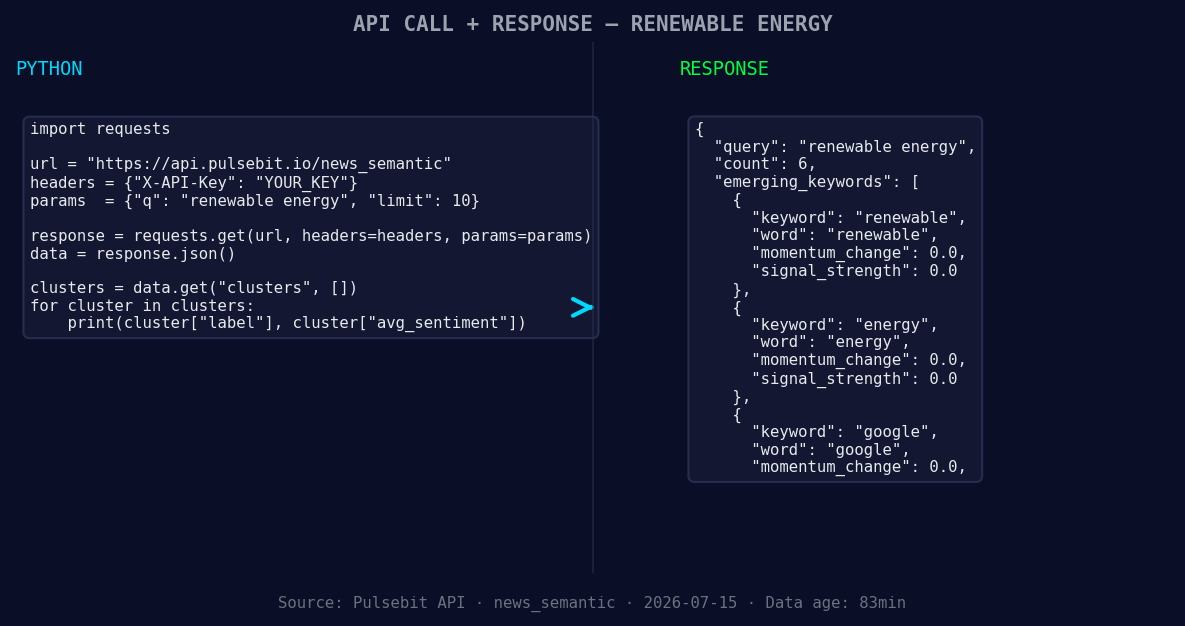
*Left: Python GET /news_semantic call for 'renewable energy'. Right: returned JSON response structure (clusters: 3). Source: Pulsebit /news_semantic.*
# Make the API call to fetch sentiment data
response = requests.get("https://api.pulsebit.com/sentiment", params=params)
data = response.json()
# Check the response
print(data)
Now, let’s process the cluster reason string through our sentiment scoring endpoint to evaluate how the narrative is framed. The input string to analyze will be:
# Define the meta-sentiment input
input_string = "Clustered by shared themes: finance, us$4, billion, renewable, energy."

# Make the API call to score the narrative framing
meta_sentiment_response = requests.post("https://api.pulsebit.com/sentiment", json={"text": input_string})
meta_sentiment_data = meta_sentiment_response.json()

# Check the sentiment score of the cluster reason
print(meta_sentiment_data)
With these two snippets, you're able to capture both the immediate sentiment spike and the underlying narrative shaping that sentiment.
Now, let’s discuss three specific builds you can implement using this data pattern:
Geo-Sentiment Dashboard: Create a real-time dashboard that visualizes sentiment trends in renewable energy, filtered by geographic location. Set a threshold where sentiment scores above +0.5 trigger an alert, ensuring you're always in the loop.
Meta-Sentiment Analysis Tool: Build a tool that runs narratives through the sentiment scoring API whenever a specific cluster is triggered. For instance, if a cluster around renewable energy and finance exceeds a score of +0.6, you can gain insights into how these topics resonate together.
Threshold-Based Alert System: Design an alert system that watches for significant changes in sentiment around renewable energy. If the momentum shifts by more than +0.3 within a 24-hour window, send an automated alert to your team to investigate further.
With these builds, you’re not just reacting to sentiment data; you’re actively shaping your understanding of emerging trends in renewable energy, especially in the context of significant themes like finance and institutional strength.
To get started with this, check out our documentation at pulsebit.lojenterprise.com/docs. With just a few lines of code, you can copy-paste and run this in under 10 minutes, putting you on the front lines of renewable energy sentiment analysis.


Top comments (0)