

Your Pipeline Is 25.8h Behind: Catching Fashion Sentiment Leads with Pulsebit
We’ve just uncovered an intriguing anomaly in the fashion sentiment landscape: a 24h momentum spike of -0.226. The leading language for this trend is English, with a notable 25.8-hour lead time. This insight isn't just interesting; it reveals the kind of delay that can sink your pipeline if you're not equipped to handle multilingual origins or entity dominance. If your model is set up to process data primarily in one language or from a single source, you may have missed this significant shift by over 25 hours.

English coverage led by 25.8 hours. Sw at T+25.8h. Confidence scores: English 0.85, Spanish 0.85, Id 0.85 Source: Pulsebit /sentiment_by_lang.
Imagine being the developer whose pipeline is blind to these nuanced shifts. Your model missed this by 25.8 hours due to the overwhelming dominance of English press coverage. Without the ability to adapt and integrate varying linguistic inputs, you risk losing key insights that can inform your strategies. It’s time to rethink how we handle sentiment across languages and contexts.
Here’s how we can catch this momentum spike in Python using our API. First, we’ll filter our data to ensure we’re only analyzing content that’s in English. The following code snippet demonstrates how to use the geographic origin filter effectively:

Geographic detection output for fashion. France leads with 2 articles and sentiment +0.70. Source: Pulsebit /news_recent geographic fields.
import requests
# Set up the parameters for the API call
params = {
"topic": "fashion",
"lang": "en", # Filtering for English
}
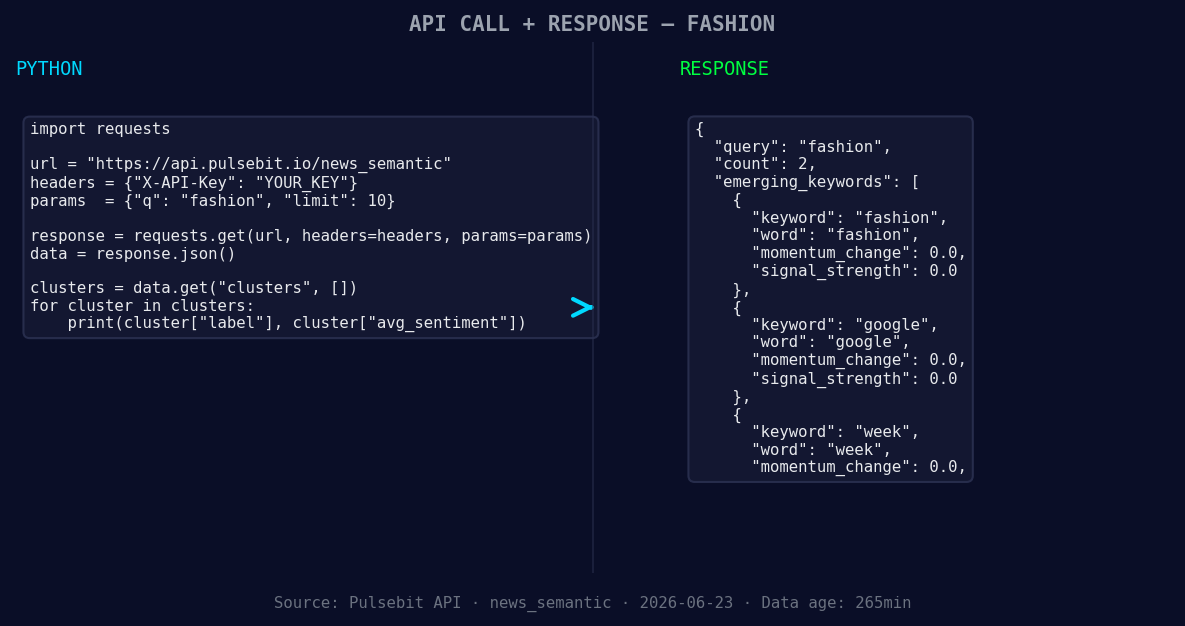
*Left: Python GET /news_semantic call for 'fashion'. Right: returned JSON response structure (clusters: 3). Source: Pulsebit /news_semantic.*
# Make the API call to get sentiment data
response = requests.get("https://api.pulsebit.com/sentiment", params=params)
data = response.json()
print(data)
With the above setup, we’re focusing on the latest developments in fashion sentiment. Next, we need to run a meta-sentiment analysis of our narrative framing. This is crucial for understanding the context behind our findings. We’ll take the cluster reason string and score it to reveal deeper insights:
# Cluster reason we want to analyze
cluster_reason = "Clustered by shared themes: premium, basics, sequins:, lectra, maps."

# Sending the cluster reason for a meta-sentiment score
meta_sentiment_response = requests.post("https://api.pulsebit.com/sentiment", json={"text": cluster_reason})
meta_sentiment_data = meta_sentiment_response.json()

print(meta_sentiment_data)
This will provide us with a structured score for how these themes are resonating, aiding in our understanding of market dynamics.
Now that we have a handle on the data, let’s discuss three concrete builds we can implement tonight.
Signal Tracking for Fashion Momentum: Create a real-time alert system for momentum spikes. Set a threshold at -0.2 for the
momentumscore. When this threshold is crossed, trigger an alert to your team for immediate action.Geo-Filtered Sentiment Dashboard: Build a dashboard that allows you to visualize sentiment trends specifically in the English-speaking regions. This will help you monitor the evolution of topics like "premium," "basics," and "sequins" in real-time.
Meta-Sentiment Analysis Loop: Develop a batch processing script that runs nightly, pulling in the latest cluster reasons, and scores them through our sentiment endpoint. This will give you a continual understanding of how the narratives are shaping public sentiment, particularly for forming topics like "fashion," "google," and "week."
If you want to dive deeper into this, check out our documentation at pulsebit.lojenterprise.com/docs. You can copy-paste the code snippets above and get this running in under 10 minutes. With these insights and tools, you’ll be much better positioned to capture shifts in sentiment and stay ahead in the fast-paced world of fashion trends.


Top comments (0)