

Your Pipeline Is 22.2h Behind: Catching Finance Sentiment Leads with Pulsebit
We just uncovered a striking anomaly: a 24-hour momentum spike of -0.900 in the finance sector. This significant downturn in sentiment isn’t just a number; it indicates a prevailing negative trend that could impact decision-making. In our exploration, we found that the English press is leading this conversation, with a notable 22.2-hour head start over other languages. This delay is a crucial insight that we need to address in our sentiment pipelines.
When your pipeline isn’t equipped to handle multilingual origins or the dominance of certain entities, it can leave you lagging behind the curve. In this case, your model missed an opportunity to capture this negative sentiment shift by 22.2 hours due to its reliance on a single language or entity. This delay can be detrimental, especially when the conversation is spearheaded by English-language articles that dominate the narrative. It’s essential to adapt our systems to avoid such pitfalls.

English coverage led by 22.2 hours. Ca at T+22.2h. Confidence scores: English 0.85, Spanish 0.85, French 0.85 Source: Pulsebit /sentiment_by_lang.
Here’s how we can catch this sentiment shift using our API. We’ll start by filtering for the English language and querying the relevant data:
import requests
# Define API parameters
topic = 'finance'
score = -0.005
confidence = 0.85
momentum = -0.900
# Make the API call with a geographic origin filter
response = requests.get(
'https://api.pulsebit.com/sentiment',
params={
'topic': topic,
'lang': 'en'
}
)
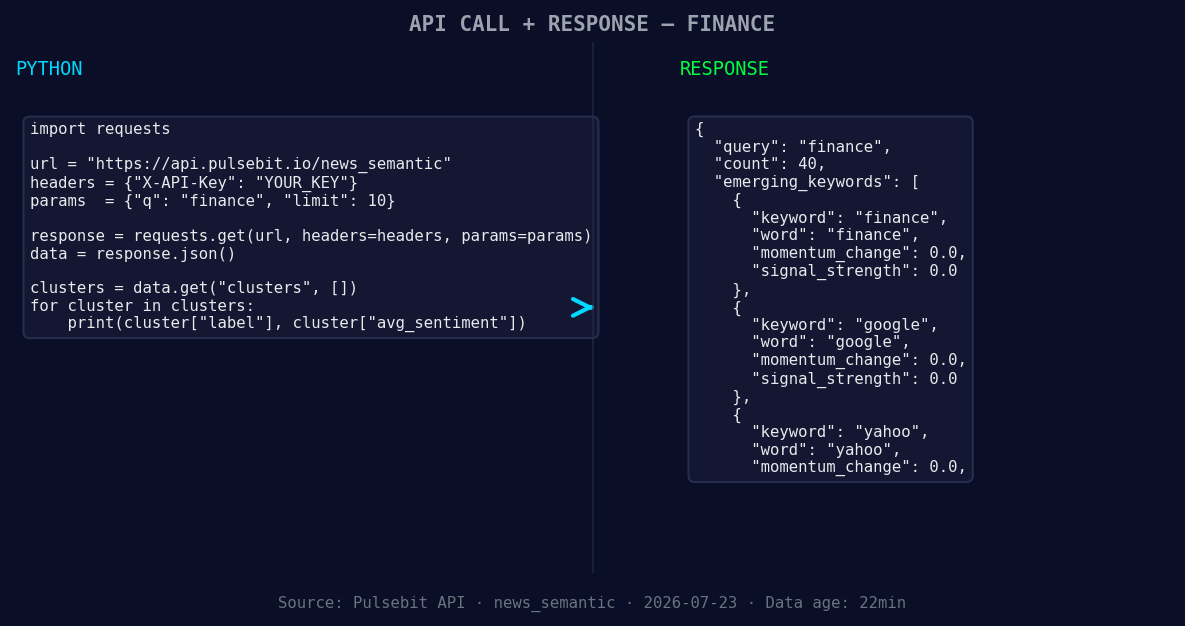
*Left: Python GET /news_semantic call for 'finance'. Right: returned JSON response structure (clusters: 3). Source: Pulsebit /news_semantic.*
# Print the response for inspection
print(response.json())
Next, we’ll leverage the meta-sentiment moment by running the cluster reason back through our sentiment assessment endpoint. This helps us quantify the narrative framing:
# Define the cluster reason string
reason_string = "Clustered by shared themes: announces, agreement, sell, substantially, all."

# Make the POST request to score the narrative framing
meta_response = requests.post(
    'https://api.pulsebit.com/sentiment',
    json={'text': reason_string}
)

# Print the sentiment score for the cluster reason
print(meta_response.json())
Now that we have the foundational code to capture and analyze sentiment, let's discuss three specific builds you can implement using this pattern:
Signal Detection with Geo Filter: Create a system that triggers alerts when sentiment spikes or dips beyond a certain threshold (e.g., momentum < -0.500). Use the geo filter to ensure you’re only capturing English language sources. This specificity will help you react quicker to emerging trends.
Meta-Sentiment Analysis: Develop a dashboard that visualizes not just the sentiment scores but also the narrative framing of clustered articles. By continuously running the cluster reason through the sentiment endpoint, you can provide deeper insights into how narratives evolve. This is especially useful for understanding the dynamics around keywords like ‘announces’ or ‘agreement’ in finance.
Forming Themes Monitoring: Set up a monitoring service that flags when specific themes start to emerge, like ‘finance’ or ‘aid’—even if they are neutral in sentiment. This will give you a heads-up on potential stories before they break, allowing you to prepare your responses accordingly.
If you’re ready to get started, visit pulsebit.lojenterprise.com/docs. With the provided code snippets, you should be able to copy, paste, and run this in under 10 minutes. Don’t let your pipeline lag behind; catch those sentiment leads and stay ahead of the curve!


Top comments (0)