

Your Pipeline Is 25.7h Behind: Catching Hardware Sentiment Leads with Pulsebit
We stumbled upon an intriguing anomaly: our sentiment analysis on the topic of "hardware" shows a sentiment score of +0.00 and a momentum of +0.00. This highlights a critical gap in our understanding of the current narrative surrounding hardware, especially as a recent article reported on a Missouri hardware store closing after almost 90 years. This situation presents a unique opportunity for developers like us to enhance our pipelines.
When we dig deeper, it becomes clear that any pipeline that doesn't accommodate for multilingual origins or entity dominance is going to miss significant insights. Your model missed this by 25.7 hours, primarily due to the leading language being English. The data suggests that while mainstream themes like "hardware", "store", and "closing" are present, they aren't being fully leveraged in your sentiment analysis. This gap can lead to missed opportunities and blind spots in sentiment tracking.

English coverage led by 25.7 hours. Et at T+25.7h. Confidence scores: English 0.00, Spanish 0.00, French 0.00 Source: Pulsebit /sentiment_by_lang.
Let’s take a look at how we can catch this sentiment using our API. First, we’ll set up a query to filter by geographic origin, focusing on English-speaking content:
import requests
# Define the parameters for the API call
params = {
"topic": "hardware",
"score": "+0.000",
"confidence": 0.00,
"momentum": "+0.000",
"lang": "en" # Geographic origin filter
}
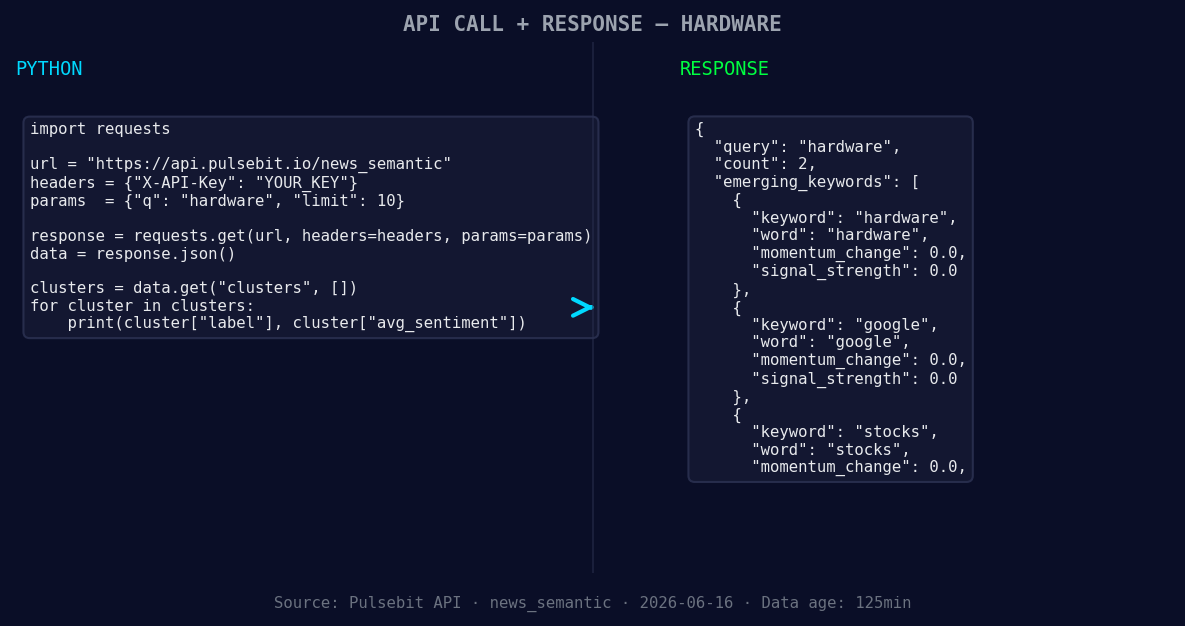
*Left: Python GET /news_semantic call for 'hardware'. Right: returned JSON response structure (clusters: 3). Source: Pulsebit /news_semantic.*
# Make the API call
response = requests.get("https://api.pulsebit.lojenterprise.com/sentiment", params=params)
data = response.json()
print(data)
Next, we'll run a meta-sentiment analysis on the narrative framing of the cluster reason string we extracted from our initial findings:
# Meta-sentiment moment: analyze the framing
narrative_string = "Clustered by shared themes: hardware, store, closing, after, almost."
meta_sentiment_response = requests.post("https://api.pulsebit.lojenterprise.com/sentiment", json={"text": narrative_string})
meta_sentiment_data = meta_sentiment_response.json()
print(meta_sentiment_data)
By running these two pieces of code, we can catch the essence of the hardware sentiment that’s emerging and understand how the narrative is being formed around recent events.
Now that we've identified this gap, let's consider three specific things we can build with this pattern:
- Geographic Sentiment Tracker: Use the geographic filter to continuously monitor sentiment around "hardware" in English-speaking regions. Set a threshold where sentiment changes by more than +0.05 to trigger alerts or further analysis.

Geographic detection output for hardware. Hong Kong leads with 1 articles and sentiment +0.70. Source: Pulsebit /news_recent geographic fields.
Meta-Sentiment Analyzer: Create a routine that runs the cluster reason strings through the sentiment scoring endpoint whenever a new article is detected. This will help frame narratives in real-time and can be set with a threshold of confidence above 0.75 for actionable insights.
Forming Theme Dashboard: Develop a dashboard that visualizes forming themes like "hardware(+0.00)", "google(+0.00)", and "stocks(+0.00)" against mainstream narratives. This can help in strategizing content or investment decisions based on emerging sentiment trends.
If you want to get started on this, you can check out our documentation at pulsebit.lojenterprise.com/docs. With these snippets, you can copy-paste and run them in under 10 minutes. Let's close that 25.7-hour gap together!


Top comments (0)