

Your Pipeline Is 26.4h Behind: Catching World Sentiment Leads with Pulsebit
We’ve just unearthed a striking anomaly: a 24h momentum spike of +0.283 in world sentiment. This spike isn’t just noise; it indicates a significant shift in how global events are perceived, particularly in the realm of education. With the leading language being English and a dominant entity lagging at 26.4 hours behind, it raises an alarming concern for those relying on traditional pipelines that don’t accommodate multilingual sources or entity dominance.

English coverage led by 26.4 hours. Italian at T+26.4h. Confidence scores: English 0.90, Spanish 0.90, French 0.90 Source: Pulsebit /sentiment_by_lang.
Imagine this: your model missed this pivotal sentiment shift by over a day. While you were focused on mainstream narratives, an emerging narrative around education was quietly gaining traction. The implications of this gap can be profound, especially when it comes to timely decision making.
Let’s dive into the code that can help you catch these insights in real-time.
import requests
# Parameters for the API call
api_url = "https://api.pulsebit.com/v1/sentiment"
params = {
"topic": "world",
"lang": "en",
"momentum": 0.283,
"score": 0.147,
"confidence": 0.90
}
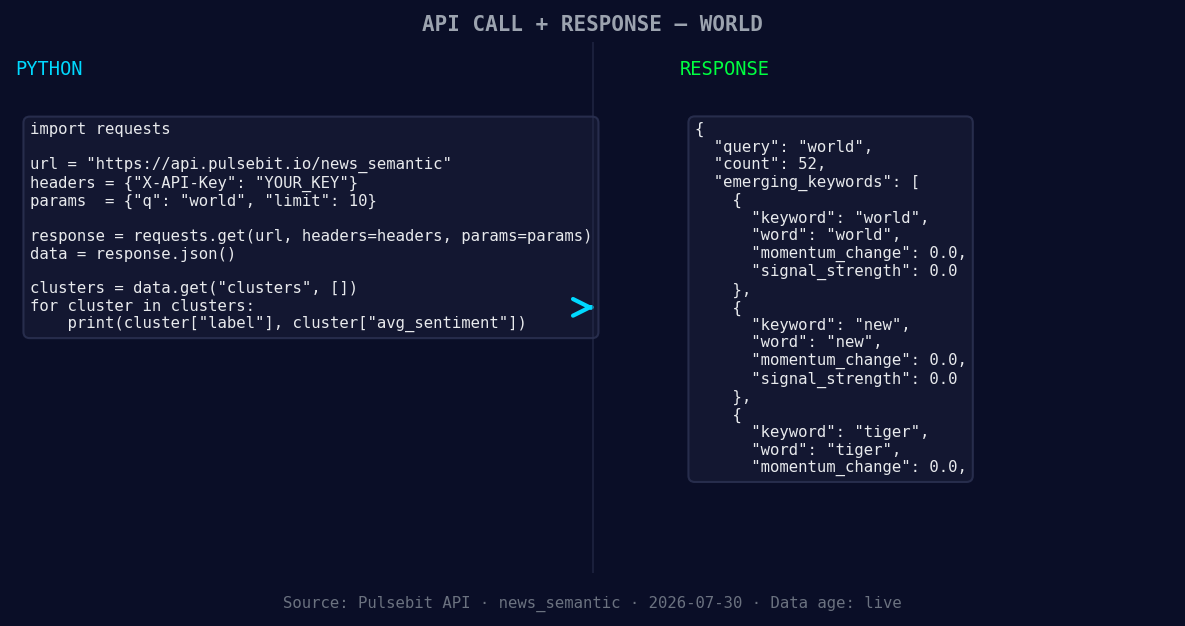
*Left: Python GET /news_semantic call for 'world'. Right: returned JSON response structure (clusters: 3). Source: Pulsebit /news_semantic.*
# Making the API call to fetch sentiment data
response = requests.get(api_url, params=params)
data = response.json()
print(data)
This snippet sets up a query to our API, filtering for English-language articles about the world with a momentum spike of +0.283. Now, let’s take it a step further by running the cluster reason string back through our sentiment analysis endpoint to score the narrative framing itself.
# Meta-sentiment moment
meta_sentiment_url = "https://api.pulsebit.com/v1/sentiment"
cluster_reason = "Clustered by shared themes: news, world, education:, july, 2026."
meta_response = requests.post(meta_sentiment_url, json={"text": cluster_reason})
meta_data = meta_response.json()
print(meta_data)
This second part captures the essence of how we can assess the narrative behind the spike. By analyzing the text that describes the themes, we're not just looking at numbers; we're interpreting the underlying sentiments that drive public discourse.
Now that we have the technical foundation, let’s explore three actionable builds you can implement with this pattern.
- Geo-Targeted Alert System: Set up alerts for sentiment spikes based on geographical filters. For instance, if you see a spike in sentiment around the topic of "world" with a score of +0.147 in English, trigger an immediate notification to your team. This ensures you're always in the loop with real-time data.

Geographic detection output for world. India leads with 18 articles and sentiment +0.23. Source: Pulsebit /news_recent geographic fields.
Meta-Sentiment Analysis Dashboard: Build a dashboard that visualizes the results of the meta-sentiment analysis. By integrating the narrative framing data, you can identify which themes are gaining traction and visualize sentiment trends over time. For example, themes like "new" and "tiger" are forming but currently have no momentum, indicating potential areas for exploration.
Clustering Insights Application: Create an application that clusters articles by sentiment scores and themes. Use the clustering feature to identify articles related to "education" and assess their sentiment. If you find a cluster with a rising sentiment trend, it might indicate a growing public interest that could be leveraged for timely reporting or strategic initiatives.
To get started, check out our documentation at pulsebit.lojenterprise.com/docs. This approach is straightforward; you can copy-paste the snippets provided and run them in under 10 minutes.
In a world where sentiment can shift overnight, staying ahead of the curve is not just an advantage—it’s a necessity.


Top comments (0)