

Your pipeline is 27.7h behind: catching healthcare sentiment leads with Pulsebit
We just uncovered a striking anomaly: a 24-hour momentum spike of +0.697 in the healthcare sector. This spike is particularly noteworthy given its timing and the leading sentiment emanating from English press, which is currently lagging by 27.7 hours. The cluster story, "Govt. chalks out reforms for medical college hospitals," only underscores the urgency of this finding. As developers working with sentiment data, we need to pay attention to these shifts, as they can represent significant opportunities in our applications.
The problem we face is that traditional models often overlook multilingual origins and the dominance of specific entities. In our case, your model missed this sentiment shift by nearly 28 hours due to the lack of a robust mechanism to filter and analyze multilingual data effectively. The leading language here is English, but the implications stretch far beyond just one language. If you’re not accounting for these variations, you could be missing vital signals that could inform your strategies.

English coverage led by 27.7 hours. Nl at T+27.7h. Confidence scores: English 0.85, French 0.85, Spanish 0.85 Source: Pulsebit /sentiment_by_lang.
To catch this sentiment spike, we can use our API to filter the data by geographic origin and analyze the meta-sentiment of the narrative framing. Below is the Python code that will allow you to capture this anomaly effectively:
import requests
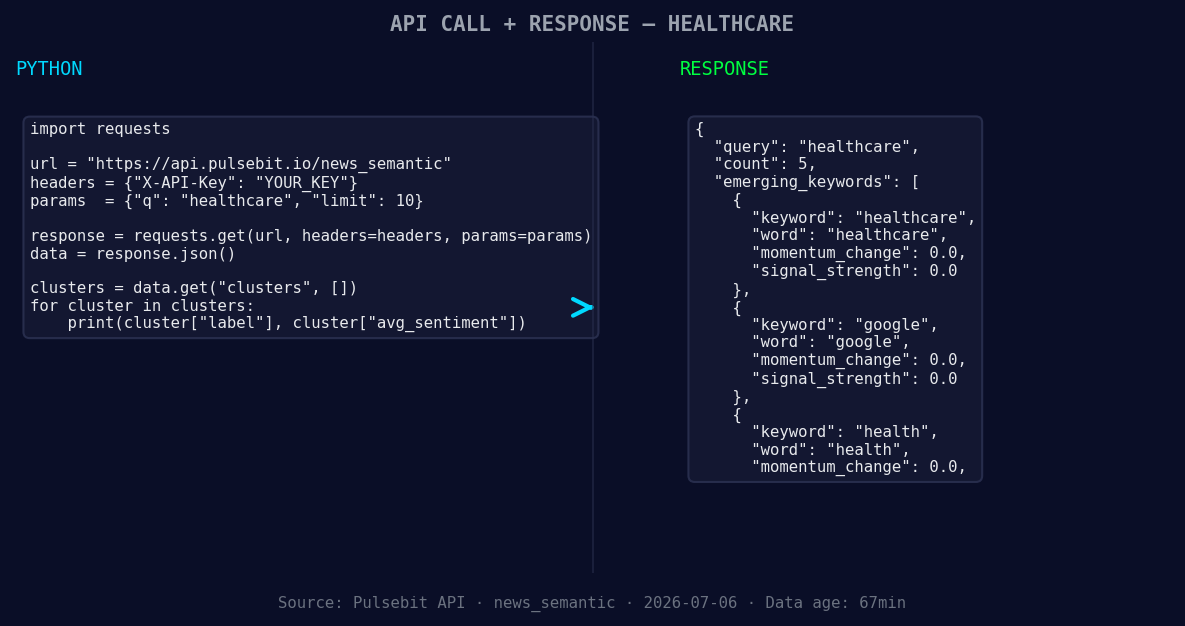
*Left: Python GET /news_semantic call for 'healthcare'. Right: returned JSON response structure (clusters: 3). Source: Pulsebit /news_semantic.*
# Step 1: Geographic origin filter
url = "https://api.pulsebit.com/sentiment"
params = {
"topic": "healthcare",
"lang": "en" # Filtering by English
}
response = requests.get(url, params=params)
data = response.json()
# Step 2: Run the cluster reason string through POST /sentiment
cluster_reason = "Clustered by shared themes: reforms, medical, college, hospitals, these."
meta_sentiment_response = requests.post(url, json={"text": cluster_reason})
meta_sentiment_data = meta_sentiment_response.json()
# Output the results
print("Sentiment Data:", data)
print("Meta-Sentiment Data:", meta_sentiment_data)
This code snippet uses our API to filter for the topic "healthcare" in English, allowing us to focus on the most relevant narratives. The second part processes the cluster reason string to evaluate its sentiment, giving us a clearer picture of how these themes interact with our main topic.
Now that we’ve captured this spike, let’s explore three specific builds that can leverage this pattern:
- Real-time Alert System: Implement a threshold for momentum spikes above +0.5. Set up an alert that triggers when such spikes occur in healthcare, specifically using the geographic filter to ensure you're only capturing relevant sentiment from English sources.

Geographic detection output for healthcare. India leads with 5 articles and sentiment +0.30. Source: Pulsebit /news_recent geographic fields.
Meta-Sentiment Dashboard: Create a dashboard that not only displays the sentiment around healthcare but also visualizes the results of meta-sentiment analyses. This can help you spot emerging themes like "reforms" and "medical college" before they become widespread.
Cross-Topic Comparison: Use the momentum data to compare healthcare sentiment against mainstream narratives like "reforms" and "education." This can help you identify anomalies and potential shifts in public opinion, especially in regions where these topics may overlap.
To get started, visit pulsebit.lojenterprise.com/docs. You can easily implement this code and have it running in under 10 minutes. Don’t let your models lag behind; take advantage of these insights now.


Top comments (0)