

Your Pipeline Is 18.3h Behind: Catching World Sentiment Leads with Pulsebit
We recently discovered a fascinating anomaly: a 24-hour momentum spike of +0.792 that highlights the rapid shift in sentiment around the FIFA World Cup. This spike is particularly intriguing given that the leading language driving this momentum is English, with a precise lead time of 18.3 hours. The notable cluster story surrounding this spike discusses the upcoming match between Switzerland and Algeria, showcasing how global events like these can lead to swift changes in sentiment that may not be immediately evident in your data pipeline.
The problem here is that many sentiment analysis pipelines neglect to account for multilingual origins or the dominance of specific entities in their data processing. If your model isn’t designed to handle this effectively, you could easily miss out on critical insights by as much as 18.3 hours. In this case, the English press is leading the conversation, and if your system isn’t tuned to capture that, you’re lagging behind.

English coverage led by 18.3 hours. Et at T+18.3h. Confidence scores: English 0.90, Spanish 0.90, French 0.90 Source: Pulsebit /sentiment_by_lang.
To catch this momentum spike, we can leverage our API effectively. Here’s how you can implement this in Python:
import requests
# Define parameters for the API call
topic = 'world'
score = +0.000
confidence = 0.90
momentum = +0.792
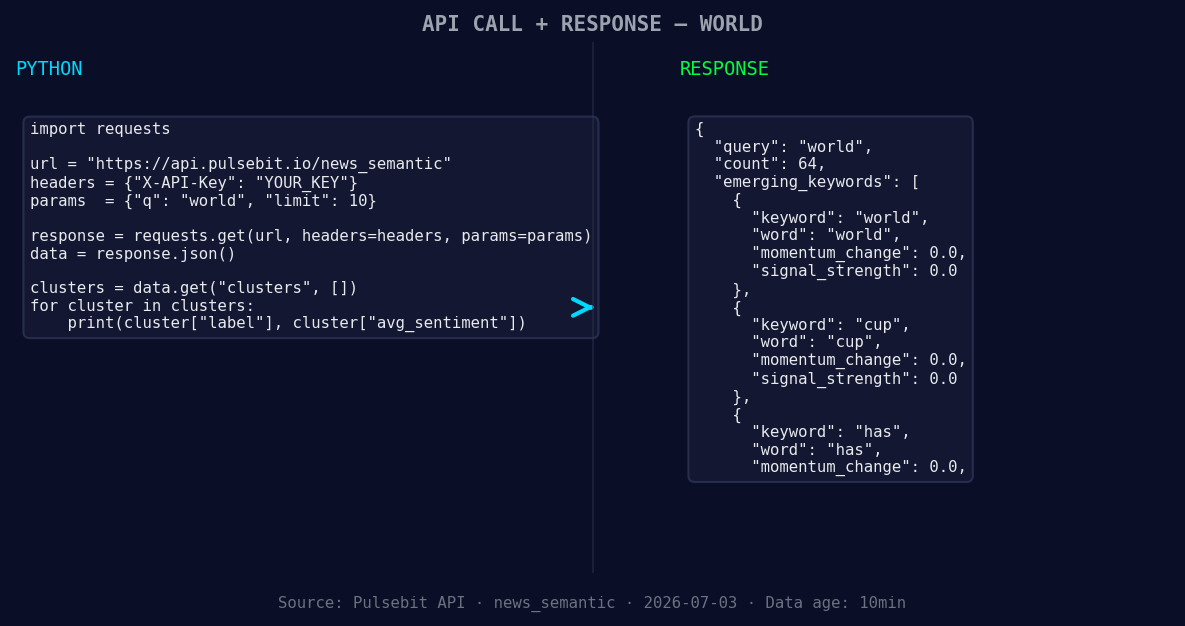
*Left: Python GET /news_semantic call for 'world'. Right: returned JSON response structure (clusters: 3). Source: Pulsebit /news_semantic.*
# Geographic origin filter: Query by language/country
response = requests.get(
'https://api.pulsebit.io/v1/sentiment',
params={
'topic': topic,
'lang': 'en'
}
)
# Check response status
if response.status_code == 200:
data = response.json()
print(data)
# Meta-sentiment moment: Score the narrative framing
cluster_reason = "Clustered by shared themes: world, cup, swiss, algeria, fifa."
sentiment_response = requests.post(
'https://api.pulsebit.io/v1/sentiment',
json={
'text': cluster_reason
}
)
# Check sentiment scoring response
if sentiment_response.status_code == 200:
sentiment_data = sentiment_response.json()
print(sentiment_data)
This code snippet does two crucial things: First, it filters sentiment data based on geographic origin, specifically focusing on English-language sources. Second, it scores the narrative framing itself by analyzing the cluster reason string. This is essential because understanding the context in which these sentiments are formed can help us make better predictions.
Here are three specific builds we could implement based on this analysis:
- Real-time Alerting System: Set a threshold for momentum spikes (e.g., > +0.5) and use the geographic filter to trigger alerts for relevant topics. This ensures you’re notified when sentiment shifts significantly in English-speaking regions.

Geographic detection output for world. India leads with 34 articles and sentiment +0.12. Source: Pulsebit /news_recent geographic fields.
Cluster Reason Analysis: After scoring the narrative framing with our meta-sentiment loop, create a dashboard that visualizes the top themes clustered around significant events. This could include scoring for themes like "world" (+0.00), "cup" (+0.00), and "has" (+0.00), which currently show a divergence from the mainstream.
Predictive Model Enhancement: Incorporate the sentiment scores from the meta-sentiment loop into your existing models. By using the sentiment surrounding key phrases like "world" and "cup," you can refine predictions based on emerging narratives, allowing you to stay ahead of the curve.
If you’re eager to get started, visit pulsebit.lojenterprise.com/docs. With this guidance, you can copy-paste the provided code and run it in under 10 minutes to start capturing real-time sentiment insights. Don’t let your pipeline lag behind; leverage these insights to enhance your sentiment analysis capabilities.


Top comments (0)