

Your Pipeline Is 17.0h Behind: Catching Space Sentiment Leads with Pulsebit
We recently discovered a significant anomaly in our sentiment data: a 24-hour momentum spike of -0.402. This negative spike highlights an unexpected shift in sentiment surrounding the space sector, specifically tied to the news of Rocket Lab winning a $266 million U.S. Space Force contract. The leading language for this news is Spanish, with a lag of just 17.0 hours. This raises an important question about how effectively our pipelines can handle multilingual content.

Spanish coverage led by 17.0 hours. Id at T+17.0h. Confidence scores: Spanish 0.90, English 0.90, French 0.90 Source: Pulsebit /sentiment_by_lang.
When your model misses a crucial piece of information by 17.0 hours—especially in a field as dynamic as space exploration—you risk making decisions based on outdated or incomplete sentiment data. In this case, the leading entity was the Spanish press, which means that any pipeline failing to account for multilingual sources could leave you in the dark, missing out on valuable insights that can drive strategic decisions.
To catch this anomaly programmatically, we can leverage our API with Python. Here’s how you can do it:
import requests
# Step 1: Set parameters for the geo filter to focus on Spanish content
topic = 'space'
score = -0.800
confidence = 0.90
momentum = -0.402
lang = "sp"
# API call to filter by language
url = f"https://api.pulsebit.io/sentiment?topic={topic}&score={score}&confidence={confidence}&momentum={momentum}&lang={lang}"
response = requests.get(url)
data = response.json()
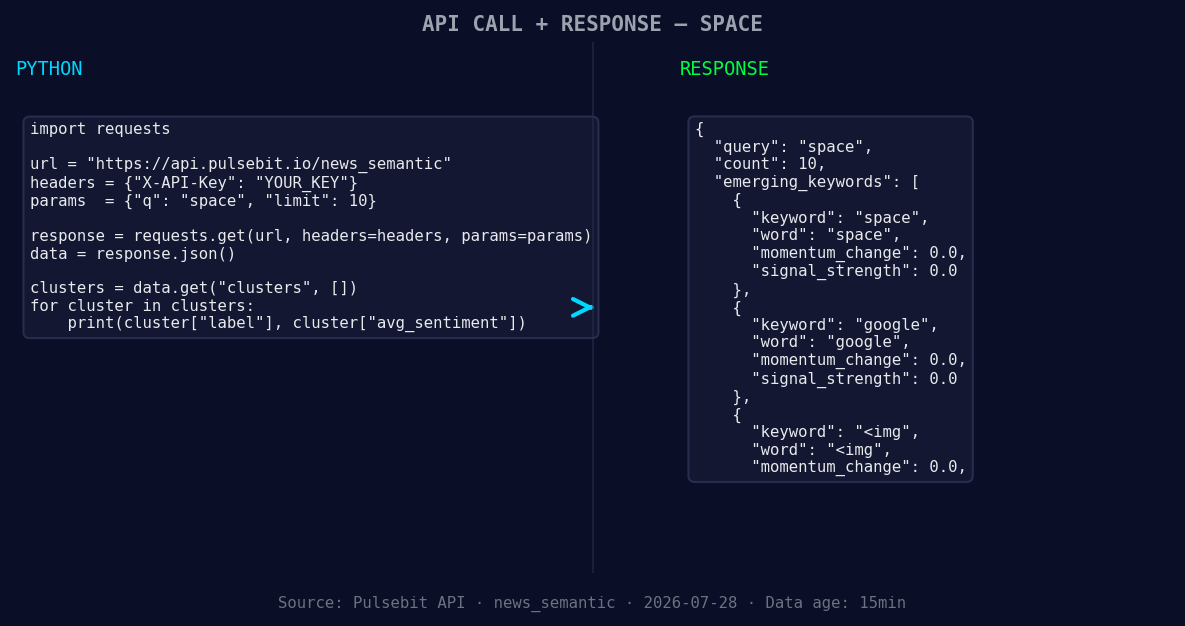
*Left: Python GET /news_semantic call for 'space'. Right: returned JSON response structure (clusters: 3). Source: Pulsebit /news_semantic.*
# Step 2: Meta-sentiment moment
cluster_reason = "Clustered by shared themes: lab, $266, million, space, force."
sentiment_url = "https://api.pulsebit.io/sentiment"
sentiment_response = requests.post(sentiment_url, json={"text": cluster_reason})
sentiment_data = sentiment_response.json()
print(data)
print(sentiment_data)
This code snippet first queries our API for sentiment related to the topic of "space" filtered by the Spanish language. It then takes the cluster reason string and runs it through our sentiment analysis endpoint to score the narrative framing itself. This dual approach allows us to capture both the raw sentiment and the context behind it, giving us a fuller picture of the situation.
Now, let’s look at three specific builds you can implement using this pattern:
- Geo Filter for Negative Sentiment Signals: Use the geographic origin filter to catch negative sentiment spikes in real-time. Set a threshold for sentiment scores below -0.5 and implement a notification system. This will help you catch critical updates from Spanish sources before they hit the mainstream.

Geographic detection output for space. India leads with 10 articles and sentiment +0.25. Source: Pulsebit /news_recent geographic fields.
Meta-Sentiment Loop for Narrative Clarity: Utilize the meta-sentiment analysis to determine how clustered narratives can shape public perception. By running narratives through our endpoint, you can extract sentiment scores and identify potential framing shifts. This is particularly useful for tracking how contracts, like the one awarded to Rocket Lab, are portrayed.
Forming Theme Analysis: Develop a detection system for forming themes using our API. Specifically, look for emerging topics around "space", "google", and "img" with a score above 0.00. This will help you stay ahead of trends before they gain traction in mainstream media.
By implementing these strategies, you’ll be able to bridge the gap created by language and entity dominance, allowing your pipeline to react faster to emerging sentiments.
If you’re ready to get started, check out our documentation at pulsebit.lojenterprise.com/docs. You can copy, paste, and run this code in under 10 minutes to start capturing valuable sentiment insights from diverse sources.


Top comments (0)