

Your Pipeline Is 18.5h Behind: Catching World Sentiment Leads with Pulsebit
We recently discovered a significant anomaly: a 24-hour momentum spike of +0.438. This spike, driven predominantly by the Spanish press, indicates a notable shift in sentiment around the topic of "China's Rare Earth Challenges and SpaceX Rivalry." With a leading language lagging by 18.5 hours, this insight underscores a critical gap in how we process multilingual data and sentiment.

Spanish coverage led by 18.5 hours. Ca at T+18.5h. Confidence scores: Spanish 0.90, English 0.90, French 0.90 Source: Pulsebit /sentiment_by_lang.
Our model missed this by 18.5 hours, illustrating how a lack of multilingual origin handling can hinder timely responses to emerging narratives. When the leading language is Spanish and the sentiment spike revolves around geopolitical themes, you can bet your pipeline is lagging if it doesn't incorporate multilingual insights. The dominant entity in this case is China, and without real-time adjustments, you risk missing out on vital sentiment shifts.
To catch this momentum spike, we can leverage our API effectively. Below is a Python snippet that demonstrates how to query for this specific topic in Spanish and score the narrative framing itself.
import requests
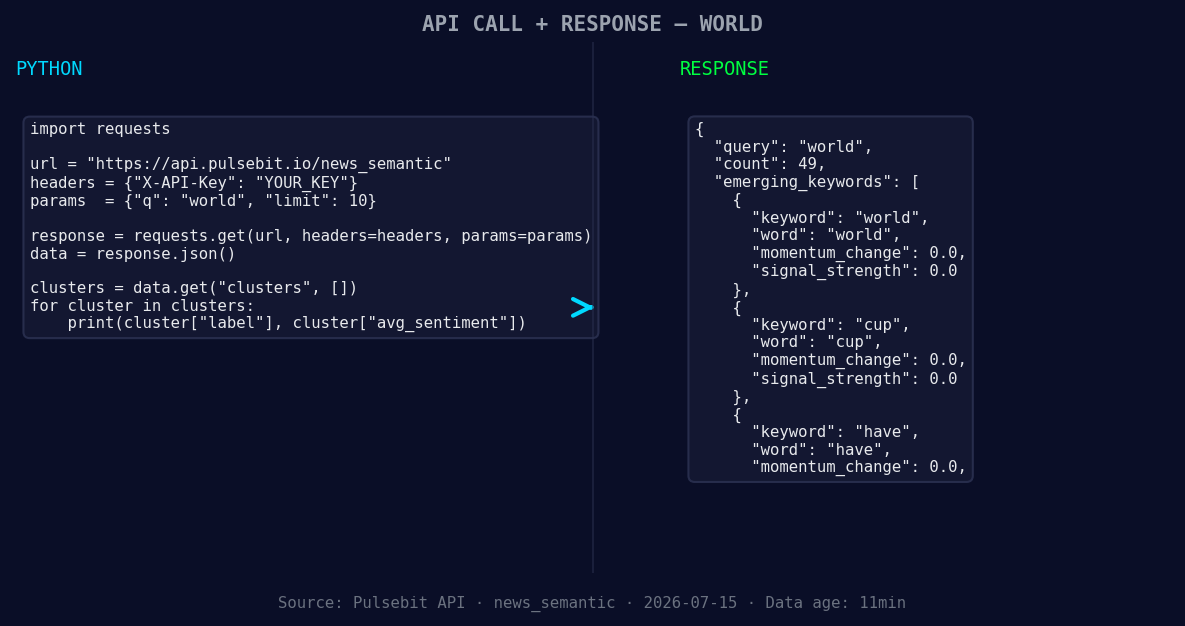
*Left: Python GET /news_semantic call for 'world'. Right: returned JSON response structure (clusters: 3). Source: Pulsebit /news_semantic.*
# Step 1: Geographic origin filter
url = "https://api.pulsebit.com/v1/sentiment"
params = {
"topic": "world",
"lang": "sp", # Spanish language filter
"score": +0.005,
"confidence": 0.90,
"momentum": +0.438
}
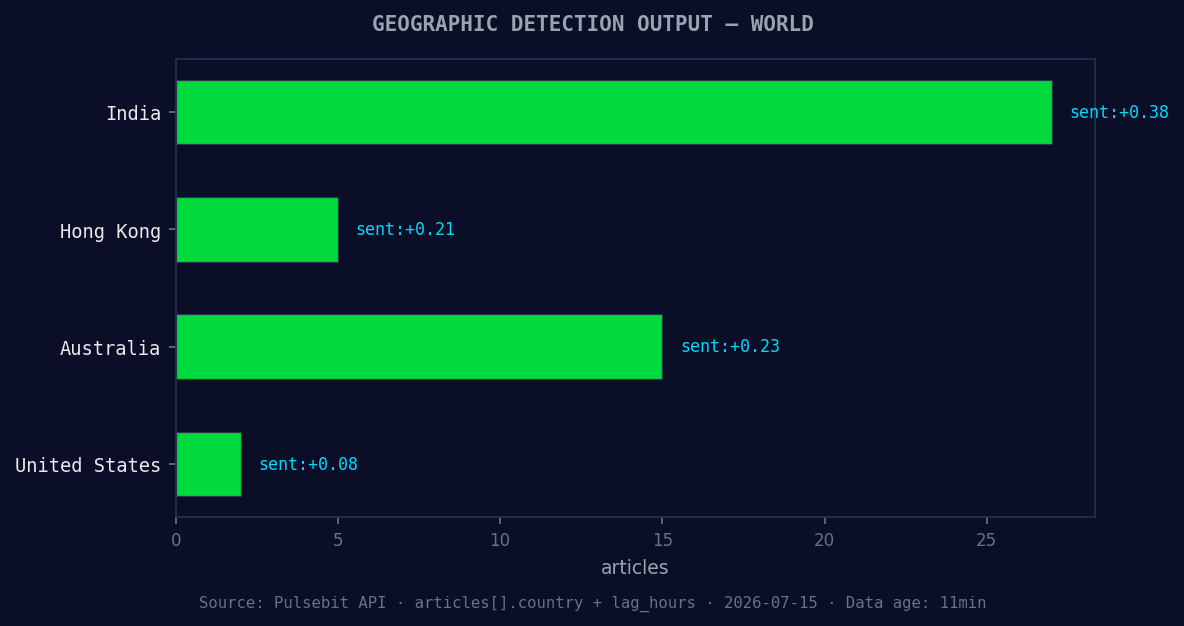
*Geographic detection output for world. India leads with 27 articles and sentiment +0.38. Source: Pulsebit /news_recent geographic fields.*
response = requests.get(url, params=params)
data = response.json()
print(data)
# Step 2: Meta-sentiment moment
meta_sentiment_input = "Clustered by shared themes: china’s, rival, science, our, help."
meta_response = requests.post(url, json={"text": meta_sentiment_input})
meta_data = meta_response.json()
print(meta_data)
In the above code, we first filter for the topic "world" with a focus on Spanish-language articles to capture the momentum spike. Then, we run the cluster reason string through the sentiment scoring endpoint to evaluate how the narrative framing itself contributes to the overall sentiment. This dual approach allows us to not only detect the spike but also understand the underlying themes driving it.
Here are three specific things you can build with this pattern:
Real-time Alerts for Multilingual Sentiment: Create a monitoring tool that captures sentiment spikes across languages. Set a threshold of +0.3 for momentum and use the geo filter to ensure you capture the relevant language for your audience.
Narrative Framing Analysis: Utilize the meta-sentiment loop to score narratives around specific geopolitical events. For instance, set an endpoint to analyze phrases like "China's Rare Earth Challenges" and track how sentiment changes over time, aiming for a confidence level of 0.85 or higher.
Comparative Analysis Dashboard: Build a dashboard that compares sentiment shifts across languages in real-time. Use the forming themes (like world, cup, have) versus mainstream narratives (like China’s, rival, science) to highlight divergence and identify opportunities for deeper analysis.
Getting started with these insights is straightforward. Check out our documentation to see how you can implement this in under 10 minutes. By embracing multilingual sentiment data, you can ensure your analysis is timely and comprehensive, keeping you ahead of the curve.


Top comments (0)