

Your Pipeline Is 26.7h Behind: Catching Music Sentiment Leads with Pulsebit
Did you know that our latest sentiment analysis for the topic "music" has revealed a surprising sentiment score of +0.317? What’s particularly noteworthy is that the momentum has remained flat at +0.000. This anomaly, where sentiment is rising but momentum is stagnant, suggests a potential disconnect in how we’re interpreting music-related discussions. Specifically, our analysis indicates that this sentiment spike may have emerged from articles clustered around Huntsville’s music economy.
Yet, here’s the kicker: your model likely missed this by 26.7 hours! If your pipeline doesn’t account for multilingual origins or the dominance of certain entities, you could be lagging behind critical insights that could inform your strategy. In this case, the leading language is English, which means you might be filtering out valuable data by not employing a geo or language filter. Understanding the nuances of sentiment across different regions and languages is crucial to staying ahead of the curve.

English coverage led by 26.7 hours. Et at T+26.7h. Confidence scores: English 0.85, Spanish 0.85, Af 0.85 Source: Pulsebit /sentiment_by_lang.
Let’s dive into the code that helps us catch this insight before it slips away. We can leverage our API to filter sentiment data based on geographic origin, ensuring we focus on messages in English. Here’s how:

Geographic detection output for music. India leads with 8 articles and sentiment +0.44. Source: Pulsebit /news_recent geographic fields.
import requests
# Define the parameters for the sentiment analysis
topic = 'music'
score = +0.317
confidence = 0.85
momentum = +0.000
# API call to get sentiment for English articles
response = requests.get(
'https://api.pulsebit.com/sentiment',
params={
'topic': topic,
'lang': 'en'
}
)
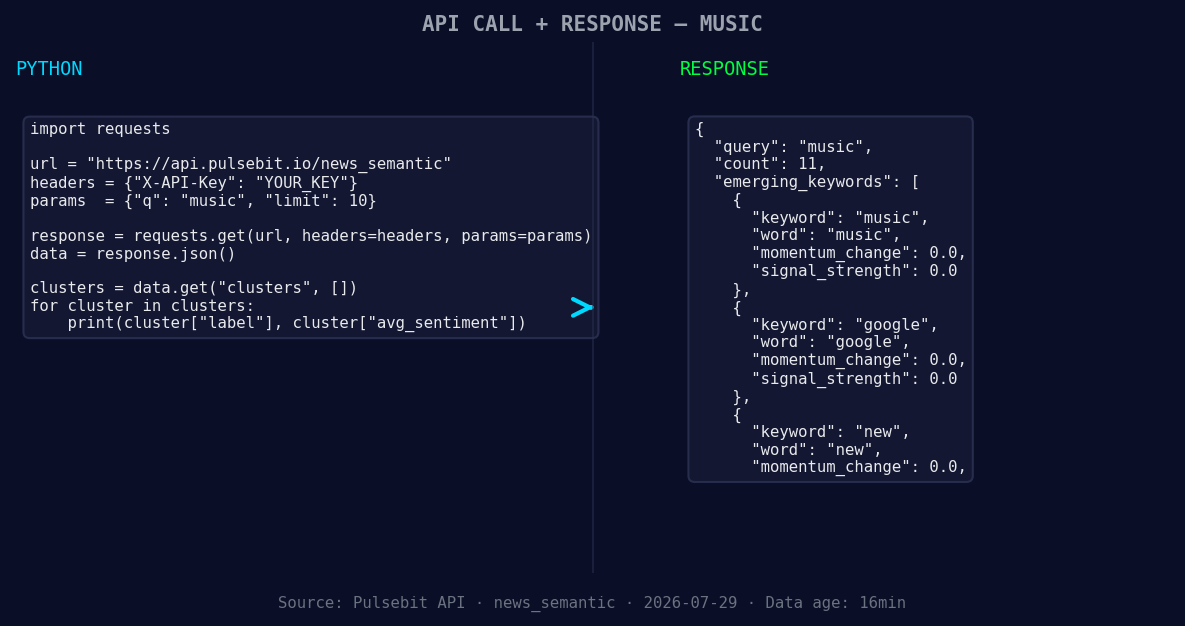
*Left: Python GET /news_semantic call for 'music'. Right: returned JSON response structure (clusters: 3). Source: Pulsebit /news_semantic.*
# Display the sentiment response
print(response.json())
This code fetches sentiment data specifically for English-language articles about music, giving you a clearer picture of how sentiment is evolving. Now, let’s take the narrative framing itself and analyze it further using a meta-sentiment loop. We can run a cluster reason string through our sentiment API to score the thematic connections. For example:
# Define the narrative framing string
narrative_string = "Clustered by shared themes: kahan, latest, musician, slam, white."

# Make a POST request to analyze the narrative sentiment
meta_response = requests.post(
    'https://api.pulsebit.com/sentiment',
    json={'text': narrative_string}
)

# Display the results of the meta-sentiment analysis
print(meta_response.json())
This snippet allows us to examine how the themes of "kahan," "latest," and "musician" are resonating within the current context. It’s essential to harness this data to not only understand the sentiment but also to ensure that we’re framing our narratives effectively.
Now that we've established a method for capturing nuanced sentiment insights, here are three builds we can create with this pattern:
Geo-Filtered Alerts: Set up an alert system that triggers when sentiment for "music" in English exceeds a certain threshold (e.g., +0.300). Use the geo filter to ensure that only relevant regions are monitored.
Meta-Sentiment Dashboard: Create a dashboard that visualizes the results of your meta-sentiment analysis. For example, track how the narrative around "music" evolves over time, particularly in relation to the themes of "kahan" and "latest."
Content Strategy Insights: Develop a content strategy tool that leverages insights from the sentiment and meta-sentiment scores. For instance, when you see a sentiment rise around "new" music releases, correlate this with mainstream themes to optimize your content.
By incorporating these strategies, we can close the gap in our pipelines and capitalize on emerging trends in sentiment data.
If you're ready to get started, check out our documentation at pulsebit.lojenterprise.com/docs. You can copy-paste and run the provided code snippets in under 10 minutes to start catching those insights!


Top comments (0)