

Your Pipeline Is 5.8h Behind: Catching Real Estate Sentiment Leads with Pulsebit
We recently stumbled upon a fascinating anomaly: a 24-hour momentum spike of +0.184 in the real estate sector. This spike caught our attention because it signifies a significant shift in sentiment that could directly impact decision-making for stakeholders in the industry. The leading language driving this spike is English, with a 5.8-hour lead time, and the cluster story revolves around a powerful real estate group expressing openness to rent control compromise. In this landscape where every hour counts, we must ensure we’re not left behind.
Your model missed this by 5.8 hours. If you’re not accounting for multilingual origins and entity dominance in your sentiment analysis, you risk overlooking critical shifts like this one. The leading story, primarily in English, is an indicator of how sentiment can rapidly fluctuate based on prevailing narratives. Without a robust pipeline that accommodates these variations, you might miss out on timely insights that could inform your strategies.

English coverage led by 5.8 hours. Ro at T+5.8h. Confidence scores: English 0.85, French 0.85, Spanish 0.85 Source: Pulsebit /sentiment_by_lang.
To get ahead, we can leverage our API to catch these real estate sentiment shifts. Below is a Python snippet that demonstrates how to query sentiment data effectively. We’ll filter for English-language articles and analyze the meta-sentiment of the cluster reason string:
import requests
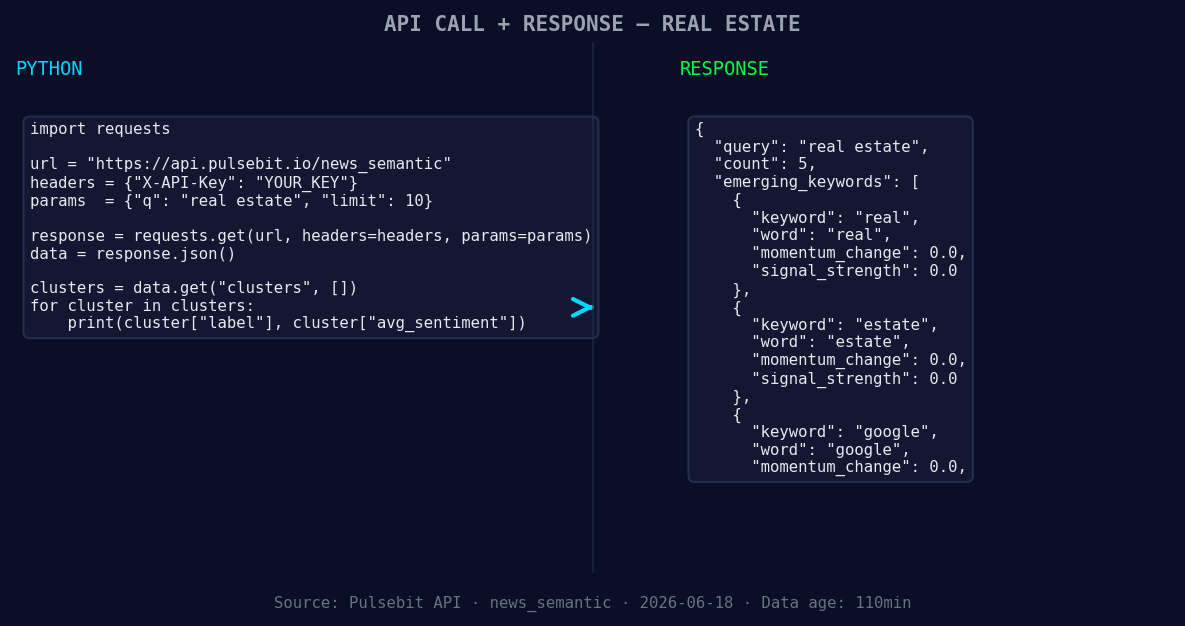
*Left: Python GET /news_semantic call for 'real estate'. Right: returned JSON response structure (clusters: 3). Source: Pulsebit /news_semantic.*
# Step 1: Fetching the English-language sentiment data for real estate
url = "https://api.pulsebit.com/v1/sentiment"
params = {
"topic": "real estate",
"score": -0.100,
"confidence": 0.85,
"momentum": +0.184,
"lang": "en" # Geographic origin filter
}
response = requests.get(url, params=params)
data = response.json()
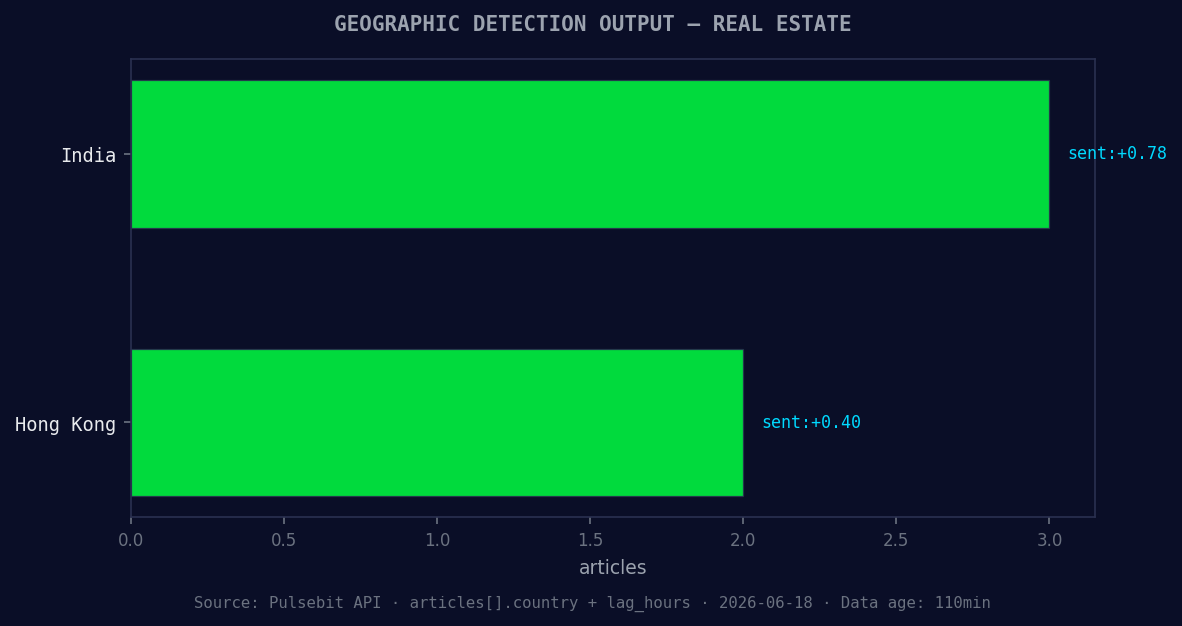
*Geographic detection output for real estate. India leads with 3 articles and sentiment +0.78. Source: Pulsebit /news_recent geographic fields.*
# Step 2: Analyzing the meta-sentiment for the cluster reason
cluster_reason = "Clustered by shared themes: real, estate, class, gives, new."
meta_sentiment_url = "https://api.pulsebit.com/v1/sentiment"
meta_response = requests.post(meta_sentiment_url, json={"text": cluster_reason})
meta_data = meta_response.json()
print(meta_data)
In the first part of the code, we’re querying our API for sentiment data specifically in English. This is crucial for narrowing down our understanding of how sentiment is evolving in a particular linguistic context. The second part runs the cluster reason through our sentiment endpoint to score the narrative framing itself. This step is vital, as it gives us deeper insight into how clustered themes like "real," "estate," and "class" are perceived by the audience.
Now, let’s discuss three specific builds that can help you leverage this pattern effectively:
Geo-Filtered Alerts: Set up a webhook that triggers alerts when sentiment momentum exceeds a defined threshold (e.g., +0.150) for English-language articles related to "real estate." This will ensure you’re notified about significant shifts as they happen.
Meta-Sentiment Dashboard: Construct a dashboard that visualizes the meta-sentiment scores derived from cluster reasons. This will allow you to monitor evolving narratives in real-time, providing a broader context for your analyses.
Forming Themes Analysis: Create an endpoint that regularly checks for forming themes such as "real(+0.00)," "estate(+0.00)," and "google(+0.00)" versus mainstream sentiments. This will help you identify emerging discussions that could impact market dynamics, allowing for proactive engagement.
By building out these functionalities, you can ensure your pipeline is not only reactive but also anticipatory in addressing sentiment shifts within the real estate sector.
If you're ready to dive in, check out our documentation at pulsebit.lojenterprise.com/docs. You can copy-paste the code above and have it running in under 10 minutes. Don’t let your pipeline lag behind—capitalize on real estate sentiment today!


Top comments (0)