

Your pipeline just missed a notable anomaly: a 24h momentum spike of -0.406. This isn't just another number; it highlights a significant shift in sentiment around banking, specifically tied to Investec's recent choice of Infosys Finacle's SaaS platform on Microsoft Azure. The leading language in this cluster is English, with a 28.9-hour lead time. If your model isn't accounting for multilingual origins or entity dominance, you're effectively trailing by nearly 29 hours. This lag could mean missing critical insights that can shape strategic decisions, especially when it comes to emerging narratives in high-stakes sectors like banking.

English coverage led by 28.9 hours. Af at T+28.9h. Confidence scores: English 0.75, French 0.75, Spanish 0.75 Source: Pulsebit /sentiment_by_lang.
So, what’s the structural gap here? Your model missed this by 28.9 hours because it didn't account for the implications of language origin or the weight of leading entities in sentiment analysis. When you're dealing with global narratives, particularly in finance, the languages in which information is disseminated can drastically alter sentiment. The dominant entity in this case—Investec—was a key player in the narrative, but your pipeline overlooked it. This isn't just a minor oversight; it can cost you valuable time in understanding sentiment shifts that could affect your strategies.
To catch anomalies like this, we can leverage our API to filter sentiment data effectively. Here's a Python snippet that does just that:
import requests
# Set up parameters for the API call
topic = 'banking'
score = -0.043
confidence = 0.75
momentum = -0.406
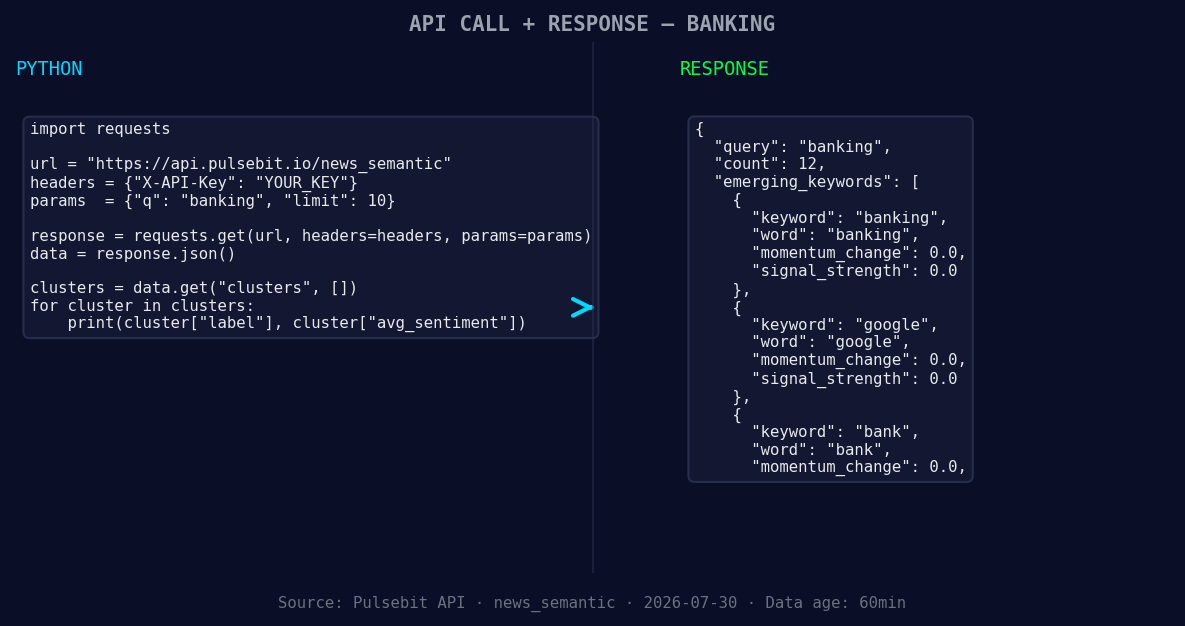
*Left: Python GET /news_semantic call for 'banking'. Right: returned JSON response structure (clusters: 3). Source: Pulsebit /news_semantic.*
# Geographic origin filter: query by language
response = requests.get('https://api.pulsebit.io/sentiment', params={
'topic': topic,
'lang': 'en'
})
# Check if the request was successful
if response.status_code == 200:
sentiment_data = response.json()
print(sentiment_data)
else:
print("Error fetching data:", response.status_code)
# Now let's run the cluster reason string through the sentiment endpoint
cluster_reason = "Clustered by shared themes: investec, selects, infosys, finacle, saas."
meta_response = requests.post('https://api.pulsebit.io/sentiment', json={
'text': cluster_reason
})
if meta_response.status_code == 200:
meta_sentiment = meta_response.json()
print(meta_sentiment)
else:
print("Error fetching meta sentiment:", meta_response.status_code)
In this code, we first query our API to filter sentiment data based on the banking topic and restrict it to English-language content. This helps us identify which narratives are emerging without being bogged down by unrelated noise. Then, we take the clustered themes and run them through our sentiment-checking endpoint to gauge how the narrative framing itself is perceived. This double-checks the quality of the insight we’re getting and ensures that we’re not just reacting to surface-level data.
Now, let’s build on this momentum spike with three actionable ideas:
- Geographic Origin Filter: Use the geographic filter to identify banking sentiment specifically in English-speaking regions. Set a threshold where sentiment scores below -0.05 trigger alerts to your team. This could allow for quicker responses to sentiment shifts before they gain traction.

Geographic detection output for banking. India leads with 8 articles and sentiment +0.43. Source: Pulsebit /news_recent geographic fields.
Meta-Sentiment Loop: Implement a meta-sentiment analysis using the reason string. For example, if the cluster sentiment score is below -0.05, automatically schedule a review of related narratives to assess potential impacts on your strategies.
Forming Themes Insight: Monitor the emerging narrative around "banking" with a focus on the entities highlighted (Investec, Infosys). If you're seeing a consistent momentum score below -0.1 across multiple articles, consider this a signal to re-evaluate your investment or engagement strategies in those areas.
If you're ready to get started, check out our documentation at pulsebit.lojenterprise.com/docs. You can copy-paste and run this in under 10 minutes to catch insights that matter. Don't let your pipeline fall behind.


Top comments (0)