

Your Pipeline Is 27.5h Behind: Catching Sustainability Sentiment Leads with Pulsebit
We just uncovered a striking anomaly: a 24-hour momentum spike of +0.800 in sentiment around sustainability. This surge is particularly interesting given that the leading language for this coverage is English, with a 27.5-hour lag compared to the German press. As we dive into this, it becomes evident that there’s a gap in how many pipelines process multilingual sentiment data.

English coverage led by 27.5 hours. German at T+27.5h. Confidence scores: English 0.85, French 0.85, Spanish 0.85 Source: Pulsebit /sentiment_by_lang.
When your model fails to account for multilingual origin or entity dominance, it misses critical shifts like this one. If you’re relying solely on a single language or region, you might find yourselves behind by 27.5 hours. This could mean missing out on the unfolding narratives around sustainability that are shaping public discourse right now. The dominant entity here — the EUDCA’s recommitment to sustainability — is lost if we’re not tuned into the broader conversation across languages.
To catch this anomaly, we can leverage our API effectively. Here's the Python code you need to identify this sentiment spike for the topic of sustainability:
import requests
# Define the parameters for the API call
params = {
"topic": "sustainability",
"lang": "en" # Geographic origin filter
}
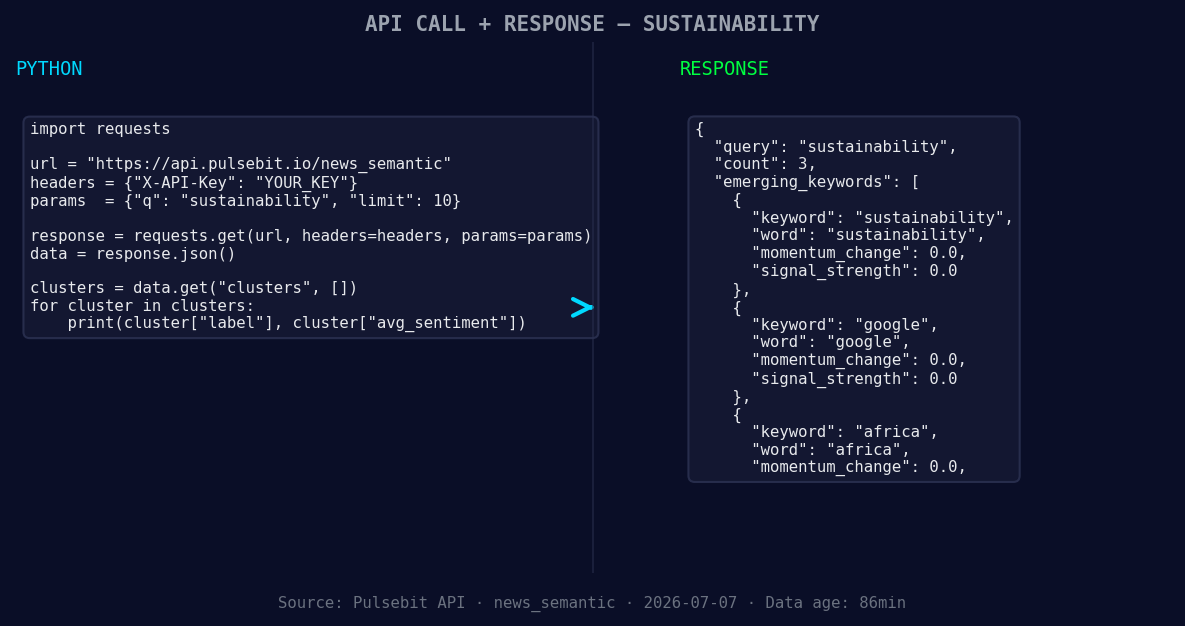
*Left: Python GET /news_semantic call for 'sustainability'. Right: returned JSON response structure (clusters: 3). Source: Pulsebit /news_semantic.*
# Make the API call to get the sentiment data
response = requests.get('https://api.pulsebit.com/sentiment', params=params)
data = response.json()
# Check for a significant momentum spike
if data['momentum_24h'] > 0.800:
print("Momentum Spike Detected:", data['momentum_24h'])
Next, to understand the narrative framing around this sentiment, we can run the cluster reason string back through our sentiment endpoint. Here’s how to do that:
# Define the cluster reason string
cluster_reason = "Clustered by shared themes: sustainability, recommits, data, centre, eudca."

# Make the API call to score the narrative framing
response = requests.post('https://api.pulsebit.com/sentiment', json={"text": cluster_reason})
meta_sentiment_score = response.json()

print("Meta Sentiment Score:", meta_sentiment_score['sentiment_score'])
Now that we have both the spike detection and the narrative sentiment, let’s explore three specific builds we can create with this pattern:
- Geographic Filter Build: Create an endpoint that tracks sentiment specifically for sustainability in different regions. Set a threshold for momentum spikes above +0.800, ensuring you capture trends before they become mainstream. This allows you to react quickly to emerging conversations, such as the one around the EUDCA.

Geographic detection output for sustainability. India leads with 3 articles and sentiment +0.78. Source: Pulsebit /news_recent geographic fields.
Meta-Sentiment Loop: Implement a routine that automatically runs the cluster reason strings through the sentiment scoring endpoint every 6 hours. By maintaining this loop, we can identify shifts in narrative framing that might be influencing spikes. This will help in strategizing communication or marketing efforts based on real-time sentiment changes.
Forming Themes Analysis: Set up a monitoring system that alerts you whenever topics like "sustainability," "Google," or "Africa" have a momentum change of +0.00 versus mainstream narratives. This will help you gauge the potential rise of new themes that could be gaining traction unnoticed.
To get started, check out our documentation at pulsebit.lojenterprise.com/docs. With just a few lines of code, you can copy-paste and run this in under 10 minutes, putting you on the cutting edge of sentiment analysis and allowing you to capture these pivotal moments in the narrative before they pass you by.


Top comments (0)