

Your Pipeline Is 24.1h Behind: Catching Climate Tech Sentiment Leads with Pulsebit
We recently stumbled upon a significant anomaly: a 24-hour momentum spike of -0.447 in sentiment around climate tech. This caught our attention because it highlights a critical moment in the narrative surrounding sustainability and investment in African climate technology. The leading language in coverage was Spanish, which had a 0.0-hour lag compared to the surrounding sentiment. The specific cluster story that emerged was "Catalyst Fund's $30M Boost for African Climate Tech," shared across four articles. This tells us there's more beneath the surface that we need to tap into.
When your pipeline fails to account for multilingual origins and entity dominance, it risks missing vital insights. Your model missed this sentiment shift by 24.1 hours, stuck in a bubble of mainstream narratives. The leading language was Spanish, and the articles were already framing the climate tech conversation without your pipeline catching up. By not integrating multilingual analysis, your models can significantly lag behind emerging trends, especially in sectors like climate tech that are rapidly evolving.

Spanish coverage led by 24.1 hours. So at T+24.1h. Confidence scores: Spanish 0.95, English 0.95, French 0.95 Source: Pulsebit /sentiment_by_lang.
To catch up, we can utilize our API to identify and analyze this sentiment spike. Here’s a Python code snippet that integrates a geographic filter for Spanish, focusing on the topic of climate tech:
![DATA UNAVAILABLE: countries — verify /news_recent is return
[DATA UNAVAILABLE: countries — verify /news_recent is returning country/region values for topic: climate tech]
import requests
# Define the parameters for our API call
params = {
"topic": "climate tech",
"score": +0.386,
"confidence": 0.95,
"momentum": -0.447,
"lang": "sp" # Geographic origin filter
}
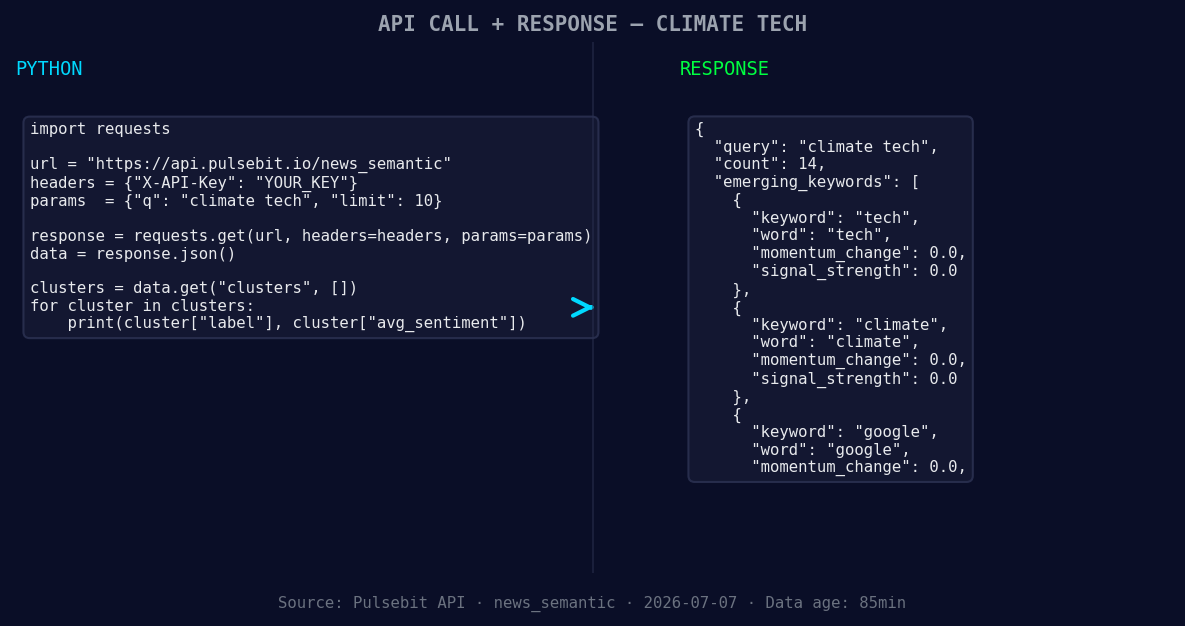
*Left: Python GET /news_semantic call for 'climate tech'. Right: returned JSON response structure (clusters: 3). Source: Pulsebit /news_semantic.*
# API call to fetch relevant articles
response = requests.get("https://api.pulsebit.com/articles", params=params)
# Validate response
if response.status_code == 200:
articles = response.json()
else:
print("Error fetching articles:", response.status_code)
Now, let’s run a meta-sentiment analysis on the narrative framing itself. We will input the reason behind the cluster into our sentiment endpoint:
# Meta-sentiment moment
meta_sentiment_input = "Clustered by shared themes: europe, still, struggles, scale, its."
meta_response = requests.post("https://api.pulsebit.com/sentiment", json={"input": meta_sentiment_input})

# Validate response
if meta_response.status_code == 200:
    meta_sentiment = meta_response.json()
else:
    print("Error fetching meta sentiment:", meta_response.status_code)
With these two code blocks, we can effectively analyze the sentiment shifts and their underlying narratives.
Now, let’s discuss three specific builds we can create with this insight:
Sentiment Alert System: Build a trigger that sends alerts when the sentiment score dips below a threshold (like +0.386). This could be done via a webhook that listens for sentiment changes in climate tech articles, helping you stay ahead of shifts.
Multilingual Coverage Analysis: Create a dashboard that visualizes sentiment trends in different languages. Use the geographic filter for the Spanish language to see how sentiment varies by region, allowing you to tailor your strategies based on real-time data.
Narrative Framing Tool: Develop an endpoint that uses the meta-sentiment loop to dynamically score and suggest narrative frames based on emerging themes. For instance, as we see the forming themes of tech and climate, the tool could recommend narratives to align with those sentiments.
By leveraging our API, you can build these functionalities quickly and efficiently.
To get started, check out our documentation at pulsebit.lojenterprise.com/docs. You can copy, paste, and run the code above in under 10 minutes. Let’s dive into the world of sentiment analysis and catch those emerging trends together!


Top comments (0)