

Your Pipeline Is 25.2h Behind: Catching Economy Sentiment Leads with Pulsebit
We recently discovered a 24h momentum spike of +0.236 in sentiment around the topic of "economy." This spike signals that something significant is brewing beneath the surface—a shift in economic sentiment that could easily slip through the cracks if your pipeline isn’t tuned to catch multilingual signals. In a world of globalization, missing these insights can be costly.

English coverage led by 25.2 hours. Nl at T+25.2h. Confidence scores: English 0.75, Spanish 0.75, French 0.75 Source: Pulsebit /sentiment_by_lang.
The data reveals a structural gap in any pipeline that fails to account for multilingual origins and entity dominance. Your model missed this by 25.2 hours, as the leading language for sentiment was English, and this dominance could easily mask critical shifts happening in other languages and regions. If you only rely on a single language or entity, you risk losing out on timely insights that could inform your trading or investment strategies.
Here’s how we can catch this spike using our API. First, we’ll filter the data by the dominant language, which in this case is English. The following Python code demonstrates how to query for sentiment data on the topic "economy," capturing the momentum spike directly.
import requests
# Define the API endpoint
api_endpoint = "https://api.pulsebit.com/sentiment"
# Set your parameters
params = {
"topic": "economy",
"score": +0.256,
"confidence": 0.75,
"momentum": +0.236,
"lang": "en" # Filtering by English
}
# Make the API call
response = requests.get(api_endpoint, params=params)
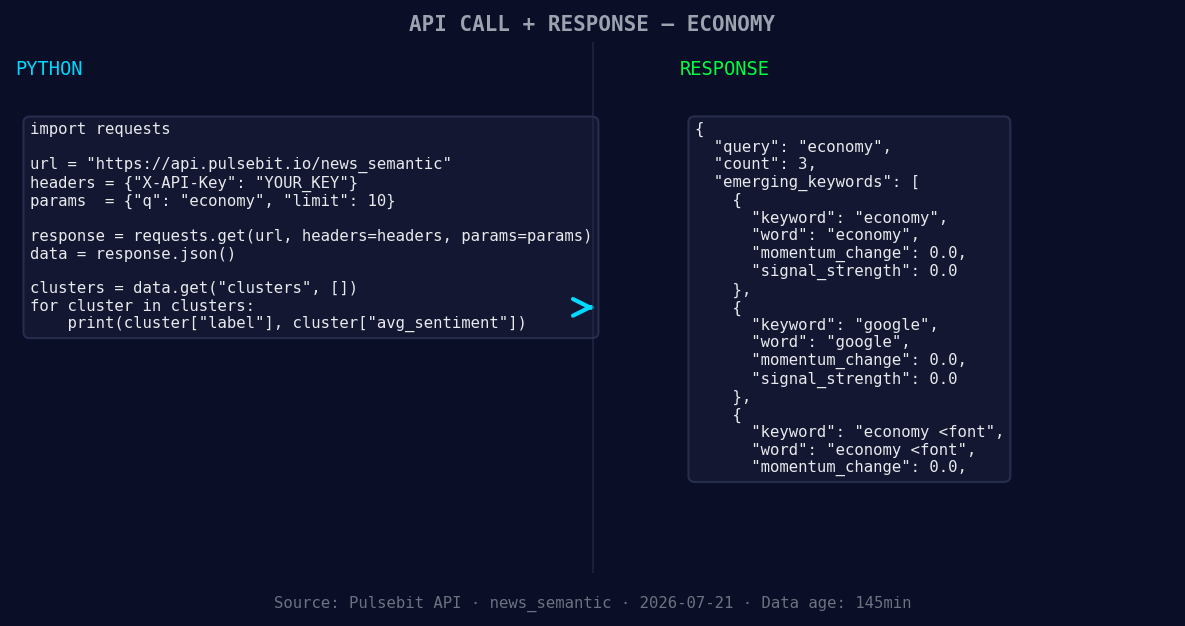
*Left: Python GET /news_semantic call for 'economy'. Right: returned JSON response structure (clusters: 3). Source: Pulsebit /news_semantic.*
# Check the response
if response.status_code == 200:
sentiment_data = response.json()
print(sentiment_data)
else:
print(f"Error: {response.status_code}")
Now, let’s run the cluster reason string through our API to score the narrative framing itself. This step is crucial as it evaluates the context around our findings.
# Define the cluster reason string
cluster_reason = "Clustered by shared themes: borderless, economy, outgrowing, its, financial."

# Call the sentiment scoring endpoint
response_meta = requests.post(api_endpoint, json={"text": cluster_reason})

# Check the response
if response_meta.status_code == 200:
    meta_sentiment_data = response_meta.json()
    print(meta_sentiment_data)
else:
    print(f"Error: {response_meta.status_code}")
With these two pieces of code, you're well on your way to catching significant shifts in sentiment around key economic topics.
Now, let’s talk about building on this momentum spike. Here are three specific things we can create:
- Geo-Filtered Alerts: Set up a notification system that triggers when the sentiment score crosses a specific threshold (e.g., +0.25) within a defined geographic filter. This will ensure you're alerted to critical shifts in sentiment real-time, helping to mitigate risks tied to delayed reactions.

Geographic detection output for economy. Hong Kong leads with 2 articles and sentiment -0.30. Source: Pulsebit /news_recent geographic fields.
Meta-Sentiment Dashboard: Create a dashboard that visualizes the sentiment scores of cluster reasons over time. By integrating the meta-sentiment scores, you can track how narrative framing affects overall sentiment in your topic areas. This can be useful for understanding the broader context and potential implications.
Thematic Trend Analyzer: Develop a script that automatically analyzes forming themes such as "economy" and "borderless," and compares them against mainstream narratives. This will allow you to identify divergences in sentiment and potentially discover undercurrents that mainstream reports might overlook.
If you're ready to implement these insights, you can find all the necessary details in our documentation at pulsebit.lojenterprise.com/docs. You can copy, paste, and run the provided code in under 10 minutes, putting you ahead of the curve in sentiment analysis.


Top comments (0)