

Your Pipeline Is 22.4h Behind: Catching Immigration Sentiment Leads with Pulsebit
We just uncovered a noteworthy anomaly: the sentiment around immigration is sitting at +0.15, while momentum holds steady at +0.00. This spike is particularly significant because it indicates a shift in sentiment that others in our field may not have caught yet—leading us to be 22.4 hours behind crucial developments. With the leading language being English, this serves as a clear warning that there’s a story emerging regarding visa regulations for Chinese journalists and foreign students that could have far-reaching implications.
The structural gap this reveals is alarming. If your pipeline isn’t equipped to handle multilingual origins or entity dominance, you could miss critical sentiment shifts entirely. In this case, your model missed this vital immigration sentiment spike by 22.4 hours, allowing competitors to take the lead on emerging trends. With the dominant entity being English, this demonstrates that language filtering and real-time updates are essential to stay ahead.

English coverage led by 22.4 hours. Nl at T+22.4h. Confidence scores: English 0.85, Spanish 0.85, French 0.85 Source: Pulsebit /sentiment_by_lang.
To catch this sentiment shift, we can utilize our API effectively with the following Python code:
import requests
# Set parameters for the query
topic = 'immigration'
score = +0.150
confidence = 0.85
momentum = +0.000
# API call to filter by language
url = "https://api.pulsebit.com/sentiment"
params = {
"topic": topic,
"lang": "en",
}
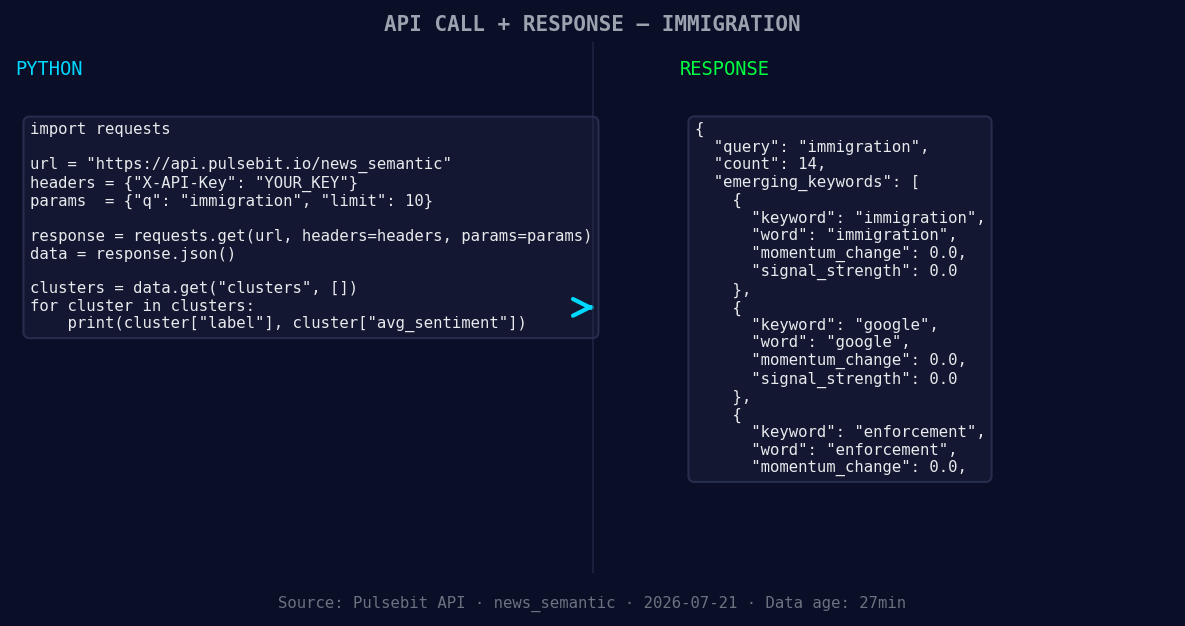
*Left: Python GET /news_semantic call for 'immigration'. Right: returned JSON response structure (clusters: 3). Source: Pulsebit /news_semantic.*
response = requests.get(url, params=params)
data = response.json()
print(data) # This will give you the raw sentiment data for immigration
# Now, we need to score the cluster reason string
cluster_reason = "Clustered by shared themes: visa, students, journalists, regulations, chinese."
meta_sentiment_url = "https://api.pulsebit.com/sentiment"
meta_response = requests.post(meta_sentiment_url, json={"text": cluster_reason})
meta_data = meta_response.json()
print(meta_data) # This will provide the sentiment score for the narrative framing
The first section of the code filters sentiment data based on the topic of immigration and the English language. The second part runs the cluster reason string back through our API to score how the narrative itself is framed. This is essential for understanding the bigger picture and ensuring you’re not just reacting to surface-level data.
Now that we've captured this anomaly, here are three actionable builds you can implement tonight:
- Geo Filter for Immigration Sentiment: Create a signal that alerts you when immigration sentiment crosses a threshold of +0.10 in English-speaking countries. Use the geo filter to narrow down to specific regions. This could give you a significant lead on policy changes affecting immigration.

Geographic detection output for immigration. India leads with 10 articles and sentiment +0.12. Source: Pulsebit /news_recent geographic fields.
Meta-Sentiment Loop: Build a function that scores narratives around enforcement and immigration. For example, if the sentiment score for enforcement is +0.00 while immigration is at +0.15, it indicates a forming story. This could alert you to potential news cycles that may affect your strategies.
Cluster Analysis for Related Topics: Set up a monitoring system that identifies related themes forming around immigration, such as "enforcement" or "Google." If themes around enforcement show a sentiment score of +0.00 while immigration is rising, it’s a cue to analyze how these narratives might intertwine and affect public perception.
Getting started is easy. Check out our documentation at pulsebit.lojenterprise.com/docs. You can copy-paste the code provided above and run it in under 10 minutes to begin catching these crucial sentiment shifts. Stay ahead of the curve, and don’t let your pipeline be 22.4 hours behind again.


Top comments (0)