

Your Pipeline Is 22.5h Behind: Catching Travel Sentiment Leads with Pulsebit
We just uncovered a striking anomaly: a 24-hour momentum spike of +1.500 in travel sentiment. This surge is not just a number; it reflects a significant shift in the discourse around travel, particularly as it relates to new offerings in small group tours in Asia and Africa. With the leading language being English and a 22.5-hour lead, this is a clear signal that your models might be missing critical sentiment changes.
The Problem
If your pipeline isn’t set up to handle multilingual origins or the dominance of specific entities, you’re potentially missing out on significant insights. Your model missed this by 22.5 hours, meaning you could be reacting too late to emerging trends. The leading narrative in English press is framing travel with fresh opportunities, but without a robust strategy to capture these nuances, you risk falling behind.

English coverage led by 22.5 hours. Nl at T+22.5h. Confidence scores: English 0.85, Spanish 0.85, French 0.85 Source: Pulsebit /sentiment_by_lang.
The Code
We can effectively capture this momentum spike by using our API. Here’s how you could do it in Python:
import requests
# Define parameters for the API call
topic = 'travel'
score = -0.600
confidence = 0.85
momentum = +1.500
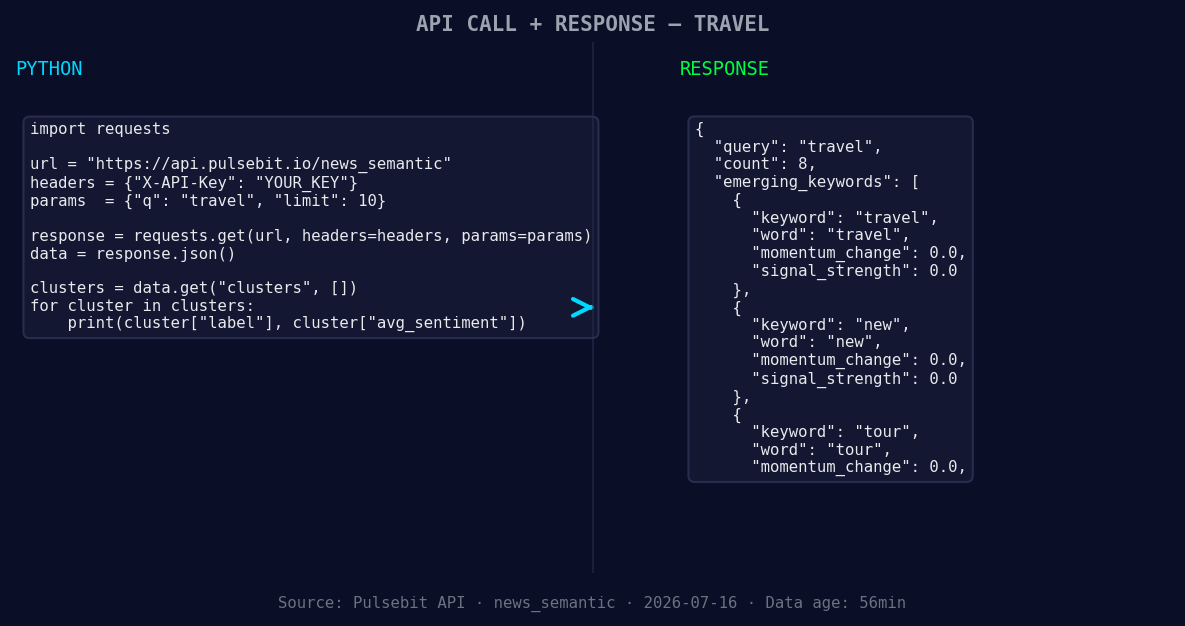
*Left: Python GET /news_semantic call for 'travel'. Right: returned JSON response structure (clusters: 3). Source: Pulsebit /news_semantic.*
# Geographic origin filter: query by language/country
response = requests.get(
"https://api.pulsebit.com/v1/sentiment",
params={
"topic": topic,
"lang": "en",
"score": score,
"confidence": confidence,
"momentum": momentum
}
)
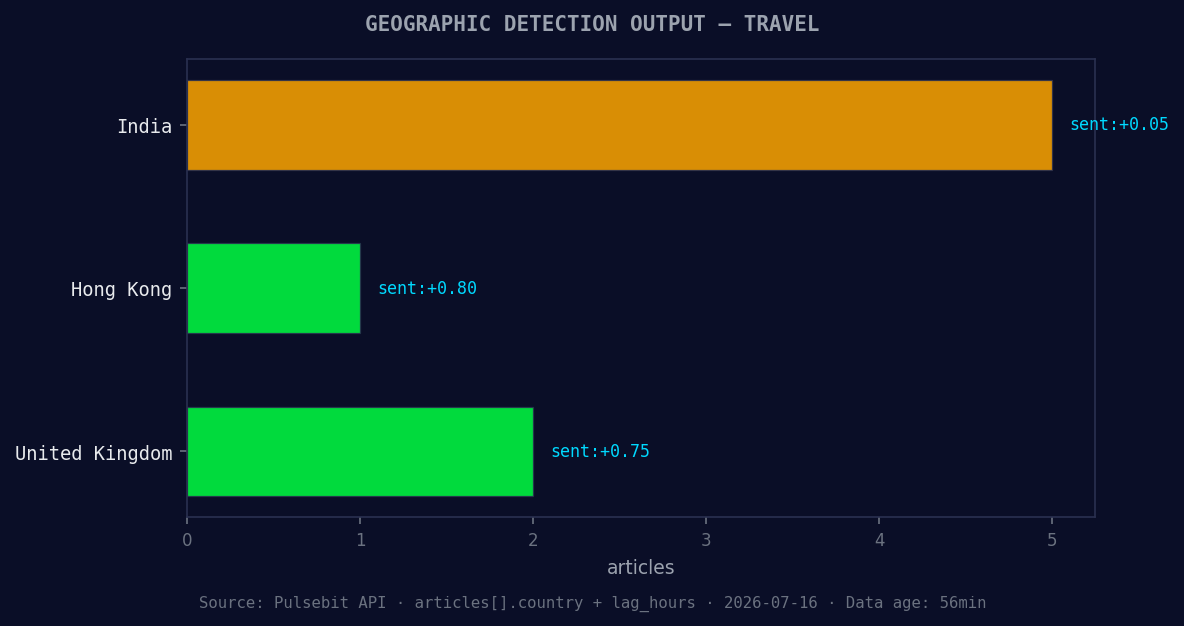
*Geographic detection output for travel. India leads with 5 articles and sentiment +0.05. Source: Pulsebit /news_recent geographic fields.*
# Check the response
print(response.json())
Now, let’s run the cluster reason string back through our sentiment scoring. This will give us insight into how the narrative is being framed. Here’s the relevant code:
# Meta-sentiment moment: scoring the narrative framing itself
cluster_reason = "Clustered by shared themes: introduces, new, small, group, tours."

meta_response = requests.post(
    "https://api.pulsebit.com/v1/sentiment",
    json={
        "text": cluster_reason
    }
)

# Check the response for meta sentiment
print(meta_response.json())
This two-step process allows us to track sentiment trends in real-time and adjust our strategies accordingly.
Three Builds Tonight
Here are three specific implementations we can create with this pattern:
Geo-Filtered Travel Insights: Use the geographic origin filter to query travel sentiment not just by language, but also by region. Set a threshold for momentum spikes, e.g.,
momentum > +1.200, to catch trends before they hit mainstream discourse.Meta-Sentiment Dashboard: Build a dashboard that continuously scores narrative clusters. For instance, track discussions around "introduces," "new," and "small" tours. Use the meta-sentiment loop to provide context around these discussions and identify positive framing.
Alerts for Emerging Trends: Create a real-time alert system that flags any sentiment with a score lower than -0.500 but rising momentum, such as
momentum > +1.000. This will help you act quickly on shifts in sentiment, particularly around travel, new offerings, and tours.
Get Started
Ready to dive in? Check out our documentation at pulsebit.lojenterprise.com/docs. You can copy-paste and run this in under 10 minutes. Don't let your pipeline lag behind; stay ahead of the trends!


Top comments (0)