

Your Pipeline Is 27.2h Behind: Catching Artificial Intelligence Sentiment Leads with Pulsebit
We recently found a striking anomaly: a 24-hour momentum spike of -0.572 in the sentiment surrounding artificial intelligence. This drop isn't just a number; it signals a significant shift in sentiment that you need to be aware of. The leading language in this discourse is English, with a notable cluster story titled "Will the U.S. and China Build Walls Around A.I.?" The urgency of this moment cannot be overstated, especially as it reveals the challenges many pipelines face in capturing real-time sentiment shifts.
When your model misses a sentiment spike like this by 27.2 hours, it exposes a structural gap that could lead to critical oversights. In this case, the dominant entity is English-language press coverage, which is shaping perceptions around artificial intelligence. If your pipeline doesn’t adequately handle multilingual origins or prioritize entities in a timely manner, you risk being left behind in the fast-paced world of AI sentiment analysis.

English coverage led by 27.2 hours. Ca at T+27.2h. Confidence scores: English 0.85, Spanish 0.85, Ro 0.85 Source: Pulsebit /sentiment_by_lang.
Here’s how you can catch it. We can start with a simple Python script that queries our API to get relevant sentiment data. First, we’ll filter by geographic origin to ensure we're only analyzing English-language content. Then, we’ll run a meta-sentiment analysis on the clustered narrative.
import requests
# Define parameters for the API call
topic = 'artificial intelligence'
score = +0.288
confidence = 0.85
momentum = -0.572
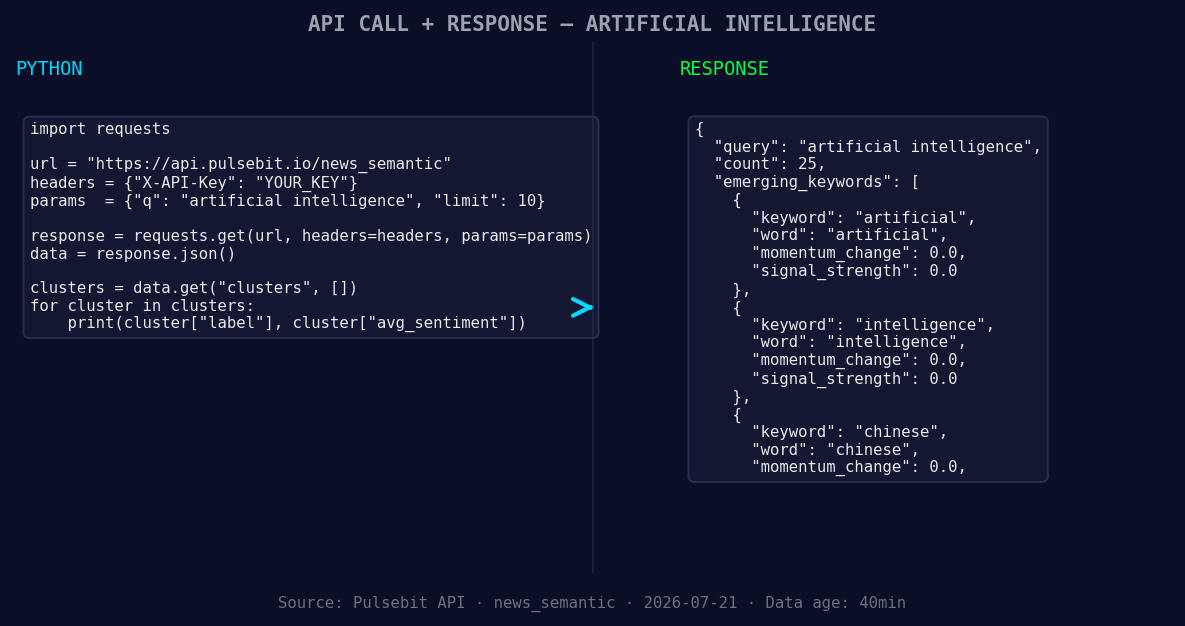
*Left: Python GET /news_semantic call for 'artificial intelligence'. Right: returned JSON response structure (clusters: 3). Source: Pulsebit /news_semantic.*
# Step 1: Geographic origin filter to query by language
response = requests.get(
'https://api.pulsebit.com/sentiment',
params={
'topic': topic,
'lang': 'en'
}
)
# Print the response
print(response.json())
# Step 2: Meta-sentiment moment using the cluster reason
cluster_reason = "Clustered by shared themes: google, academic, skills, vtu, enter."
meta_response = requests.post(
'https://api.pulsebit.com/sentiment',
json={'text': cluster_reason}
)
# Print the meta-sentiment response
print(meta_response.json())
This script first performs a GET request to filter for English-language articles about artificial intelligence. The subsequent POST request analyzes the narrative around the clustered themes. By capturing both the sentiment and the thematic framing, we can get a more holistic view of the discourse.
Now that we've identified the anomaly, let’s talk about three specific builds you can implement tonight using this pattern.
- Geo-Filtered Alert System: Set a threshold for sentiment score drops below -0.5. Use the geographic filter to ensure you're only tracking English-language content. This will give you timely alerts for significant shifts in sentiment related to artificial intelligence.

Geographic detection output for artificial intelligence. Hong Kong leads with 10 articles and sentiment +0.45. Source: Pulsebit /news_recent geographic fields.
Meta-Sentiment Dashboard: Build a dashboard that displays the sentiment of clustered narratives. Use the output from the meta-sentiment loop to visualize how themes like "China" and "AI" interact with mainstream topics like "Google" and "academic skills." This will help contextualize sentiment shifts in real-time.
Anomaly Detection Pipeline: Create a pipeline that checks for momentum spikes, specifically targeting those that fall below a momentum threshold of -0.5. Incorporate the geographic filter in your API calls to ensure comprehensive coverage while focusing on emerging themes like "artificial," "intelligence," and "Chinese" sentiments.
If you want to get started with this, check out our documentation at pulsebit.lojenterprise.com/docs. With just a few copy-paste actions, you can have this running in under 10 minutes, setting you up to catch sentiment leads like a pro.


Top comments (0)