

Your pipeline just missed a significant anomaly: a 24-hour momentum spike of +0.608 in travel sentiment. This isn't just another number; it's a clear signal that something is happening within the travel domain, particularly as English-language press coverage is leading the charge. With a reporting window of 26.8 hours, it's crucial for us to understand what this means and how we can leverage it to stay ahead of the curve. One particular article caught our attention: “Flying into Hyderabad airport to get costlier as GHIAL proposes arrival fee from.” This indicates a rising sentiment that could impact our models and predictions around travel behavior.
If your pipeline doesn't account for multilingual origins or entity dominance, you're potentially leaving critical insights on the table. Your model missed this spike by 26.8 hours, which is a glaring gap when it comes to real-time sentiment tracking. The leading English-language article is a testament to that. If you’re only analyzing data in a vacuum, you’ll struggle to catch these nuanced shifts in sentiment, especially when they’re anchored by dominant entities like GHIAL and specific geographic contexts.

English coverage led by 26.8 hours. Hr at T+26.8h. Confidence scores: English 0.75, Spanish 0.75, French 0.75 Source: Pulsebit /sentiment_by_lang.
Let’s catch this anomaly with Python. Below is a code snippet that demonstrates how to query our API to capture this momentum spike in travel sentiment.
import requests
# Define parameters for our API call
params = {
"topic": "travel",
"score": 0.324,
"confidence": 0.75,
"momentum": 0.608,
"lang": "en" # Geographic filter for English language
}
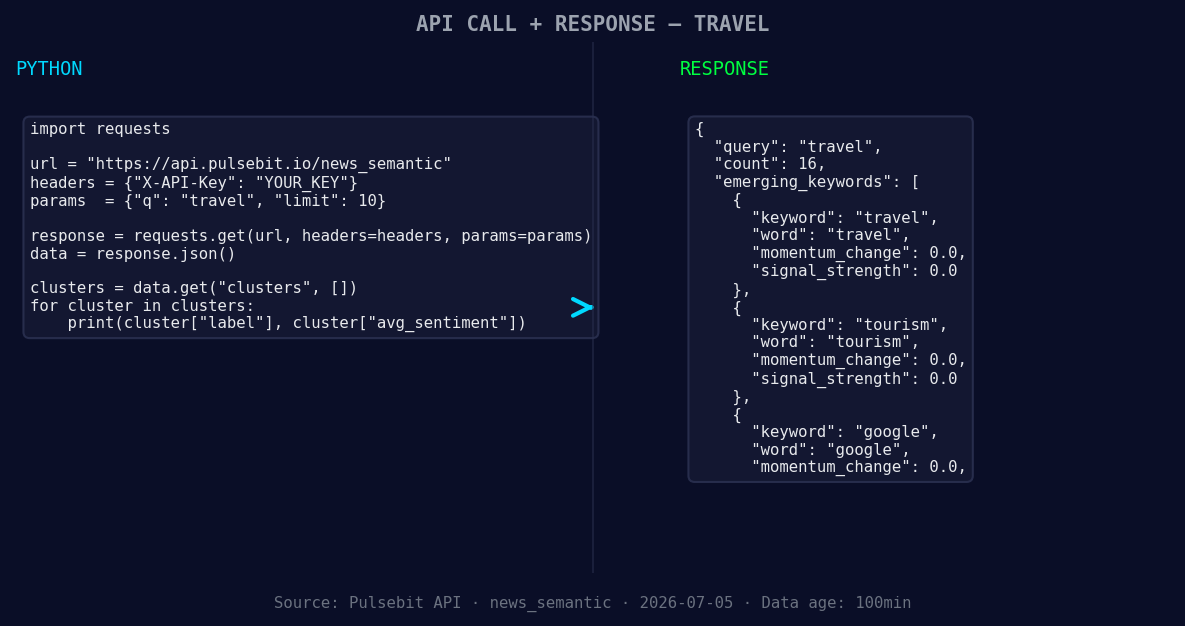
*Left: Python GET /news_semantic call for 'travel'. Right: returned JSON response structure (clusters: 3). Source: Pulsebit /news_semantic.*
# Make the API call
response = requests.get('https://api.pulsebit.com/sentiment', params=params)
data = response.json()
print(data)
Next, we need to run a meta-sentiment analysis on the cluster reason string to score the narrative framing itself. This is where we can uncover the underlying themes that our pipeline should account for. Here's how you can do that:
# Cluster reason string
cluster_reason = "Clustered by shared themes: flying, into, hyderabad, airport, ghial."

# POST request to score the narrative framing
meta_sentiment_response = requests.post('https://api.pulsebit.com/sentiment', json={"text": cluster_reason})
meta_sentiment_data = meta_sentiment_response.json()

print(meta_sentiment_data)
Now that we’ve identified how to catch this sentiment spike, here are three specific builds we can implement based on these findings:
Geographic Origin Filter: Use the geolocation component to focus specifically on English-language articles about travel. Set a threshold for momentum spikes over +0.5 to trigger alerts for your team to investigate.
Meta-Sentiment Loop: Create a routine that runs monthly to analyze cluster narratives like the one we observed. If the score falls below a confidence level of 0.7, flag it for review. This will help you understand how narrative framing changes over time.
Forming Theme Dashboard: Develop a dashboard that visualizes forming themes — such as travel, tourism, and Google — against the mainstream narrative. Use the API to pull in data and highlight anomalies whenever the sentiment score diverges significantly from the average.
By focusing on these specific signals, you can ensure your pipeline is more robust and responsive to real-world events.
If you’re ready to get started, check out our documentation at pulsebit.lojenterprise.com/docs. With the provided code snippets, you can copy-paste and run this in under 10 minutes. Let’s make sure we’re not left behind again!


Top comments (0)