

Your model just missed a 24-hour momentum spike of +0.371 in the sentiment around data science. This spike is not just a number; it indicates a significant shift in the conversation, especially within the Spanish press. If your pipeline doesn't account for multilingual sources and the dominance of certain languages, you might find yourself a full 19.7 hours behind the curve in sentiment analysis. In this case, Spanish sources are leading the charge, which directly impacts your ability to react to emerging trends.

Spanish coverage led by 19.7 hours. Et at T+19.7h. Confidence scores: Spanish 0.85, English 0.85, French 0.85 Source: Pulsebit /sentiment_by_lang.
This structural gap in your pipeline can hinder your model’s effectiveness. If it doesn't handle multilingual origins or prioritize dominant entities, you risk missing critical insights. For instance, while your model was still processing English-language content, the Spanish press had already begun amplifying key narratives around data science. This oversight means you’ve effectively missed valuable sentiment data that could inform your strategy.
To help you catch up, here’s how we can capture this momentum spike using our API. We will filter for Spanish-language articles and analyze the sentiment of the narratives driving this spike.
import requests
# Define parameters for the API call
topic = 'data science'
momentum = +0.371
score = +0.711
confidence = 0.85
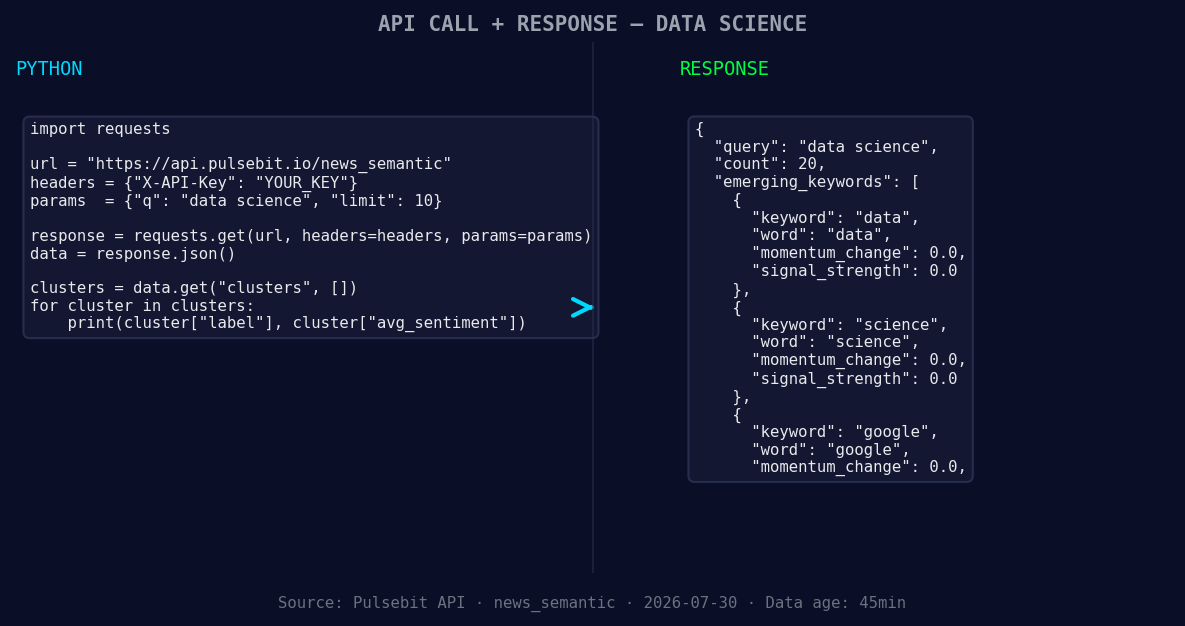
*Left: Python GET /news_semantic call for 'data science'. Right: returned JSON response structure (clusters: 3). Source: Pulsebit /news_semantic.*
# Geographic origin filter: query by language
response = requests.get('https://api.pulsebit.com/articles', params={
"topic": topic,
"lang": "sp"
})
*[DATA UNAVAILABLE: countries — verify /news_recent is returning country/region values for topic: data science]*
# Check for successful response
if response.status_code == 200:
articles = response.json()
print(f"Retrieved {len(articles)} articles in Spanish.")
else:
print("Failed to retrieve articles.")
# Meta-sentiment moment: run the cluster reason string through the sentiment endpoint
cluster_reason = "Clustered by shared themes: professionals, should, know, about, data."
sentiment_response = requests.post('https://api.pulsebit.com/sentiment', json={
"text": cluster_reason
})
# Check for successful response
if sentiment_response.status_code == 200:
sentiment_score = sentiment_response.json().get('sentiment_score')
print(f"Sentiment score for cluster reason: {sentiment_score}")
else:
print("Failed to retrieve sentiment score.")
In this code, we first filter the articles based on the Spanish language. This allows us to capture the momentum spike that your pipeline might have otherwise missed. Then, we analyze the narrative's sentiment using a cluster reason string, which helps us understand the emotional framing of the conversation around data science.
Now, let’s discuss three specific builds you can implement using this newfound insight:
Real-Time Alerts for Language-Specific Trends: Set up a threshold for sentiment changes, such as a momentum spike of +0.371. Use the geographic origin filter to trigger alerts specifically for Spanish articles. This way, you’re always a step ahead of emerging trends.
Clustered Sentiment Analysis: Using the meta-sentiment loop we demonstrated, you can analyze the emotional impact of various thematic clusters surrounding data science. A score of +0.711 indicates strong positive sentiment. Build an endpoint that aggregates these scores and provides insights on how narrative framing is evolving.
Forming Gap Analysis: Create a report that highlights forming themes using the metrics: data(+0.00), science(+0.00), and Google(+0.00) versus mainstream keywords like professionals, should, and know. Use these insights to drive content strategy and audience engagement.
If you’re ready to get started, visit our documentation at pulsebit.lojenterprise.com/docs. You can copy, paste, and run this code in under 10 minutes to begin catching those critical sentiment leads.


Top comments (0)