

Your Pipeline Is 26.8h Behind: Catching Software Sentiment Leads with Pulsebit
We recently discovered an anomaly in our sentiment data where the sentiment score for the topic "software" is sitting at a flat +0.00, with a momentum of +0.00, despite being led by English coverage with a 26.8-hour lead time. This lack of movement in sentiment and momentum exposes a structural gap in any pipeline that isn't equipped to handle multilingual origins or recognize dominant entities. If your model missed this by 26.8 hours, you’re lagging in understanding the software landscape.

English coverage led by 26.8 hours. Et at T+26.8h. Confidence scores: English 0.85, Spanish 0.85, French 0.85 Source: Pulsebit /sentiment_by_lang.
The Problem
This gap highlights a critical issue: without a robust mechanism to process sentiment across different languages, your insights become stale. Right now, the leading language is English, which accounts for the sentiment's dominance. Without acknowledging this, you risk missing out on vital trends. If your model isn't adapting to this multilingual reality, you're effectively sitting on news that's 26.8 hours old, leaving you behind in a fast-paced environment where every hour counts.
The Code
To catch this anomaly, let's dive into the code. We will first query our data based on the geographic origin using the language filter. Here's how you can do it in Python:

Geographic detection output for software. India leads with 1 articles and sentiment -0.60. Source: Pulsebit /news_recent geographic fields.
import requests
# Define the parameters for the API call
params = {
"topic": "software",
"lang": "en"
}
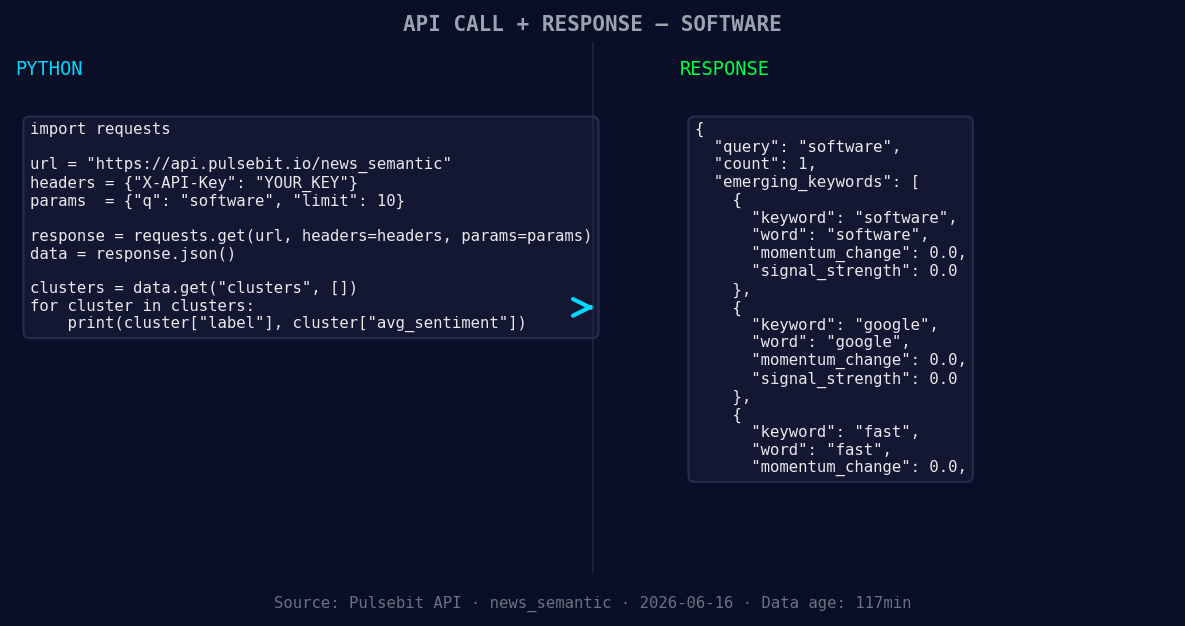
*Left: Python GET /news_semantic call for 'software'. Right: returned JSON response structure (clusters: 3). Source: Pulsebit /news_semantic.*
# Make the API call to get the sentiment data
response = requests.get("https://api.pulsebit.com/sentiment", params=params)
data = response.json()
# Output the sentiment data
print(data)
Next, we need to run the cluster reason string through our sentiment endpoint to analyze the narrative framing. This is crucial since it allows us to understand the context surrounding the sentiment.
# Define the narrative framing string
narrative = "Clustered by shared themes: your, marks:, get, software, products."

# Make the API call to score the narrative framing
response_narrative = requests.post("https://api.pulsebit.com/sentiment", json={"text": narrative})
narrative_score = response_narrative.json()

# Output the narrative sentiment score
print(narrative_score)
By employing both the geographic origin filter and the meta-sentiment moment, we can gain a clearer view of the software sentiment landscape.
Three Builds Tonight
Here are three specific builds we can implement using this pattern:
Geographic Origin Filter: Create a real-time alert system that notifies you when a significant sentiment shift occurs in the English language sentiment towards software. Set a threshold of +0.01 to trigger alerts.
Meta-Sentiment Loop: Build a dashboard that visualizes sentiment narratives. Use the narrative string from the clustering process as input and display sentiment scores over time, focusing on the themes: software(+0.00), google(+0.00), fast(+0.00).
Incorporate Forming Themes: Develop a feature that cross-references emerging software trends with mainstream narratives. For instance, track the sentiment scores of "your," "marks:," and "get" against the backdrop of software developments.
Get Started
You can start exploring these insights by visiting our documentation at pulsebit.lojenterprise.com/docs. This code can be copied and run in under 10 minutes, allowing you to harness the power of sentiment analysis for your applications.


Top comments (0)