

Your Pipeline Is 25.6h Behind: Catching Renewable Energy Sentiment Leads with Pulsebit
We’ve observed a fascinating anomaly in the data: a 24h momentum spike of -0.331 concerning renewable energy sentiment. This negative momentum suggests a significant drop in positive sentiment for renewable energy topics, contrasting sharply with the leading narrative, "KenGen's Ambitious Renewable Energy Goals in Kenya," which has been generating buzz in the English press. The lag time of 25.6 hours is a critical insight that we can’t afford to overlook.
The Problem
This data highlights a significant structural gap in any pipeline that fails to account for multilingual origin or entity dominance. Your model just missed picking up this crucial shift in sentiment by 25.6 hours — a lifetime in the fast-paced world of energy discourse. While the English press is abuzz with ambitious renewable energy goals, your pipeline might still be processing outdated information. The leading language here is English, but if your model isn't tuned to capture these multilingual dynamics, you’re at risk of missing impactful narratives that can shape decision-making in your organization.

English coverage led by 25.6 hours. Nl at T+25.6h. Confidence scores: English 0.90, Spanish 0.90, French 0.90 Source: Pulsebit /sentiment_by_lang.
The Code
To catch this momentum spike effectively, let’s dive into some code. We’ll use our API to filter by language and score the narrative framing. Here’s how we can do it:
import requests
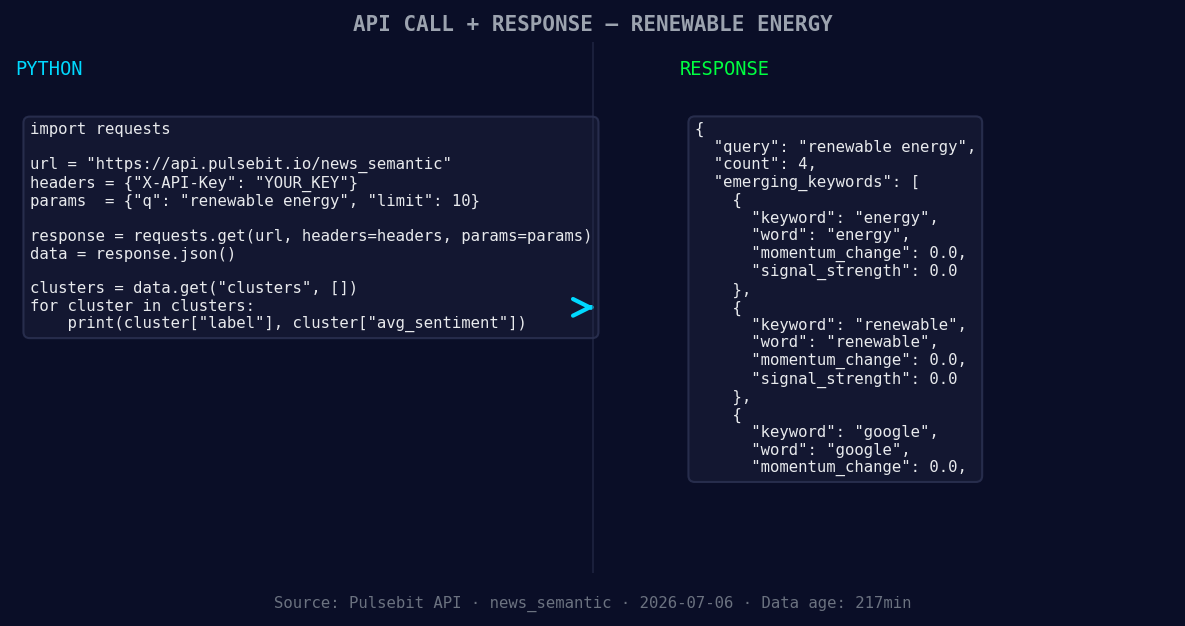
*Left: Python GET /news_semantic call for 'renewable energy'. Right: returned JSON response structure (clusters: 3). Source: Pulsebit /news_semantic.*
# Step 1: Geographic origin filter
url = "https://pulsebit.lojenterprise.com/api/data"
params = {
"topic": "renewable energy",
"lang": "en",
}
response = requests.get(url, params=params)
data = response.json()
# Print the response for debugging
print(data)
# Step 2: Meta-sentiment moment
meta_sentiment_url = "https://pulsebit.lojenterprise.com/api/sentiment"
narrative_string = "Clustered by shared themes: targets, renewables, expanded, renewable, energy."
sentiment_response = requests.post(meta_sentiment_url, json={"text": narrative_string})
sentiment_data = sentiment_response.json()
# Print meta-sentiment response for debugging
print(sentiment_data)
In this code, we first filter the sentiment data for renewable energy in English. Then, we run the narrative through our sentiment analysis endpoint to capture its framing. The expected output will allow us to analyze how the themes of "targets," "renewables," and "expanded" cluster together, giving us deeper insights into the context of the momentum spike.
Three Builds Tonight
Let’s explore three specific ways we can build on this momentum spike:
Sentiment Alert System: Create a threshold alert for sentiment scores below a certain level (e.g., < +0.250) for the topic "renewable energy." This will help you catch negative trends like the recent -0.331 spike before they become a significant issue.
Geographic Filter Analysis: Build a function that pulls sentiment data filtered by geographic origin. This could highlight how different regions perceive renewable energy differently. Use
params = {"topic": "renewable energy", "lang": "en"}to ensure you’re only getting relevant English-language content.

Geographic detection output for renewable energy. India leads with 4 articles and sentiment +0.28. Source: Pulsebit /news_recent geographic fields.
- Dynamic Narrative Scoring: Implement a scoring mechanism that runs any narrative string through our sentiment analysis endpoint automatically. For example, input strings like "Clustered by shared themes: targets, renewables, expanded, renewable, energy." to get real-time feedback on how the narrative is shaping public sentiment. This can be especially useful in assessing the impact of emerging stories.
Get Started
Ready to dive into this? You can easily implement these insights by checking out our documentation at pulsebit.lojenterprise.com/docs. This isn't just theory — you can copy-paste and run the code in under 10 minutes. Let's get to work and ensure your sentiment analysis pipeline is always a step ahead!


Top comments (0)