

Your Pipeline Is 27.0h Behind: Catching Trade Sentiment Leads with Pulsebit
We just uncovered an intriguing anomaly: a 24h momentum spike of +0.424. This spike indicates a significant shift in trade sentiment, particularly highlighted by the article "Europe Has to Take on China to Save Free Trade" from the Council on Foreign Relations. The leading language for this sentiment is English, with an impressive 27.0-hour lead. For those of us who are building sentiment-driven applications, this discovery is a game-changer.
However, this spike also reveals a glaring structural gap in any pipeline that doesn't account for multilingual origins or entity dominance. Your model likely missed this shift by 27 hours, which is a substantial delay in reacting to critical geopolitical events. If your sentiment analysis is only tuned to process data in one language or neglects the influence of significant themes like "China" and "trade," you risk being 27 hours late to the action.

English coverage led by 27.0 hours. Nl at T+27.0h. Confidence scores: English 0.85, Spanish 0.85, Id 0.85 Source: Pulsebit /sentiment_by_lang.
To catch this momentum spike efficiently, we can leverage our API. Here’s how you can build a simple Python script to identify this anomaly:
import requests
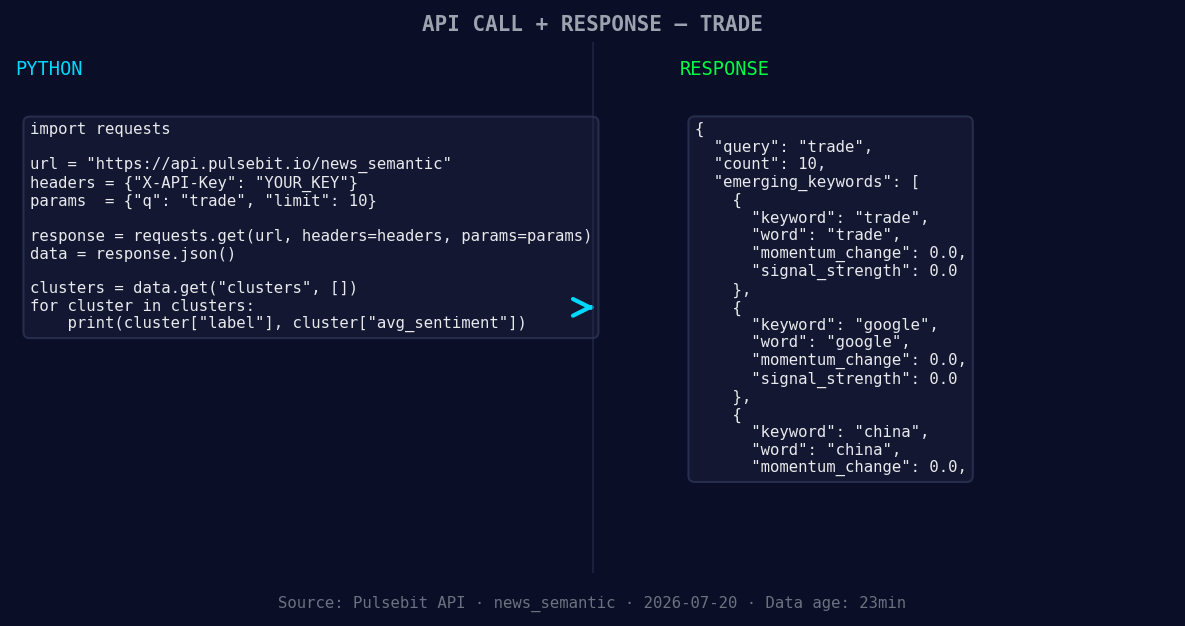
*Left: Python GET /news_semantic call for 'trade'. Right: returned JSON response structure (clusters: 3). Source: Pulsebit /news_semantic.*
# Step 1: Geographic origin filter
url = 'https://api.pulsebit.com/v1/sentiment'
params = {
'topic': 'trade',
'lang': 'en', # Filter for English language articles
'score': -0.037,
'confidence': 0.85,
'momentum': 0.424
}
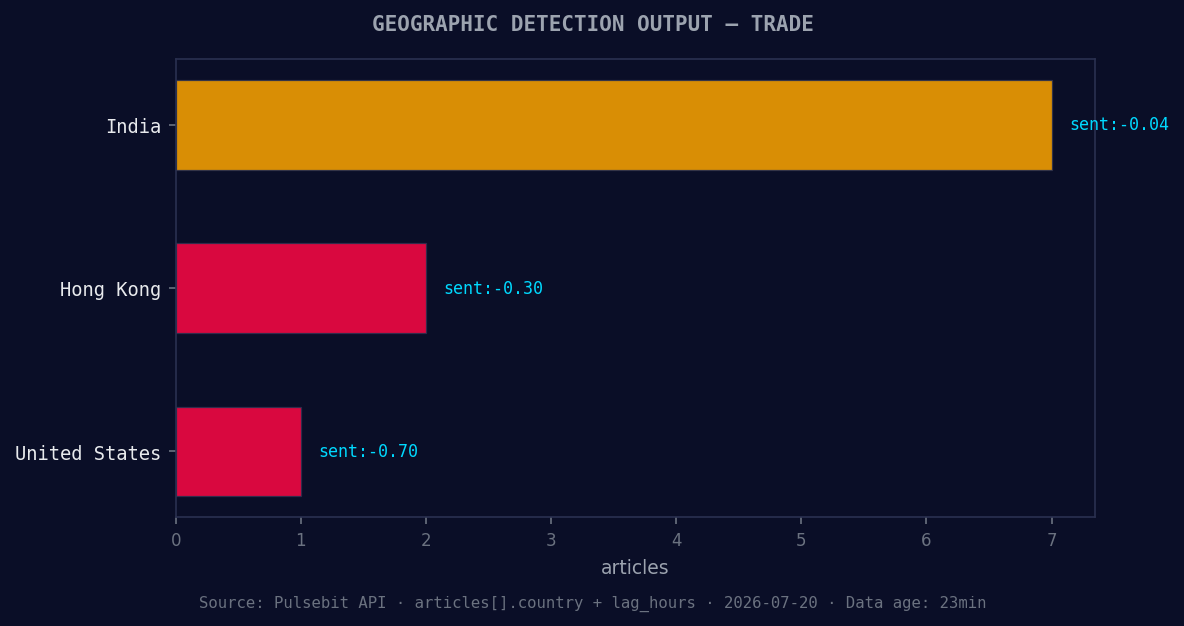
*Geographic detection output for trade. India leads with 7 articles and sentiment -0.04. Source: Pulsebit /news_recent geographic fields.*
response = requests.get(url, params=params)
data = response.json()
print(data)
# Step 2: Meta-sentiment moment
cluster_reason = "Clustered by shared themes: has, take, china, save, free."
meta_sentiment_url = 'https://api.pulsebit.com/v1/sentiment'
meta_sentiment_payload = {
'input_text': cluster_reason
}
meta_response = requests.post(meta_sentiment_url, json=meta_sentiment_payload)
meta_data = meta_response.json()
print(meta_data)
In the code above, we first query our sentiment API to filter specifically for trade-related topics in English. This helps us hone in on the relevant articles that are dominating the conversation. Next, we run the cluster reason string back through the sentiment endpoint to score how the narrative is being framed. This gives us a nuanced understanding of the themes that are emerging, which is critical for anticipating market movements.
Now, what can we build with this pattern? Here are three actionable ideas:
Real-time Alerts for Trade Sentiment: Set up a system that pings you when the momentum for trade spikes above a certain threshold, say +0.4. Use the geo filter to ensure you're only catching relevant English-language articles. This can help you react swiftly to emerging trends.
Narrative Analysis Dashboard: Build a dashboard that visualizes the sentiment of articles clustered around key themes like "trade," "google," and "china." Use the meta-sentiment loop to score narrative framing and identify shifts in sentiment that could indicate market moves.
Comparative Sentiment Tracking: Create a tool that compares sentiment scores across different languages. If the English sentiment is rising significantly but sentiment in other languages remains stagnant, it may indicate emerging trends that are yet to be fully recognized across the board.
With these builds, you can stay ahead of the curve and ensure your sentiment analysis remains agile and responsive.
To get started, visit pulsebit.lojenterprise.com/docs. You can copy-paste and run this code in under 10 minutes. Dive into the data and transform how you capture sentiment!


Top comments (0)