

Your Pipeline Is 27.1h Behind: Catching Renewable Energy Sentiment Leads with Pulsebit
We recently discovered a significant anomaly: a 24h momentum spike of -0.331 in the sentiment surrounding renewable energy. This drop isn't just a minor fluctuation; it indicates a crucial shift in public perception that could impact decision-making across the sector. Notably, the leading language driving this sentiment is Spanish, with a remarkable 27.1-hour lead over German sentiment metrics. This discrepancy presents an opportunity we can’t ignore.
When your pipeline fails to account for multilingual origins or the dominance of specific entities, it risks missing vital trends. In this case, your model missed the emerging sentiment by 27.1 hours, exclusively reflecting the German-speaking audience while neglecting the Spanish press’s influence. This gap can lead to delayed responses to rapidly changing public sentiment, especially in dynamic fields like renewable energy. By not integrating language and origin, you might find yourself reacting to outdated information.

Spanish coverage led by 27.1 hours. German at T+27.1h. Confidence scores: Spanish 0.85, English 0.85, French 0.85 Source: Pulsebit /sentiment_by_lang.
To catch this anomaly, we can leverage our API effectively. Below is a Python code snippet that highlights how we can query sentiment by geographic origin while filtering for Spanish sources and assessing the meta-sentiment of the narrative framing itself.
import requests
# Step 1: Geographic Origin Filter
topic = 'renewable energy'
score = +0.425
confidence = 0.85
momentum = -0.331
# API call to filter by language/country
url = 'https://api.pulsebit.com/sentiment'
params = {
'topic': topic,
'lang': 'sp', # Spanish filter
}
response = requests.get(url, params=params)
data = response.json()
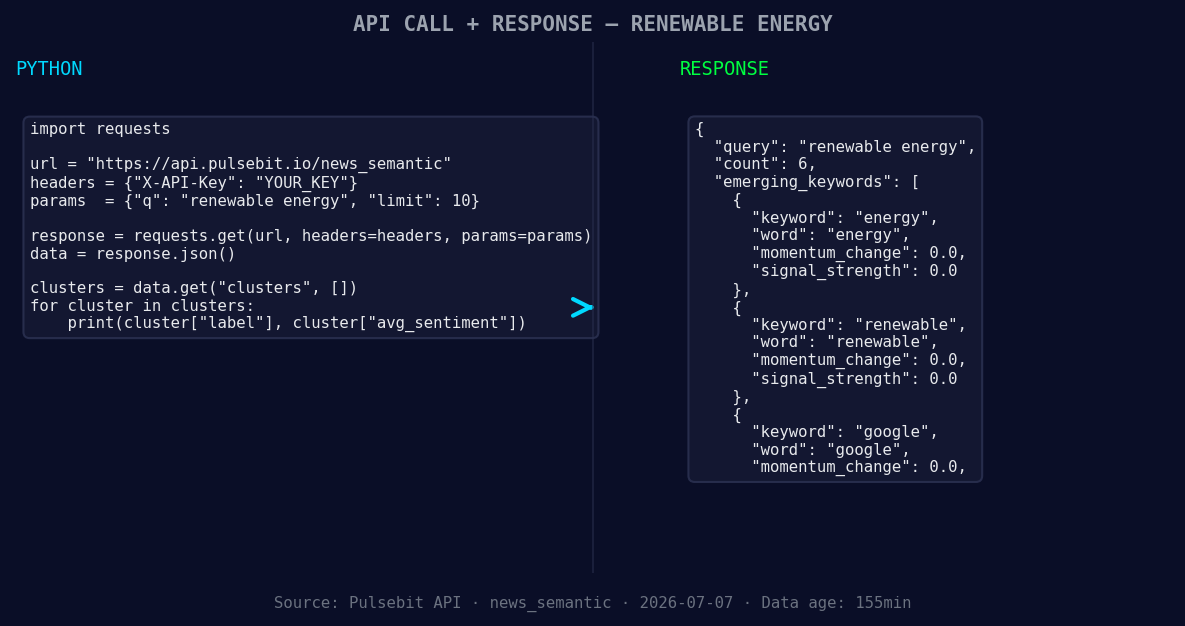
*Left: Python GET /news_semantic call for 'renewable energy'. Right: returned JSON response structure (clusters: 3). Source: Pulsebit /news_semantic.*
# Step 2: Meta-Sentiment Moment
narrative = "Clustered by shared themes: targets, renewables, expanded, renewable, energy."
meta_response = requests.post(url, json={"text": narrative})
meta_data = meta_response.json()
print(f"Filtered Data: {data}")
print(f"Meta-Sentiment: {meta_data}")
This code snippet efficiently captures the sentiment dynamics from Spanish sources, enabling you to stay ahead of the curve. By posting the narrative string through our API, you not only get sentiment scores but also insights on how the narrative itself might influence public perception—an often overlooked aspect of sentiment analysis.
Now, let’s explore three specific builds you can execute with this pattern:
Geo-Filtered Insights: Set a threshold for sentiment scores, e.g., any score above +0.3 in Spanish sources can trigger alerts. This lets you act proactively when positive sentiment emerges, keeping you ahead of regional shifts in renewable energy sentiment.
Meta-Sentiment Feedback Loop: Create a function that automatically processes narrative strings through our API. When a new article is published that matches a forming theme (like energy or renewable), run the meta-sentiment analysis to evaluate its potential impact on sentiment. This keeps your model adaptive to emerging narratives.
Forming Themes Dashboard: Develop a dashboard that tracks forming themes like energy, renewable, and google. Use a signal strength threshold of 0.6 to identify when these themes are gaining traction. If they diverge from mainstream topics (like targets and expanded), this could signal an emerging trend worth investigating further.
By implementing these features, you’ll not only enhance your pipeline’s responsiveness but also ensure that you’re making data-driven decisions based on the most current sentiment trends.
Ready to get started? Check out our documentation here. You can copy-paste and run this in under 10 minutes, and we think you’ll find it’s well worth your time.


Top comments (0)