

Your pipeline is 27.9h behind: catching artificial intelligence sentiment leads with Pulsebit
We recently spotted a compelling anomaly: a 24h momentum spike of -1.300 for the topic "artificial intelligence." This isn't just a number; it's a signal that a shift is happening. The leading language for this spike is English, with a notable lag of 27.9 hours. The cluster story making waves is titled "India should ride AI wave to emerge as a product nation: Industry experts." With only one article reflecting this sentiment, we see an opportunity to dig deeper.
However, this spike exposes a significant structural gap in any pipeline that fails to account for multilingual origins or entity dominance. If your model isn't set up to handle this, you missed this critical information by 27.9 hours. The dominant entity here is India, and it's actively shaping the conversation around artificial intelligence. If you're not capturing these trends in real-time, you risk falling behind.

English coverage led by 27.9 hours. Da at T+27.9h. Confidence scores: English 0.80, Spanish 0.80, French 0.80 Source: Pulsebit /sentiment_by_lang.
To catch this momentum spike, we can leverage our API. Below is a Python snippet that demonstrates how to query the relevant sentiment data and analyze the narrative framing.
import requests
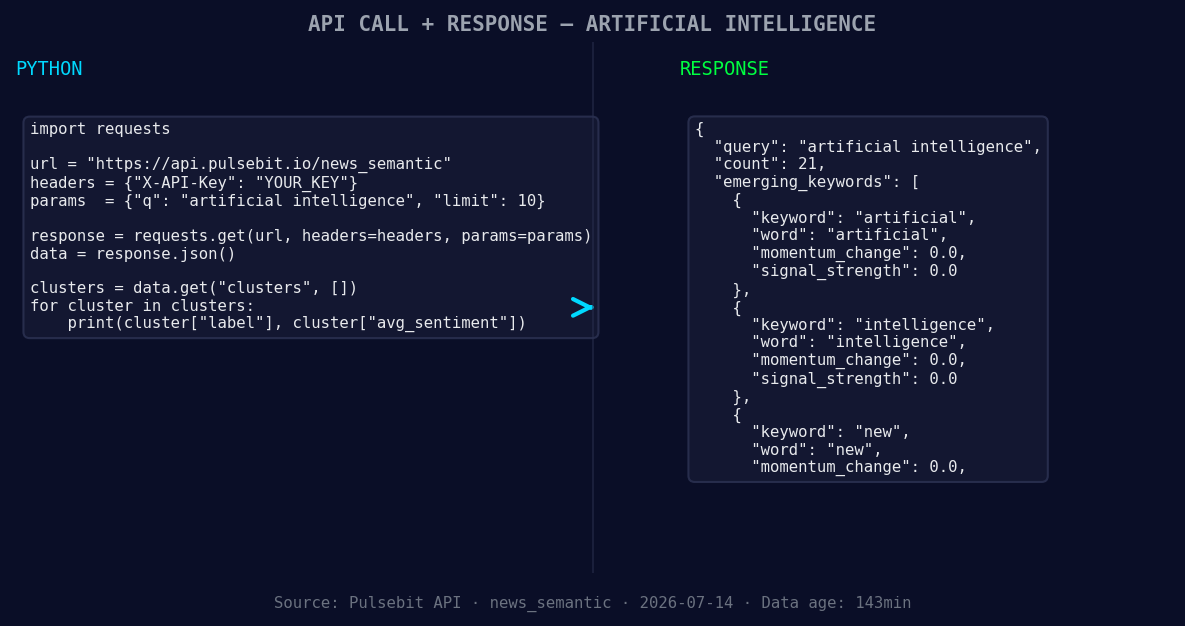
*Left: Python GET /news_semantic call for 'artificial intelligence'. Right: returned JSON response structure (clusters: 3). Source: Pulsebit /news_semantic.*
# Set up parameters
topic = 'artificial intelligence'
score = +0.464
confidence = 0.80
momentum = -1.300
lang = 'en'
# Geographic origin filter: Query by language/country
response = requests.get(
'https://api.pulsebit.com/sentiment',
params={
'topic': topic,
'lang': lang
}
)
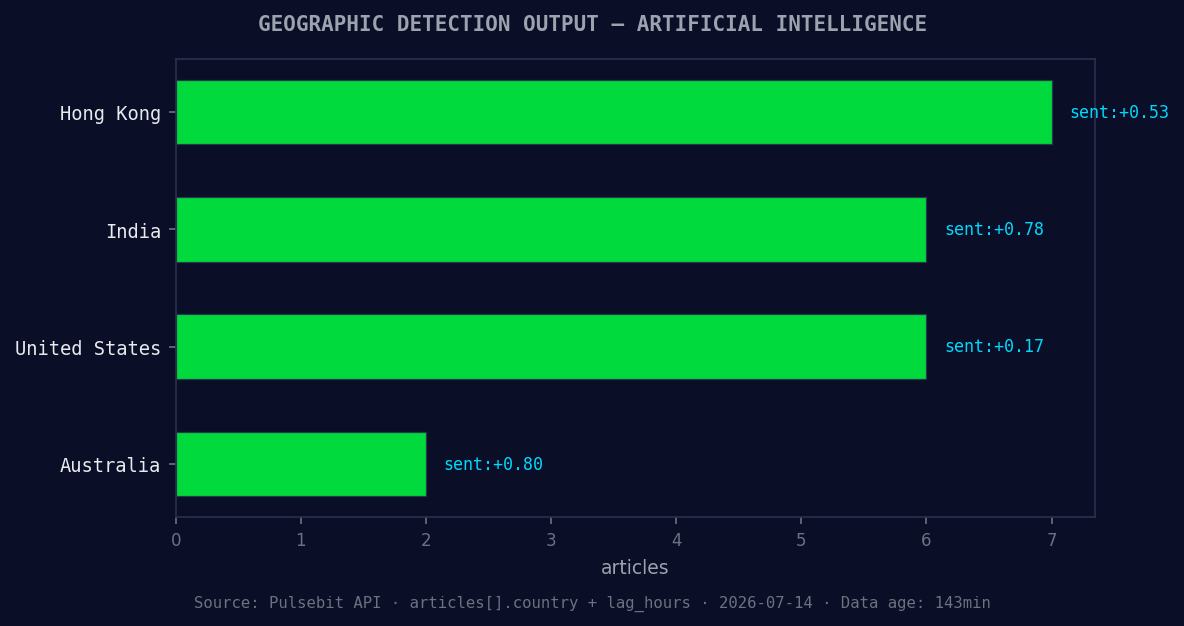
*Geographic detection output for artificial intelligence. Hong Kong leads with 7 articles and sentiment +0.53. Source: Pulsebit /news_recent geographic fields.*
data = response.json()
print(data)
# Meta-sentiment moment: Analyze the clustered reason
cluster_reason = "Clustered by shared themes: india, should, product, industry, experts."
meta_response = requests.post(
'https://api.pulsebit.com/sentiment',
json={
'text': cluster_reason
}
)
meta_data = meta_response.json()
print(meta_data)
In this code snippet, we first perform a GET request to our API with the specified topic and language filter. This ensures we only process sentiment data relevant to English-language articles. Then, we use the POST method to analyze the narrative framing of the cluster reason itself. By doing this, we can assess how the themes of "india," "should," "product," "industry," and "experts" are resonating in the context of artificial intelligence.
Now, let's consider three specific builds we can implement based on this pattern.
Signal Detection with Geo Filter: Create a real-time alert system that notifies you when the sentiment score for "artificial intelligence" crosses a threshold of +0.4 in English articles. This way, you’ll be immediately aware of any positive shifts.
Meta-Sentiment Analysis: Develop a function that automatically runs the cluster reason through our API whenever you detect a significant sentiment change (e.g., momentum below -1.0). This will help you understand the narrative framing around emerging trends.
Forming Themes Tracker: Build a dashboard that visualizes sentiment trends for forming themes. For example, track the sentiment scores for "artificial," "intelligence," and "new" against mainstream topics like "india," "should," and "product." This will help you identify potential opportunities before they become mainstream.
If you’re eager to harness this data, head over to our documentation at pulsebit.lojenterprise.com/docs. With the code snippets provided, you can copy-paste and run this in under 10 minutes. Don’t let your pipeline lag behind — seize the momentum!


Top comments (0)