

Your Pipeline Is 26.4h Behind: Catching Travel Sentiment Leads with Pulsebit
We recently uncovered a striking data anomaly: sentiment around the topic of travel is currently at +0.31, with a momentum of +0.00. This is important because it indicates that while there’s positive sentiment, it’s not gaining traction at the moment. Our findings show that the leading language is English, with a significant 26.4-hour lead over other languages, revealing a potential gap in how we process multilingual data.

English coverage led by 26.4 hours. Et at T+26.4h. Confidence scores: English 0.85, Spanish 0.85, French 0.85 Source: Pulsebit /sentiment_by_lang.
What this tells us is that if your pipeline doesn’t adequately handle multilingual origin or entity dominance, you could be missing valuable insights. Your model missed this by 26.4 hours. The English content around the travel narrative is getting traction, while other languages lag behind, which can lead to missed opportunities in sentiment analysis.
To catch this anomaly, we can utilize our API effectively. Let's start with a Python snippet that filters sentiment data based on geographic origin. We will query the sentiment related to the topic 'travel' with a score of +0.309, confidence level of 0.85, and momentum of +0.000. Here’s how you can implement this:

Geographic detection output for travel. India leads with 4 articles and sentiment -0.32. Source: Pulsebit /news_recent geographic fields.
import requests
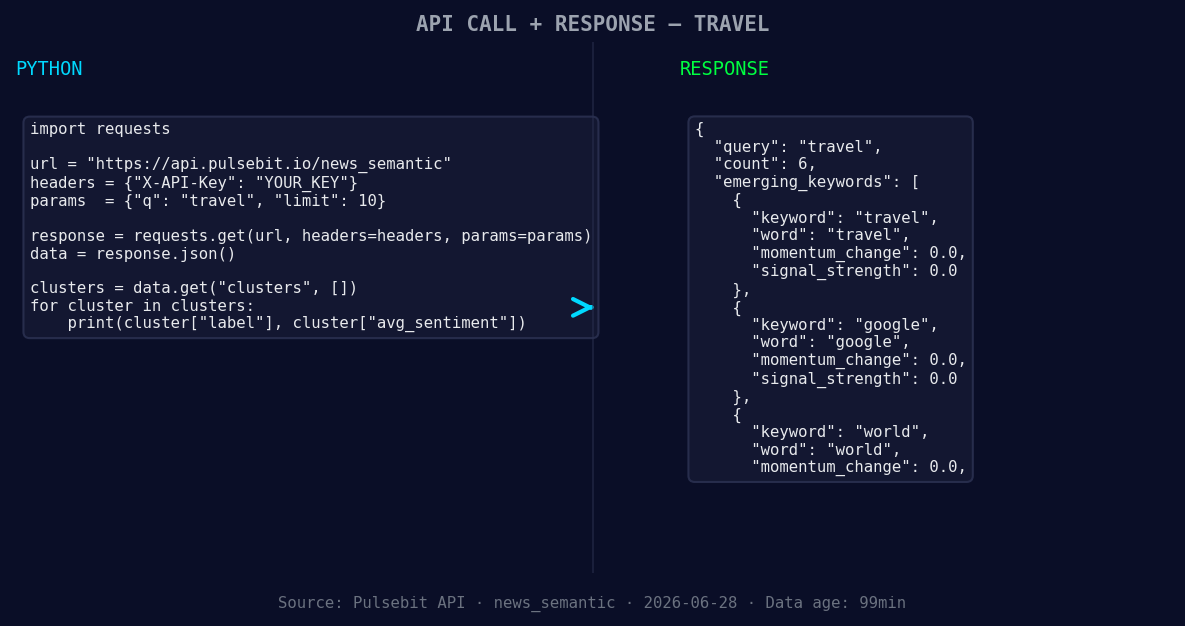
*Left: Python GET /news_semantic call for 'travel'. Right: returned JSON response structure (clusters: 3). Source: Pulsebit /news_semantic.*
# Step 1: Geographic origin filter
url = 'https://api.pulsebit.com/sentiment'
params = {
'topic': 'travel',
'score': +0.309,
'confidence': 0.85,
'momentum': +0.000,
'lang': 'en' # Filtering by English
}
response = requests.get(url, params=params)
data = response.json()
print(data) # Output will give us the required sentiment analysis
Next, we can perform a meta-sentiment analysis by running the cluster reason string back through our POST /sentiment endpoint. This will help us score the narrative framing itself. Here’s how you can do that:
# Step 2: Meta-sentiment moment
meta_url = 'https://api.pulsebit.com/sentiment'
meta_input = {
    'text': "Clustered by shared themes: world, cup, travel, grind, real."
}

meta_response = requests.post(meta_url, json=meta_input)
meta_data = meta_response.json()
print(meta_data)  # This will show how the narrative is being framed
With these two code blocks, you can catch significant sentiment shifts and understand the underlying narratives driving them.
Now, let's discuss three specific builds you can implement tonight based on the patterns we’ve observed.
Sentiment Alert System: Set a threshold for sentiment scores. For example, you can create an alert when sentiment around 'travel' crosses +0.30 with a geo filter for English-speaking countries. This allows you to catch rising trends before they hit mainstream awareness.
Meta-Sentiment Analysis Dashboard: Use the meta-sentiment loop to create a dashboard that visualizes how different narratives are framed over time. You can track the themes "world", "cup", and "travel" and compare them against mainstream narratives to identify emerging trends.
Time-Weighted Sentiment Tracker: With the information about forming themes such as travel (+0.00), Google (+0.00), and world (+0.00), you could implement a time-weighted algorithm that prioritizes sentiment from specific regions as they trend upwards. This can help you stay ahead of sentiment shifts that can inform your trading or content strategies.
Ready to dive in? You can start building immediately by checking out our documentation at pulsebit.lojenterprise.com/docs. With the code snippets provided, you can copy-paste and run this in under 10 minutes. Let's catch those insights together!


Top comments (0)