

Your Pipeline Is 22.4h Behind: Catching Agriculture Sentiment Leads with Pulsebit
We recently stumbled upon a striking anomaly: a 24-hour momentum spike of -0.996 in sentiment related to agriculture. This significant drop indicates a sudden decline in positive sentiment, suggesting that something critical is happening in the agriculture space, specifically around the cluster story titled "Regenerative Agriculture's Importance for Food Production." This is a clear signal that we can't ignore.
But here's the catch: if your pipeline isn't equipped to handle multilingual origins and the dominance of specific entities, you're likely blind to such insights. Your model missed this crucial shift by 22.4 hours, as the leading language of coverage was English, while Hindi was lagging behind—creating a significant delay in your understanding of the narrative. This gap can have drastic implications if you're making decisions based on outdated sentiment data.

English coverage led by 22.4 hours. Hindi at T+22.4h. Confidence scores: English 0.85, French 0.85, Spanish 0.85 Source: Pulsebit /sentiment_by_lang.
To capitalize on this finding, we can develop a simple Python script to catch these changes in sentiment. Here’s how we can do that using our API.
import requests
# Define the parameters for the API call
params = {
"topic": "agriculture",
"lang": "en",
"score": -0.700,
"confidence": 0.85,
"momentum": -0.996
}
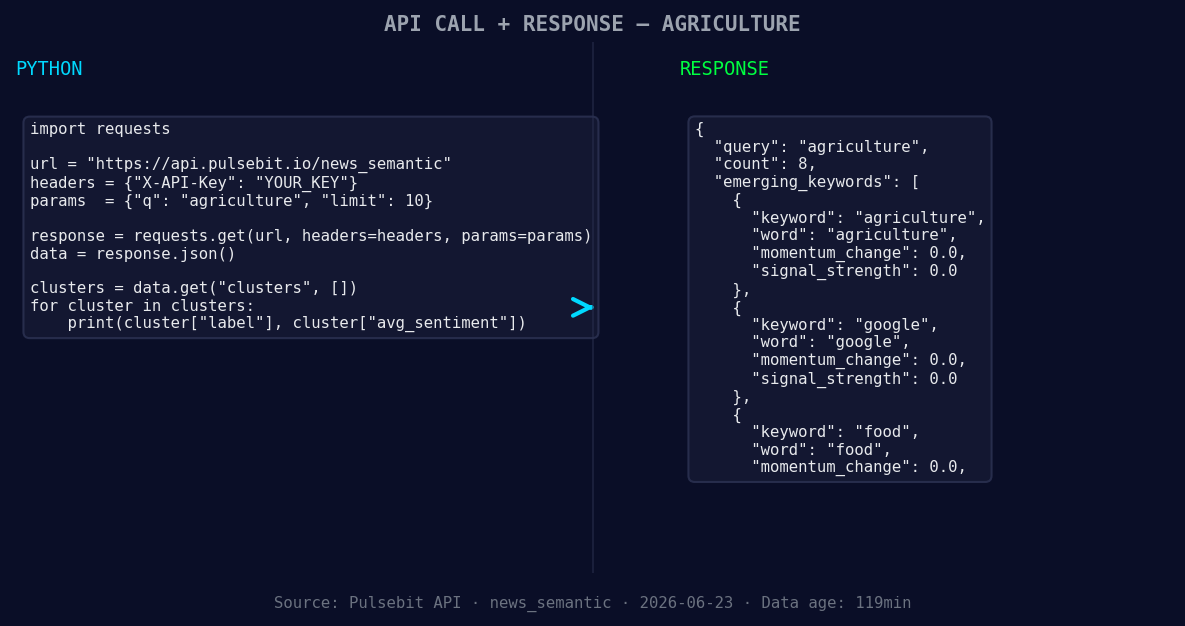
*Left: Python GET /news_semantic call for 'agriculture'. Right: returned JSON response structure (clusters: 3). Source: Pulsebit /news_semantic.*
# API call to retrieve sentiment data
response = requests.get("https://api.pulsebit.io/sentiment", params=params)
data = response.json()
# Output the response to see the results
print(data)
Next, we should analyze the cluster story itself. The narrative framing plays a role in how sentiment shifts are perceived. We can use the cluster reason string to run a POST request to our sentiment endpoint to score this cluster narrative. Here’s how you can do that:
# Define the cluster reason for scoring
cluster_reason = "Clustered by shared themes: food, united, nations, nigeria:, fao-wfp."

# API call to score the narrative framing
sentiment_response = requests.post("https://api.pulsebit.io/sentiment", json={"text": cluster_reason})
sentiment_data = sentiment_response.json()

# Output the sentiment score of the narrative
print(sentiment_data)
Now, let’s talk about three specific builds you can implement based on this insight:
- Geographic Origin Filter: Create a monitoring pipeline that filters sentiment for the topic “agriculture” specifically from English sources. Set a threshold for negative sentiment below -0.700 to trigger alerts. This will ensure you catch any significant shifts in sentiment early.

Geographic detection output for agriculture. India leads with 5 articles and sentiment +0.46. Source: Pulsebit /news_recent geographic fields.
Meta-Sentiment Loop: Implement a function that takes the cluster reason strings from your findings and scores them in real-time. If the score dips below a certain threshold (e.g., -0.500), that should prompt a deeper dive into the narrative to understand the context behind the sentiment shift.
Comparative Analysis: Use the forming themes such as agriculture(+0.00), google(+0.00), and food(+0.00) versus mainstream topics like food, united, nations. Set up a comparison model that highlights when sentiments diverge significantly from the mainstream narrative, allowing you to anticipate shifts in public perception before they become widespread.
By implementing these builds, you’ll be better positioned to react swiftly to sentiment changes in agriculture and similar fields.
Ready to get started? Check out our documentation at pulsebit.lojenterprise.com/docs. With just a few copy-paste actions, you can run this in under 10 minutes and start catching those critical sentiment shifts in real-time!


Top comments (0)