

Your Pipeline Is 24.1h Behind: Catching Mobile Sentiment Leads with Pulsebit
We just spotted something noteworthy: a sentiment score of -0.60 and a momentum of +0.00 surrounding the topic of "mobile" over the last 24.1 hours. This leads to an interesting anomaly where sentiment is trending negative, yet the momentum shows no movement. With only one article discussing the restoration of stolen mobile phones in this timeframe, we can see a gap in how we capture sentiment around emerging narratives.
Now, let’s address the problem at hand. If your pipeline isn’t built to handle multilingual origins or entity dominance, you’re missing out. Your model missed this shift by 24.1 hours. The leading language in this case is English, and without accounting for the nuances of this sentiment, especially around the theme of stolen mobile devices, you risk losing valuable insights that could inform your strategies.

English coverage led by 24.1 hours. Da at T+24.1h. Confidence scores: English 0.95, Spanish 0.95, Tl 0.95 Source: Pulsebit /sentiment_by_lang.
To catch this anomaly, we can leverage our API effectively. Here’s some Python code to illustrate how we can do this:
import requests
# Define the parameters for the sentiment analysis
topic = 'mobile'
sentiment_score = -0.600
confidence = 0.95
momentum = +0.000
# Geographic origin filter: query by language/country
response = requests.post('https://api.pulsebit.io/sentiment', json={
"topic": topic,
"lang": "en",
"score": sentiment_score,
"confidence": confidence,
"momentum": momentum
})
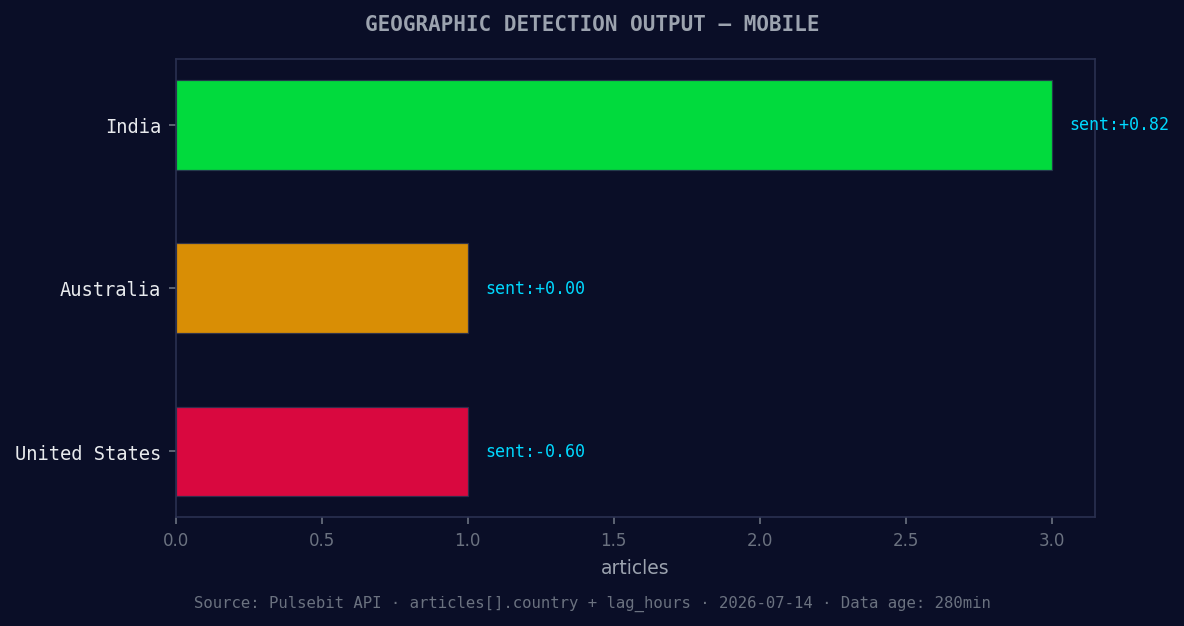
*Geographic detection output for mobile. India leads with 3 articles and sentiment +0.82. Source: Pulsebit /news_recent geographic fields.*
# Check the response
if response.ok:
print("Sentiment Data Retrieved:", response.json())
else:
print("Error:", response.status_code, response.text)
# Meta-sentiment moment: run the cluster reason string back through POST /sentiment
cluster_reason = "Clustered by shared themes: 518, stolen, missing, mobile, phones."
meta_response = requests.post('https://api.pulsebit.io/sentiment', json={
"text": cluster_reason
})
# Check the meta response
if meta_response.ok:
print("Meta Sentiment Score:", meta_response.json())
else:
print("Error:", meta_response.status_code, meta_response.text)
This code snippet first fetches sentiment data for mobile using a language filter for English. It then runs the cluster reason string through our sentiment endpoint to score the narrative framing itself. By doing this, we can not only identify the sentiment about mobile phones but also assess how narratives around stolen devices are being framed.
Now, let’s explore three specific builds you can implement tonight based on this pattern:
- Geo-Filtered Sentiment Alerts: Set a threshold for sentiment scores below -0.5 within English-speaking regions. This allows you to catch negative sentiment spikes regarding mobile devices before they gain traction. Use the geo filter in your API calls to ensure you’re only monitoring relevant regions.

Left: Python GET /news_semantic call for 'mobile'. Right: returned JSON response structure (clusters: 3). Source: Pulsebit /news_semantic.
Meta-Sentiment Monitoring: Run a scheduled task that sends cluster reason strings through our meta-sentiment endpoint every hour. You can use the same string we tested: "Clustered by shared themes: 518, stolen, missing, mobile, phones." This will help you gauge how narratives change and evolve in real-time.
Forming Theme Analysis: Build a dashboard that visualizes forming themes, such as "mobile(+0.00)", "google(+0.00)", and "home(+0.00)" against mainstream themes like "stolen, missing, mobile." This comparative analysis will help you identify emerging trends that could affect user sentiment and behavior.
To get started, visit pulsebit.lojenterprise.com/docs. You can copy-paste and run this code in under 10 minutes, making it easy to integrate powerful sentiment analysis into your applications. Let’s not let our pipelines lag behind.


Top comments (0)