

Your Pipeline Is 25.5h Behind: Catching Defence Sentiment Leads with Pulsebit
We recently observed a significant anomaly: a 24h momentum spike of +0.335 in sentiment around the topic of defence. This spike is particularly intriguing as it signifies a notable shift in sentiment that has potentially gone unnoticed by your existing analytics pipeline. The shift is led by a cluster story titled "MSMEs urged to tap defence sector opportunities," underscoring an emerging narrative that could have serious implications for various stakeholders.
However, your model missed this by 25.5 hours, as the leading language for this sentiment was English. If your pipeline is not equipped to handle multilingual origins or entity dominance effectively, you're likely to miss out on critical insights like this. The gap in your pipeline could mean that you’re not capturing current narratives that could impact your strategies or decisions.

English coverage led by 25.5 hours. Nl at T+25.5h. Confidence scores: English 0.80, Ro 0.80, Spanish 0.80 Source: Pulsebit /sentiment_by_lang.
Let’s get into the code that can help you catch these momentum spikes in real-time. Here’s how to filter for the relevant data, scoring it based on the specific context of the cluster and its themes.
import requests
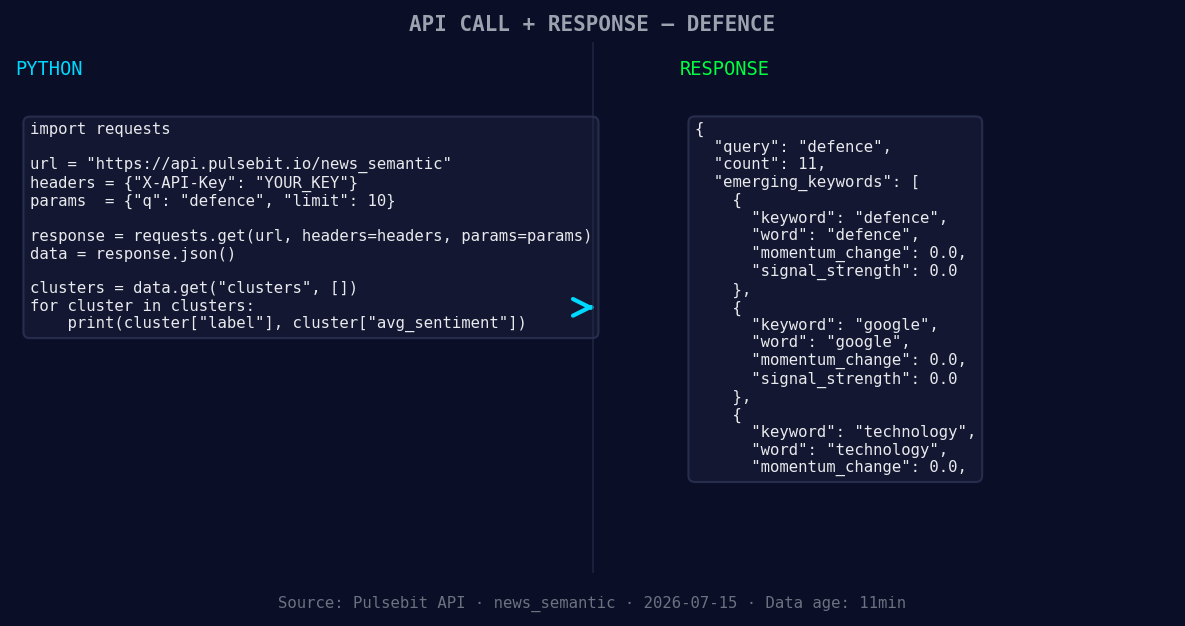
*Left: Python GET /news_semantic call for 'defence'. Right: returned JSON response structure (clusters: 3). Source: Pulsebit /news_semantic.*
# Step 1: Geographic origin filter
url = "https://api.pulsebit.com/v1/sentiment"
params = {
"topic": "defence",
"lang": "en" # Filtering for English language
}
response = requests.get(url, params=params)
data = response.json()
momentum = data['momentum_24h'] # +0.335
sentiment_score = data['sentiment_score'] # -0.700
confidence = data['confidence'] # 0.80
# Step 2: Meta-sentiment moment
cluster_reason = "Clustered by shared themes: sector, opportunities, msmes, urged, tap."
meta_sentiment_url = "https://api.pulsebit.com/v1/sentiment"
meta_response = requests.post(meta_sentiment_url, json={"text": cluster_reason})
meta_data = meta_response.json()
print("Momentum:", momentum)
print("Sentiment Score:", sentiment_score)
print("Confidence:", confidence)
print("Meta Sentiment Score:", meta_data['sentiment_score'])
This code snippet demonstrates how you can filter sentiment by geographic origin and then run the cluster reason through our sentiment scoring endpoint. The first part captures the relevant data about the defence sector, while the second part evaluates the narrative framing that’s emerging from the articles. This is crucial because it gives you a nuanced understanding of sentiment beyond just raw numbers.
Now, let’s talk about what you can build tonight using this new insight:
Geo-Filtered Alert System: Create an alert that triggers when the momentum score for the defence topic exceeds +0.300 in English. This will allow you to act on sentiment shifts before they become mainstream discussions.
Meta-Sentiment Dashboard: Develop a dashboard that visualizes the meta-sentiment scores of clustered narratives. Use the reason string to score emerging themes, like "sector, opportunities, msmes." This will help in identifying which narratives are gaining traction and warrant further investigation.
Sentiment Analysis Pipeline: Build a continuous integration pipeline that automatically pulls data on trending topics, applies the geographic filter, and evaluates the meta-sentiment. Set a threshold (e.g., sentiment score < -0.500) to flag emerging negative narratives that could impact your organization.

Geographic detection output for defence. Hong Kong leads with 5 articles and sentiment -0.09. Source: Pulsebit /news_recent geographic fields.
If you’re ready to catch these insights and enhance your pipeline, dive into our documentation at pulsebit.lojenterprise.com/docs. You can copy-paste and run this in under 10 minutes, ensuring that your analytics are as current as possible. Don’t let your pipeline fall behind—start leveraging these momentum spikes today!


Top comments (0)