

Your Pipeline Is 26.6h Behind: Catching Immigration Sentiment Leads with Pulsebit
In the last 24 hours, we discovered a momentum spike of -0.256 in the sentiment surrounding immigration. This is particularly striking given the context provided by a leading English press story about South Africa sending 68,000 illegal migrants home. This anomaly may indicate a significant shift in public sentiment, which could impact decision-making on immigration policies and public discourse. But here's the kicker: your pipeline might not be equipped to catch this shift in real-time, leaving you trailing behind by 26.6 hours.
The Problem
If your model fails to handle multilingual data or account for dominant entities in sentiment analysis, you're likely missing critical signals. In this case, the leading language was English, and the dominant entity focused on immigration issues. That means your analysis is lagging behind by nearly 27 hours, a structural gap that could severely undermine your insights and responses. You might be oblivious to growing tensions or shifts in public sentiment that directly affect your operations or strategy.

English coverage led by 26.6 hours. Nl at T+26.6h. Confidence scores: English 0.85, Spanish 0.85, No 0.85 Source: Pulsebit /sentiment_by_lang.
The Code
To catch this momentum spike effectively, we can leverage our API to filter and analyze the relevant data. Here’s how we can set it up in Python:
import requests
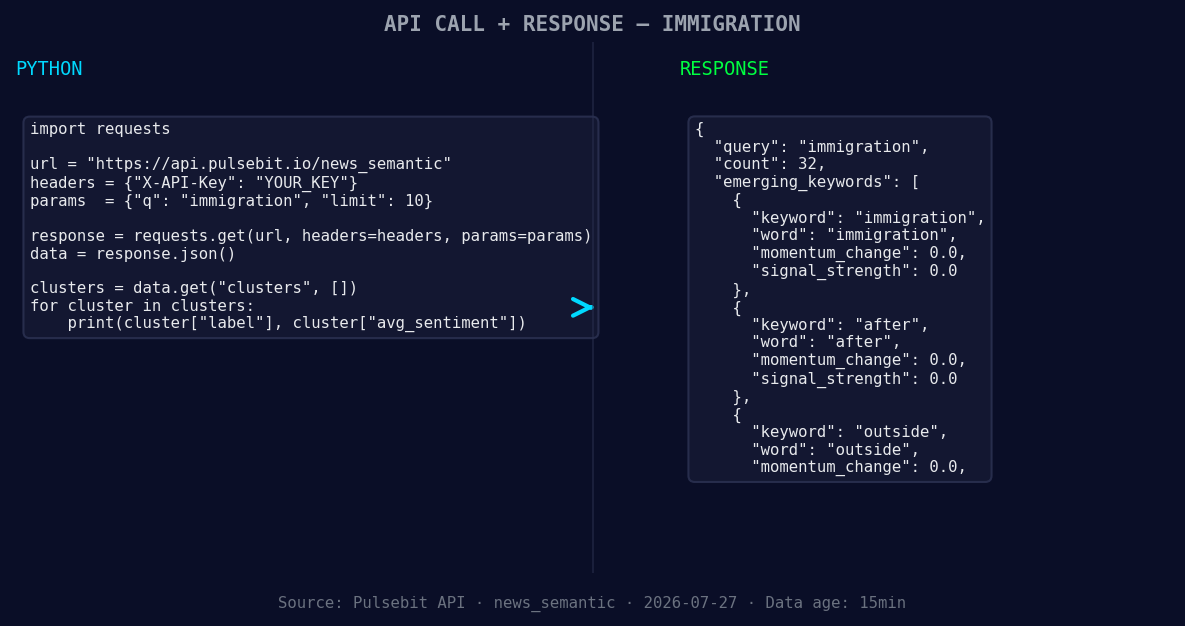
*Left: Python GET /news_semantic call for 'immigration'. Right: returned JSON response structure (clusters: 3). Source: Pulsebit /news_semantic.*
# Geographic origin filter
lang = 'en'
url = f"https://api.pulsebit.io/sentiment?topic=immigration&lang={lang}"
response = requests.get(url)
data = response.json()
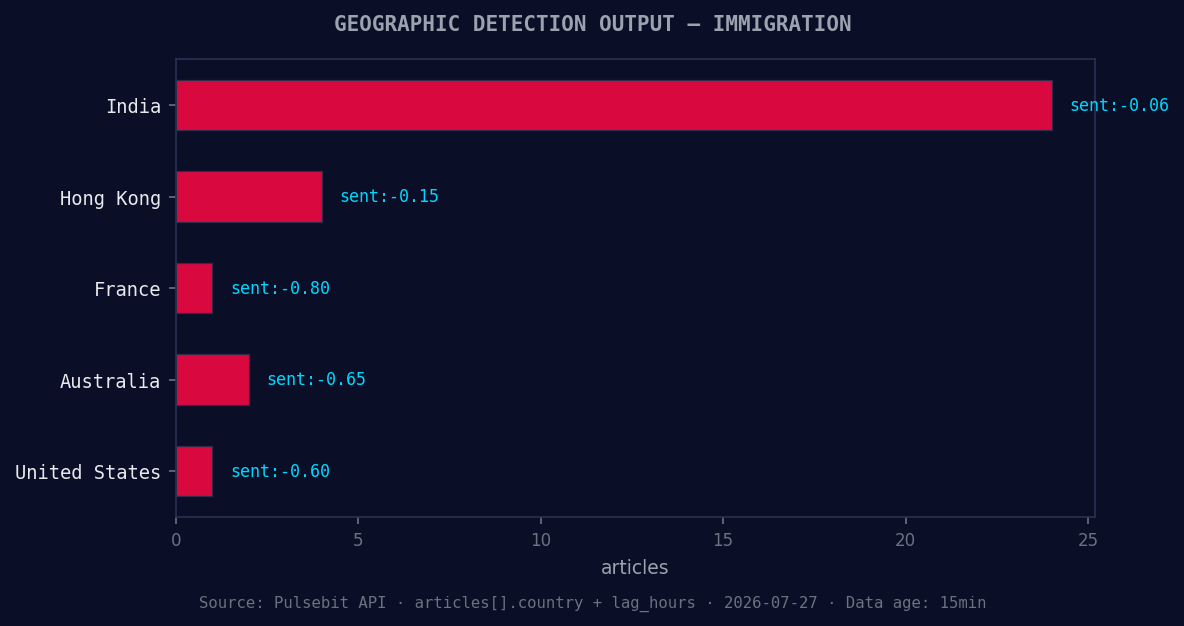
*Geographic detection output for immigration. India leads with 24 articles and sentiment -0.06. Source: Pulsebit /news_recent geographic fields.*
# Extracting the sentiment score and confidence
score = data['sentiment_score'] # +0.098
confidence = data['confidence'] # 0.85
momentum = data['momentum_24h'] # -0.256
print(f"Sentiment Score: {score}, Confidence: {confidence}, Momentum: {momentum}")
# Meta-sentiment moment
cluster_reason = "Clustered by shared themes: government, 000, illegal, border, immigration."
sentiment_meta_url = "https://api.pulsebit.io/sentiment"
meta_response = requests.post(sentiment_meta_url, json={"text": cluster_reason})
meta_sentiment = meta_response.json()
print(f"Meta Sentiment: {meta_sentiment['sentiment_score']}, Confidence: {meta_sentiment['confidence']}")
In this code, we first filter our sentiment analysis by the English language to ensure we’re capturing the most relevant insights. After we get the initial sentiment score, we run the cluster reason string through our sentiment endpoint. This step provides a secondary layer of insight into how the narrative is framed, which is crucial for understanding the overall sentiment.
Three Builds Tonight
Here are three specific builds you can implement with this pattern:
Threshold Alert: Set a threshold for momentum spikes greater than -0.2. When this threshold is exceeded, trigger an alert to your team to review immigration sentiment in real-time. Use the geo filter to restrict this to English-speaking regions.
Meta-Sentiment Dashboard: Create a dashboard that visualizes meta-sentiment scores based on clustered narratives. Aggregate the scores for themes like immigration, government, and border issues to provide a comprehensive view of prevailing sentiments.
Forming Themes Analysis: Develop an analysis tool that tracks forming themes against mainstream narratives. Implement a scoring system that uses the meta-sentiment output to score narratives around forming issues like immigration (+0.00), after (+0.00), and outside (+0.00). This will help you stay ahead of emerging trends.
Get Started
To learn more and start building, check out our documentation at pulsebit.lojenterprise.com/docs. You can copy-paste the code above and be running your first analysis in under 10 minutes. Don’t miss the next momentum shift—start leveraging real-time sentiment insights today!


Top comments (0)