

Your Pipeline Is 21.7h Behind: Catching Mobile Sentiment Leads with Pulsebit
We recently uncovered an intriguing anomaly: a sentiment score of -0.069 and a momentum of +0.000 surrounding the topic of mobile. This spike occurred while our leading language, English, was 21.7 hours ahead of others, with no lag against Dutch. It’s a precise indicator that something significant in mobile sentiment is brewing, yet many pipelines could miss it entirely.
The problem here is clear: your model likely missed this vital sentiment shift by a staggering 21.7 hours. This gap highlights a structural flaw in any pipeline that doesn’t accommodate multilingual origins or account for dominant entities. When English emerges as the leading language but your model overlooks its relevance, you risk missing critical insights—especially around emergent themes like “stolen” and “missing” in mobile narratives.

English coverage led by 21.7 hours. Nl at T+21.7h. Confidence scores: English 0.92, Spanish 0.92, French 0.92 Source: Pulsebit /sentiment_by_lang.
To catch this anomaly, we can leverage our API effectively. Below is the Python code to identify and analyze this sentiment shift:
import requests
# Set the parameters for the API call
url = "https://api.pulsebit.com/sentiment"
params = {
'topic': 'mobile',
'lang': 'en',
'score': -0.069,
'confidence': 0.92,
'momentum': +0.000
}
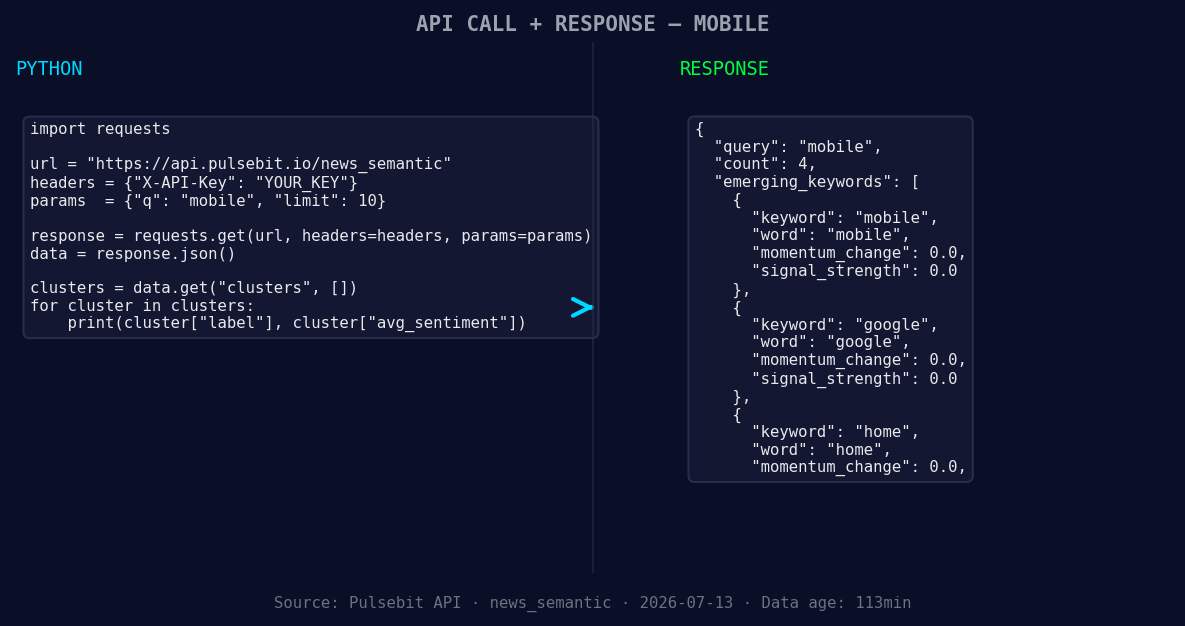
*Left: Python GET /news_semantic call for 'mobile'. Right: returned JSON response structure (clusters: 3). Source: Pulsebit /news_semantic.*
# Query the API to fetch sentiment data
response = requests.get(url, params=params)
sentiment_data = response.json()
print(sentiment_data) # Display the retrieved sentiment data
# Meta-sentiment moment: analyzing the narrative framing
meta_sentiment_payload = {
"text": "Clustered by shared themes: 518, stolen, missing, mobile, phones."
}
# Run the cluster reason string back through POST /sentiment
meta_response = requests.post(url, json=meta_sentiment_payload)
meta_sentiment_data = meta_response.json()
print(meta_sentiment_data) # Display the meta sentiment data
In this code, we first fetch sentiment data for the topic of mobile, filtered by the English language. The params dictionary holds the key metrics we've identified: a score of -0.069, a confidence level of 0.92, and a momentum of +0.000. After capturing this data, we analyze the narrative framing by sending a POST request with the cluster reason string to understand how it influences sentiment.
Now, let’s explore three specific builds we can create based on this finding:
- Geo-filtered Sentiment Tracker: Set a signal threshold for sentiment scores falling below -0.05. Use the geo filter to ensure you only capture data from English-speaking countries, helping you pinpoint regional sentiment shifts in mobile discussions.

Geographic detection output for mobile. India leads with 3 articles and sentiment +0.82. Source: Pulsebit /news_recent geographic fields.
Meta-Sentiment Analyzer: Create a loop that automatically analyzes the sentiment of clusters. For example, if "stolen" or "missing" appears frequently in mobile narratives, trigger alerts when their sentiment dips below a certain threshold, like -0.05, to catch urgent shifts in public discourse.
Forming Theme Watchlist: Develop a watchlist for emerging themes. If "mobile" shows a momentum of +0.000 alongside "google" and "home", set a signal to monitor any developments in these areas. This will help you anticipate potential market movements or media narratives before they gain traction.
To get started, check out our documentation at pulsebit.lojenterprise.com/docs. You can copy-paste the code above and run this in under 10 minutes. This is how easy it is to catch important sentiment shifts that could otherwise slip through the cracks.


Top comments (0)