

Your pipeline just missed a significant anomaly: a 24h momentum spike of +0.345 in the education sector. This spike indicates a notable shift in sentiment, particularly highlighted by the leading English language coverage from Kerala, which was ahead by 21.6 hours. This kind of signal can be pivotal in understanding emerging trends in legal education reform, led by the Kerala Chief Minister. If you aren't keeping an eye on these developments, you could be left in the dust, unaware of the narrative shaping up around education and legal reforms.
The gap here is glaring. If your model doesn't account for multilingual origins and entity dominance, it’s likely missing crucial insights like this one. Your pipeline may have been running on outdated sentiment data, missing this spike by a whopping 21.6 hours. That’s an eternity in a fast-paced environment where sentiment can shift dramatically, especially on topics like education, which are often intertwined with political narratives and public interest.

English coverage led by 21.6 hours. Et at T+21.6h. Confidence scores: English 0.90, Spanish 0.90, French 0.90 Source: Pulsebit /sentiment_by_lang.
Here’s how you can catch this sentiment shift using our API. First, let’s filter for English language articles on education to identify relevant content:
import requests
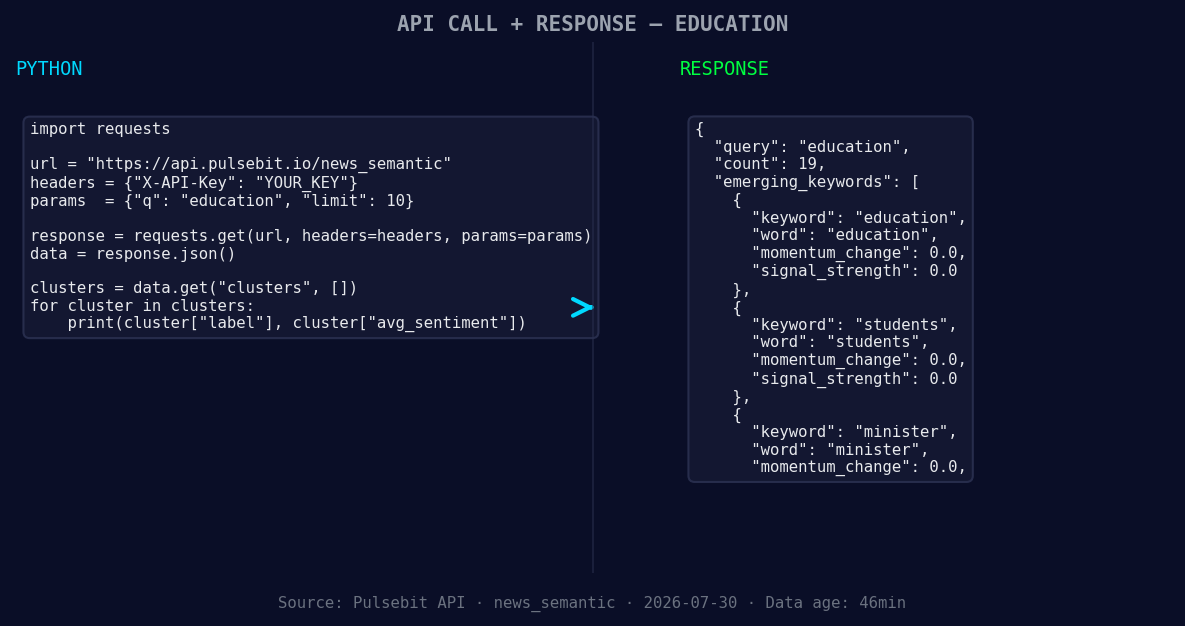
*Left: Python GET /news_semantic call for 'education'. Right: returned JSON response structure (clusters: 3). Source: Pulsebit /news_semantic.*
url = "https://api.pulsebit.com/v1/sentiment"
params = {
"topic": "education",
"lang": "en",
"score": -0.090,
"confidence": 0.90,
"momentum": +0.345
}
response = requests.get(url, params=params)
data = response.json()
Next, we’ll run a sentiment analysis on the cluster reason string to understand the narrative framing better. Here’s how that looks:
narrative = "Clustered by shared themes: legal, education, kerala, chief, minister."
sentiment_response = requests.post(url, json={"text": narrative})
sentiment_data = sentiment_response.json()
This dual approach allows us to not only capture the immediate spike in sentiment but also to analyze the underlying themes driving that sentiment. It’s a powerful combination that can reveal the nuances necessary for informed decision-making.
Now, here are three specific things we can build using this data pattern:
Real-time Alerts for Education Sentiment: Set a threshold for momentum spikes above +0.3 in the education sector. Use the geo filter to monitor English articles from Kerala. If you hit that threshold, trigger an alert or notification to your team.
Narrative Framing Analysis: Utilize the meta-sentiment loop on the cluster reason string. Create a dashboard that visualizes sentiment trends over time, specifically focusing on the themes of education, students, and political figures like the minister. This can be invaluable for understanding how these narratives evolve.
Comparative Analysis Tool: Build a tool that compares the current sentiment scores against historical baselines for the education sector, particularly in relation to legal reform. This could be done by querying past sentiment data and visualizing it alongside current spikes.
By focusing on these actionable insights, you can not only catch up with the emerging trends but also stay ahead in understanding the evolving landscape of education sentiment.
Ready to dive deeper? Visit pulsebit.lojenterprise.com/docs. You can copy-paste and run this in under 10 minutes. Happy coding!

Geographic detection output for education. India leads with 16 articles and sentiment +0.22. Source: Pulsebit /news_recent geographic fields.


Top comments (0)