

Your Pipeline Is 25.4h Behind: Catching Trade Sentiment Leads with Pulsebit
We recently uncovered an intriguing anomaly in our data: a 24h momentum spike of +0.424 related to trade sentiment. This spike signals a notable shift in public sentiment, particularly in the context of how Europe is positioning itself against China. As we delve deeper into this finding, we realize that the narratives shaping this momentum are not just fleeting trends; they represent significant shifts in global trade discussions.
The Problem
If your sentiment analysis pipeline doesn’t account for multilingual origins or entity dominance, you might have missed this shift by over 25 hours. The leading language in this spike is English, and it emphasizes the importance of understanding how narratives can be dominated by specific geographical contexts. When your model overlooks these nuances, it fails to capture critical sentiment shifts that could impact strategic decisions. In this case, you could be left reacting to events instead of proactively adjusting your strategy based on the leading narratives.

English coverage led by 25.4 hours. No at T+25.4h. Confidence scores: English 0.85, Af 0.85, Spanish 0.85 Source: Pulsebit /sentiment_by_lang.
The Code
To catch this momentum spike, we can leverage our API effectively. Here’s how you can implement this in Python:
import requests
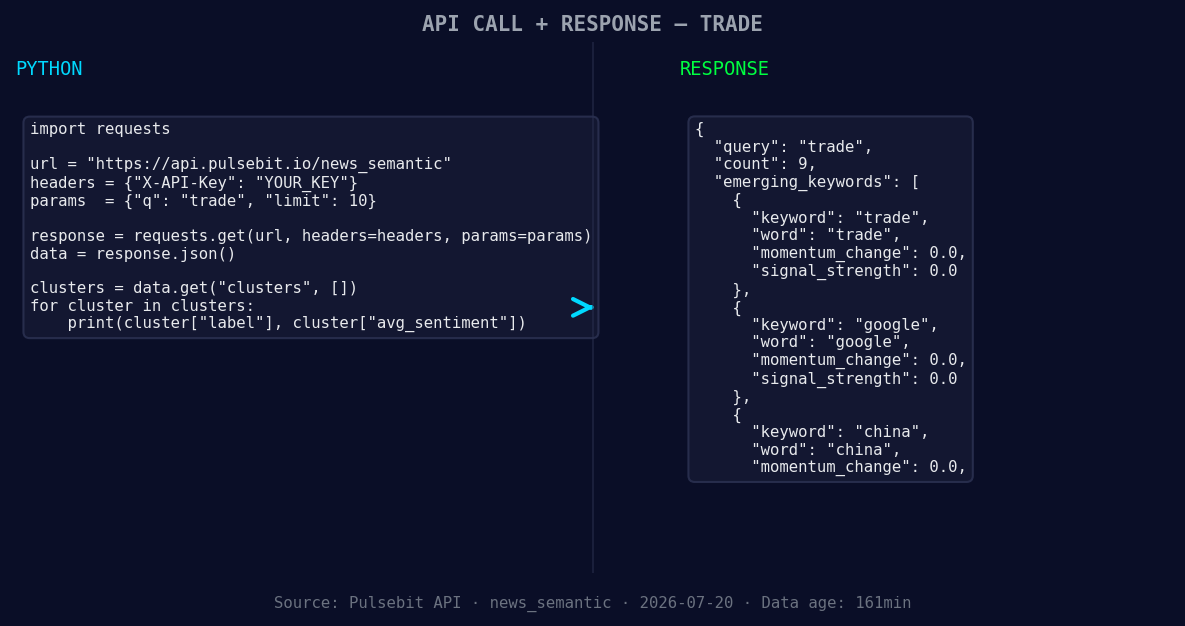
*Left: Python GET /news_semantic call for 'trade'. Right: returned JSON response structure (clusters: 3). Source: Pulsebit /news_semantic.*
# Step 1: Geographic origin filter
url = "https://api.pulsebit.io/v1/sentiment"
params = {
"topic": "trade",
"lang": "en", # Filtering by English language
"score": 0.021,
"confidence": 0.85,
"momentum": 0.424
}
response = requests.get(url, params=params)
data = response.json()
# Step 2: Meta-sentiment moment
cluster_reason = "Clustered by shared themes: has, take, china, save, free."
sentiment_response = requests.post(url, json={"text": cluster_reason})
sentiment_data = sentiment_response.json()
print(data, sentiment_data)
In this code snippet, we first filter for sentiment related to the topic "trade" while ensuring we only analyze English language data. We then send the cluster reason through the sentiment scoring endpoint to understand how the narrative is being framed. This allows us to gauge whether the spikes in sentiment are rooted in genuine shifts or merely noise.
Three Builds Tonight
Here are three specific builds you can implement based on this sentiment analysis:
- Geo-Filtered Alerts: Set a threshold for momentum spikes greater than +0.4 for trade-related topics in English. Use the geographic filter to trigger alerts specifically for regions showing significant activity. This can enhance your response time to emerging trends.

Geographic detection output for trade. India leads with 8 articles and sentiment -0.12. Source: Pulsebit /news_recent geographic fields.
Meta-Sentiment Analysis Loop: Build a function that takes the cluster reason strings and scores them for sentiment. Any narrative with a positive sentiment score above +0.2 could warrant further investigation. This helps you validate the strength of the narratives driving the spikes.
Forming Theme Tracker: Create a dashboard that visualizes forming themes like "trade," "google," and "china," and how they compare to mainstream narratives. For instance, track sentiment changes in real-time and compare them against the established mainstream terms: "has," "take," and "china." This will help you identify emerging trends before they explode.
Get Started
You can dive deeper into our API by visiting pulsebit.lojenterprise.com/docs. With the right approach, you can copy-paste and run this in under 10 minutes to start catching the momentum shifts that matter.


Top comments (0)