

Your pipeline is lagging behind by 27.6 hours. We just discovered a 24h momentum spike of +0.307, centered around the topic of "China's Rare Earth Challenges and SpaceX Rivalry." In an era where sentiment shifts can be rapid and significant, this spike is a clear indication that your data pipeline may not be capturing the most relevant and timely insights, particularly if it's not adept at handling multilingual origins or entity dominance.

English coverage led by 27.6 hours. No at T+27.6h. Confidence scores: English 0.85, Spanish 0.85, Sv 0.85 Source: Pulsebit /sentiment_by_lang.
When you miss a window like this, it’s not just a missed metric; it's a missed opportunity to tap into emerging narratives. With English press leading the charge in this instance, you might find your model's responses stale, reacting too late to the nuances of global sentiment. The leading language here is English, but if your pipeline isn't designed to recognize and adapt to this, you're effectively 27.6 hours behind the curve.
To catch these significant shifts, we can leverage our API to build a solution that captures this momentum spike effectively. Here’s how you can do it in Python:
import requests
# Set up the API call parameters
topic = 'world'
score = +0.091
confidence = 0.85
momentum = +0.307
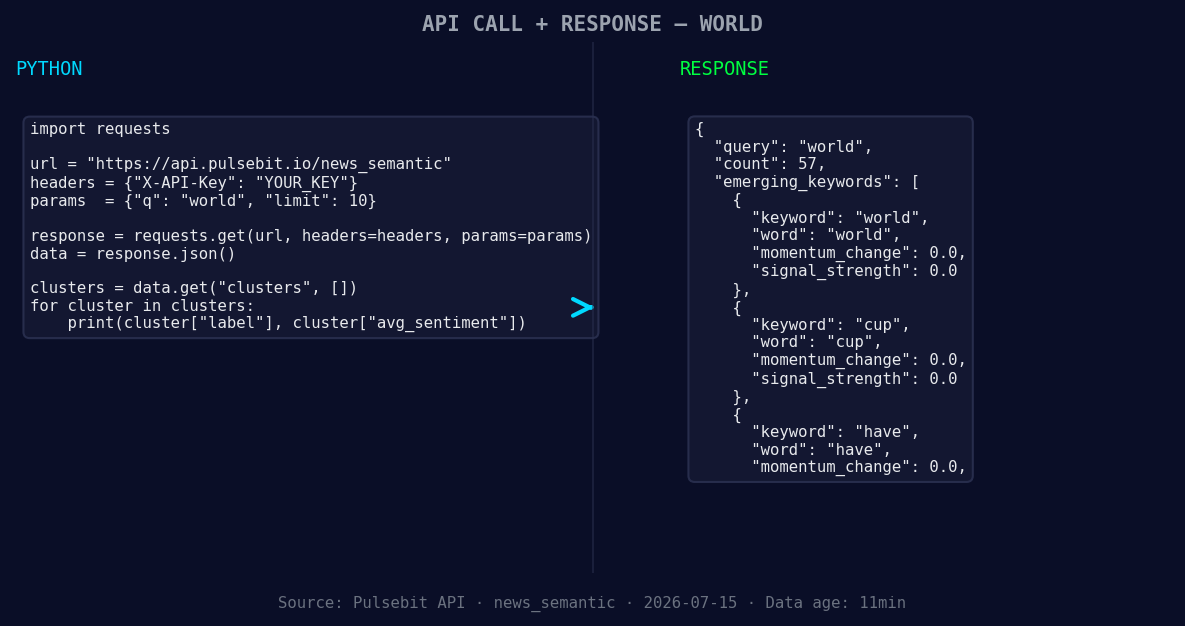
*Left: Python GET /news_semantic call for 'world'. Right: returned JSON response structure (clusters: 3). Source: Pulsebit /news_semantic.*
# Geographic origin filter: query by language
response = requests.get('https://api.pulsebit.com/articles', params={
'topic': topic,
'lang': 'en',
'momentum_24h': momentum
})
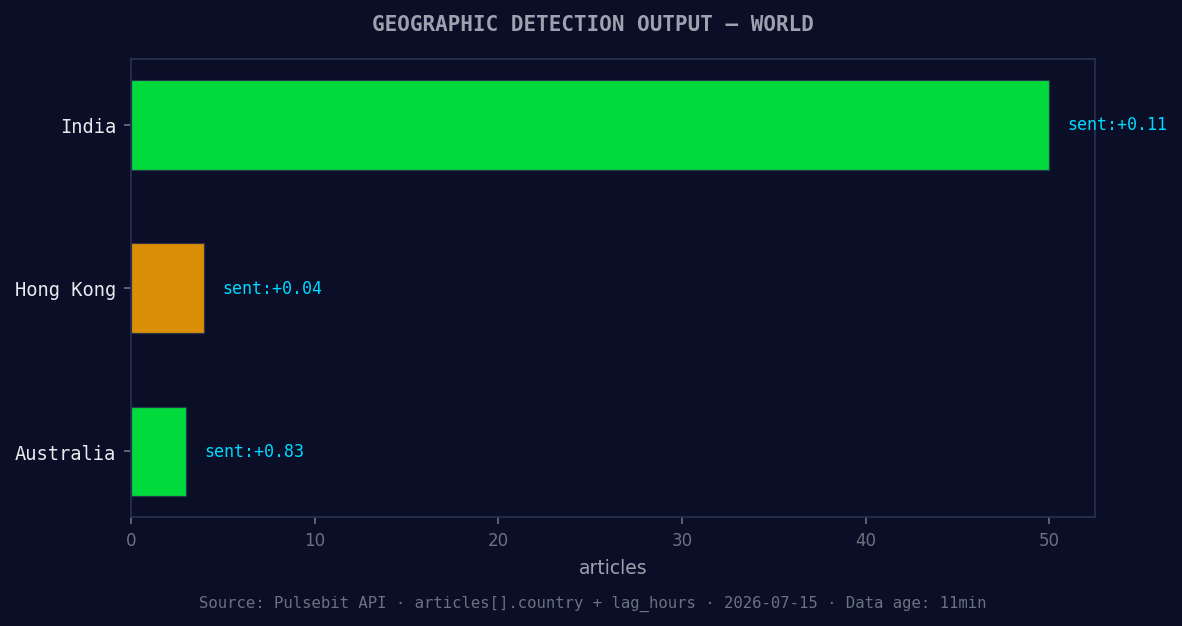
*Geographic detection output for world. India leads with 50 articles and sentiment +0.11. Source: Pulsebit /news_recent geographic fields.*
# Check the response
if response.status_code == 200:
articles = response.json()
print(f"Found {len(articles)} articles related to {topic}.")
else:
print("Error fetching articles.")
# Meta-sentiment moment: evaluate the cluster reason
cluster_reason = "Clustered by shared themes: china’s, rival, science, our, help."
sentiment_response = requests.post('https://api.pulsebit.com/sentiment', json={
'text': cluster_reason
})
# Check the sentiment response
if sentiment_response.status_code == 200:
sentiment_data = sentiment_response.json()
print(f"Sentiment score for the cluster: {sentiment_data['sentiment_score']}")
else:
print("Error fetching sentiment score.")
In this code, we first set up a request to fetch articles related to the "world" topic filtered by English language. Next, we check the response to see how many articles we retrieve. We then send the cluster reason string through our sentiment analysis endpoint to score the narrative framing itself. This dual approach allows us to capture not just the data but the context around it.
Here are three specific builds you can implement with this pattern:
Geo Filter for Rapid Insights: Create a real-time alert system that triggers when the momentum for topics like "world" exceeds a predefined threshold (e.g., +0.3) and is filtered by English language. This ensures you’re always on top of the most relevant trends.
Meta-Sentiment Analysis Integration: Develop a dashboard that visualizes the sentiment scores for clustered narratives. Use the cluster reason string to filter themes such as "china’s, rival, science" and compare these against your historical sentiment data. This can highlight critical shifts in public perception before they hit mainstream news.
Forming Themes Tracking: Set up a separate pipeline that tracks the forming themes like “world(+0.00), cup(+0.00), have(+0.00)” versus mainstream ones. When a notable divergence occurs, trigger an alert for deeper investigation. This can help you stay ahead of potential market-moving stories.
By leveraging our API effectively, you can build a robust data pipeline that not only catches momentum spikes but also contextualizes them, allowing you to make informed decisions faster than ever.
For more details, check out our documentation at pulsebit.lojenterprise.com/docs. You can copy-paste and run this code in under 10 minutes. Let's keep our pipelines sharp and responsive!


Top comments (0)