

Your pipeline just missed a significant signal: a 24-hour momentum spike of +0.248 in the sentiment around culture, led by the Spanish press. This anomaly is underscored by the singular story, "Tyndis Biennale to celebrate Malabar’s maritime, cultural legacy." The leading narrative has a 28.4-hour lead time, which means if your model isn't set up to handle multilingual origin or entity dominance, it could be lagging behind critical cultural trends. This is a clear indication that your current setup needs to adapt to the evolving landscape of sentiment analysis.

Spanish coverage led by 28.4 hours. Sw at T+28.4h. Confidence scores: Spanish 0.80, English 0.80, French 0.80 Source: Pulsebit /sentiment_by_lang.
This structural gap is particularly concerning. Your model missed this by 28.4 hours, as the Spanish press has been leading the charge in sentiment around this topic. Without the capability to recognize and prioritize different languages or dominant entities, you risk being out of sync with emerging cultural narratives. In an age where sentiment shifts can happen in real-time, being behind can cost you valuable insights.
Let’s dive into the code to catch this momentum spike effectively. We’ll start by querying our API for content in Spanish that relates to the topic of culture. Here’s the request you can use to filter by language:
import requests
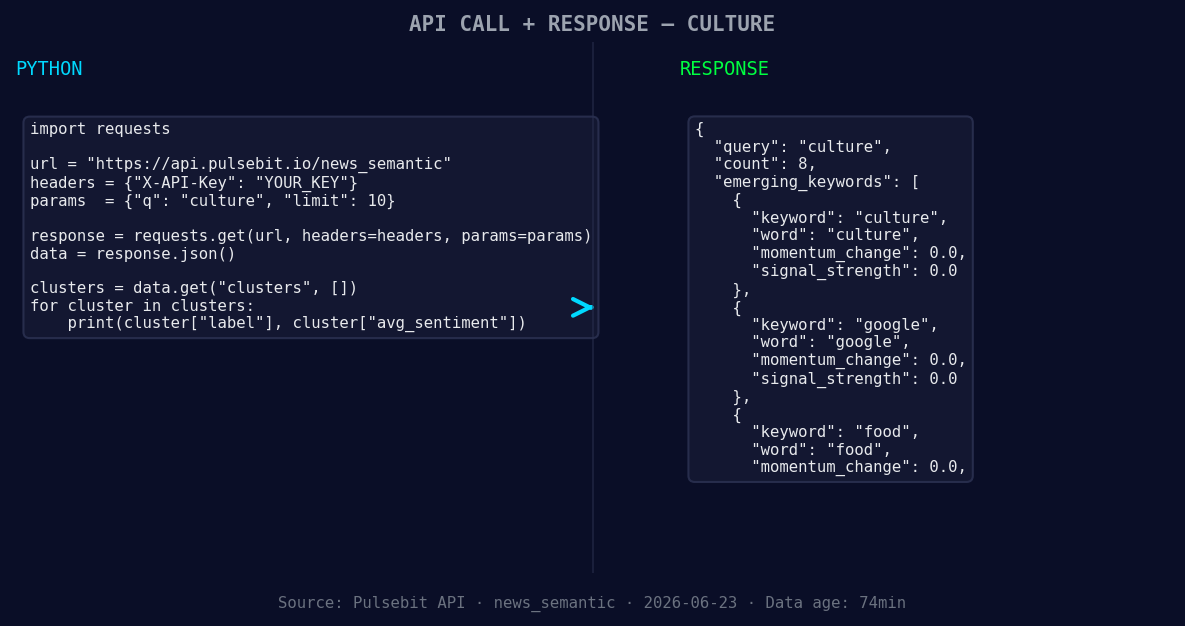
*Left: Python GET /news_semantic call for 'culture'. Right: returned JSON response structure (clusters: 3). Source: Pulsebit /news_semantic.*
url = "https://api.pulsebit.com/v1/articles"
params = {
"topic": "culture",
"lang": "sp",
"momentum": "+0.248"
}
response = requests.get(url, params=params)
articles = response.json()
Now that we've filtered for relevant articles, let's run the cluster reason string back through our sentiment scoring endpoint to assess how the narrative itself is framed:
sentiment_url = "https://api.pulsebit.com/v1/sentiment"
cluster_reason = "Clustered by shared themes: maritime, tyndis, biennale, cultural, celebrate."

sentiment_response = requests.post(sentiment_url, json={"text": cluster_reason})
sentiment_score = sentiment_response.json()
This meta-sentiment analysis will give us insight into how the thematic clusters are perceived, allowing us to understand not just the data but the narrative context around it.
With the insights from the momentum spike and the meta-sentiment analysis, we can build out three specific constructs:
Cultural Momentum Tracker: Create an endpoint that constantly monitors for cultural topics with momentum spikes greater than +0.2 and filter results by language, specifically Spanish. This will keep your model ahead of the curve when it comes to emerging trends.
Narrative Framing Analysis: Implement a routine that takes the output of the meta-sentiment loop and categorizes articles based on their thematic framing. For instance, stories that center around "maritime" themes will be flagged for further exploration, as they are forming a gap compared to mainstream narratives.
Real-Time Alerts for Emerging Themes: Set up a webhook that triggers real-time alerts for any topics that hit a sentiment score above +0.4 with a positive confidence level, particularly focusing on cultural or food-related narratives, as these are currently forming gaps against the mainstream topics of maritime and biennale.
If you want to get started, check out our documentation at pulsebit.lojenterprise.com/docs. You can copy-paste the above code and run it in under 10 minutes, putting you right on track to catch emerging cultural sentiments before they become mainstream.

Geographic detection output for culture. India leads with 5 articles and sentiment +0.37. Source: Pulsebit /news_recent geographic fields.


Top comments (0)