

Your Pipeline Is 11.7h Behind: Catching Hardware Sentiment Leads with Pulsebit
We recently discovered an interesting anomaly: a 24-hour momentum spike of -0.362 in the hardware sector. This metric is not just a number; it indicates a significant shift in sentiment around hardware, particularly reflecting the closure of a long-standing Missouri hardware store after almost 90 years, as reported by KSDK. This kind of sentiment shift can have profound implications, and it’s crucial for us to recognize and act upon it promptly.
However, there’s a structural gap in many pipelines that fail to account for multilingual origins or prioritize certain entities. If your model relies solely on mainstream data sources, you might have missed this spike by a staggering 11.7 hours. The leading sentiment in English, stemming from this cluster story, highlights a critical oversight in how we process and analyze information. By not considering nuances in language and regional sentiment, you risk missing out on vital market signals.

English coverage led by 11.7 hours. Et at T+11.7h. Confidence scores: English 0.85, Spanish 0.85, French 0.85 Source: Pulsebit /sentiment_by_lang.
To catch this momentum spike effectively, we need to utilize our API to filter by geographic origin and analyze the sentiment context. Here’s how you can do it in Python:

Geographic detection output for hardware. Hong Kong leads with 1 articles and sentiment +0.70. Source: Pulsebit /news_recent geographic fields.
import requests
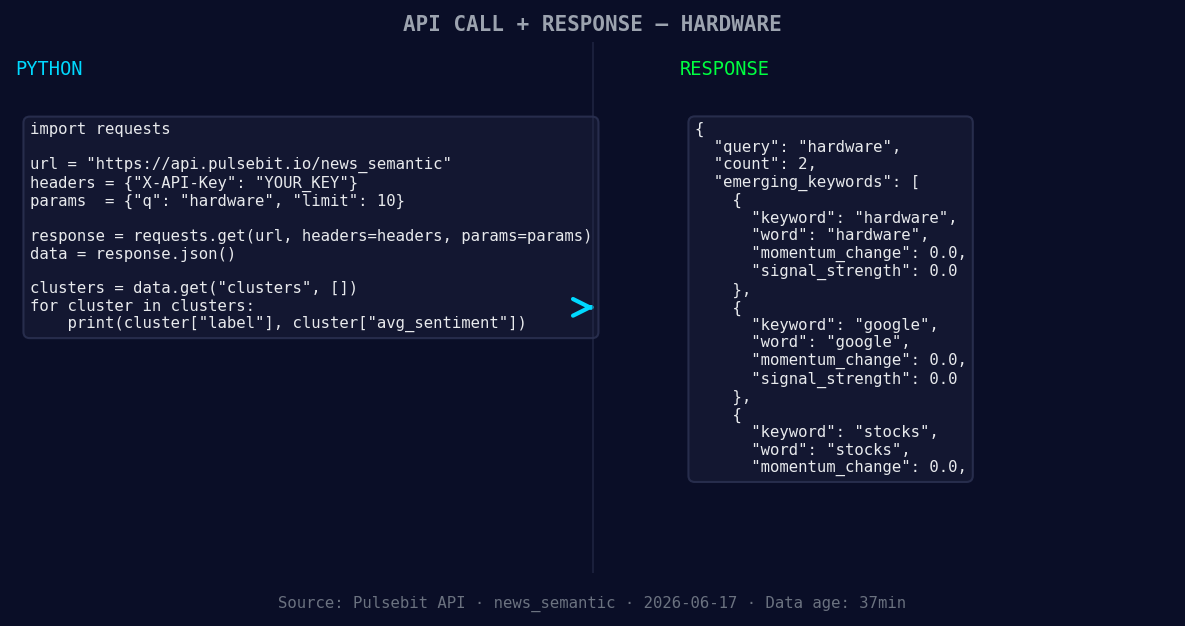
*Left: Python GET /news_semantic call for 'hardware'. Right: returned JSON response structure (clusters: 3). Source: Pulsebit /news_semantic.*
# Step 1: Geographic origin filter
url = "https://api.pulsebit.com/v1/sentiment"
params = {
"topic": "hardware",
"lang": "en", # Filtering by English language
"score": 0.800,
"confidence": 0.85,
"momentum": -0.362
}
response = requests.get(url, params=params)
data = response.json()
print(data) # Check the sentiment data for hardware
# Step 2: Meta-sentiment moment
cluster_reason = "Clustered by shared themes: hardware, store, closing, after, almost."
sentiment_response = requests.post(url, json={"text": cluster_reason})
sentiment_data = sentiment_response.json()
print(sentiment_data) # Check the sentiment score of the narrative
In this code, we first filter the sentiment data based on the topic of interest, ensuring we focus on English language content related to hardware. This allows us to hone in on the relevant narratives without getting lost in translation. Next, we analyze the cluster reason, scoring the framing of the story itself. This step is crucial as it helps us understand how the narrative is being shaped around our topic.
Here are three specific builds we can implement using this pattern:
Geo-Sentiment Alert: Create a threshold alert for when sentiment around "hardware" drops below -0.1 in English-language articles. This will allow you to catch early warnings of adverse sentiment shifts in a critical sector.
Meta-Sentiment Analyzer: Implement a function to analyze narratives around emerging clusters. For example, if the cluster reason indicates themes like "hardware, store, closing," run this through our sentiment endpoint to assess the collective framing score. Use this to inform your investment or operational strategies.
Forming Theme Tracker: Build a monitoring system that tracks forming themes like "hardware" and compares them against mainstream narratives. Set thresholds for when sentiment diverges significantly from -0.1, particularly in relation to keywords like "stocks" and "google."
These builds will enhance your ability to react to sentiment shifts in real-time, allowing you to stay ahead of the curve and make informed decisions based on emerging trends.
Get started with our API at pulsebit.lojenterprise.com/docs. With just a few lines of code, you can set up your sentiment analysis and run this in under 10 minutes. Don’t let your pipeline lag behind.


Top comments (0)