

Your pipeline just missed a critical 24h momentum spike of +0.600, indicating a significant shift in sentiment around the topic of "mobile." This spike is particularly intriguing as it’s emerging from the Spanish press, showing a leading language dominance with a 23.9-hour head start. If you’re not factoring in multilingual sources or entity dominance, your model could be lagging behind by nearly a full day, missing key insights that could influence your decisions.

Spanish coverage led by 23.9 hours. Nl at T+23.9h. Confidence scores: Spanish 0.85, English 0.85, French 0.85 Source: Pulsebit /sentiment_by_lang.
This anomaly highlights a structural gap in your pipeline. Imagine if you had a model that didn’t account for the nuances of language and geographic origin. You might be stuck in a feedback loop, focusing only on mainstream narratives while missing emerging themes from dominant entities. In this case, the Spanish press has given us a timely lead on mobile sentiment, but if you’re reliant solely on English sources, you could be late to the party.

Geographic detection output for mobile. India leads with 3 articles and sentiment +0.03. Source: Pulsebit /news_recent geographic fields.
Let’s dive into how to catch this momentum spike programmatically. Here's a quick Python snippet that utilizes our API to filter for Spanish-language content related to "mobile":
import requests
# Define parameters for the API request
params = {
"topic": "mobile",
"lang": "sp",
"momentum": 0.600,
}
# Make the API call to retrieve data
response = requests.get('https://api.pulsebit.com/v1/sentiment', params=params)
data = response.json()
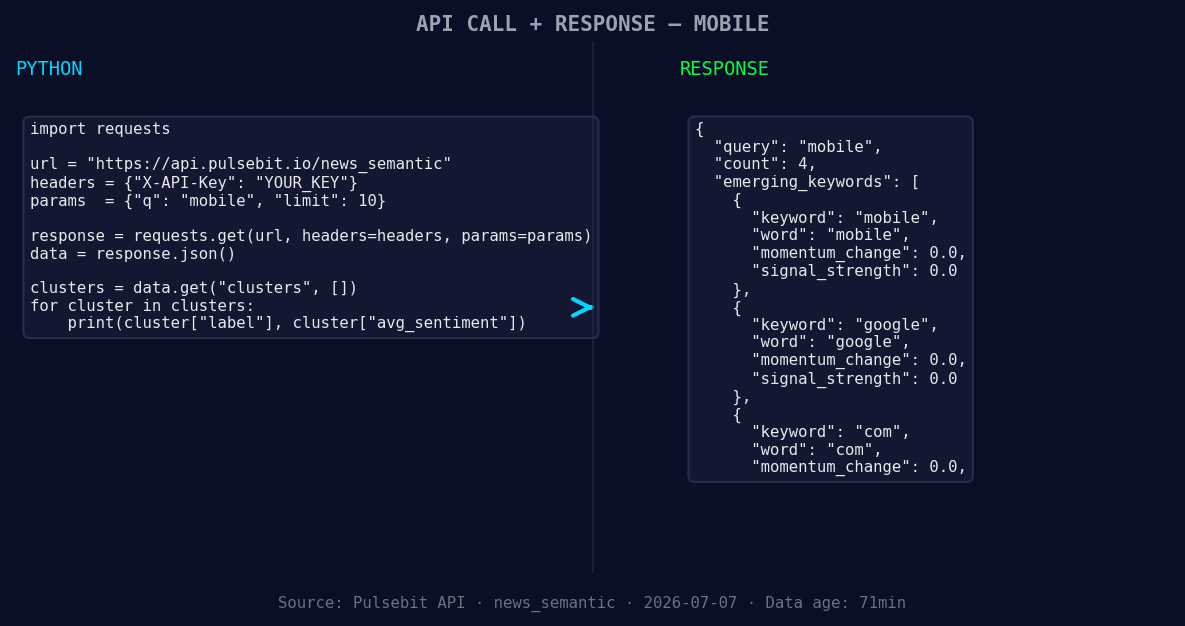
*Left: Python GET /news_semantic call for 'mobile'. Right: returned JSON response structure (clusters: 3). Source: Pulsebit /news_semantic.*
# Print the relevant data
print(data)
Next, we need to run the cluster reason string through our sentiment scoring endpoint to assess the narrative framing itself. Here’s how you do that:
# Define the cluster reason
cluster_reason = "Clustered by shared themes: base, camp:, off-grid, move, mobile."
sentiment_response = requests.post('https://api.pulsebit.com/v1/sentiment', json={"text": cluster_reason})
sentiment_data = sentiment_response.json()

# Output the sentiment score
print(sentiment_data)
This piece of code captures the essence of what's happening within the "mobile" discourse and evaluates the relevance of the emerging themes. It’s crucial to not only observe the spike but to understand the context around it.
Here are three specific builds to consider based on this anomaly:
Geo-Filtered Momentum Alert: Set a threshold to trigger alerts for any topic showing a momentum spike greater than +0.500 from Spanish sources. This would give you an early warning on shifts that could impact your strategy.
Meta-Sentiment Analysis Dashboard: Build a dashboard that visualizes the sentiment scores of clustered narratives, particularly focusing on emerging themes like "mobile," "base," and "off-grid." Use the meta-sentiment loop to score these narratives continuously.
Forming Gap Tracker: Implement a tracker that monitors forming gaps between emerging topics like "mobile" and mainstream narratives. If a new theme like "google" or "com" starts to show sentiment divergence, alert your team for further investigation.
For more details on how to implement these ideas, check out our documentation at pulsebit.lojenterprise.com/docs. You can easily copy-paste the provided code snippets and get this running in under 10 minutes. Don't let your pipeline fall behind—capitalize on these emerging sentiment trends now.


Top comments (0)