

Your Pipeline Is 28.7h Behind: Catching Software Sentiment Leads with Pulsebit
We’ve just identified a striking 24h momentum spike of +0.475 in the software sentiment landscape. This anomaly signals a significant shift in how news is being framed, particularly with a focus on the ongoing trend of "Accelerating Software Product Launches". Given that press coverage in English is leading this charge with a 28.7-hour head start, it’s clear that there’s a timely opportunity being missed if your pipeline isn’t equipped to catch these developments in real-time.
Your model missed this by a staggering 28.7 hours. If you’re not accommodating multilingual origins or the dominance of specific entities, you risk lagging behind critical insights. The leading language in this case is English, and that’s where the momentum is strongest. If you’re solely focused on a narrow dataset, you could miss out on emerging themes that are shaping the software landscape.

English coverage led by 28.7 hours. Sw at T+28.7h. Confidence scores: English 0.85, French 0.85, Spanish 0.85 Source: Pulsebit /sentiment_by_lang.
To catch this anomaly, we can utilize our API effectively. Below is a Python code snippet that demonstrates how to filter for English-language articles, giving us a solid foundation for understanding the sentiment around the topic "software":
import requests
# Set parameters for the API call
params = {
"topic": "software",
"score": -0.700,
"confidence": 0.85,
"momentum": +0.475,
"lang": "en" # Geographic origin filter
}
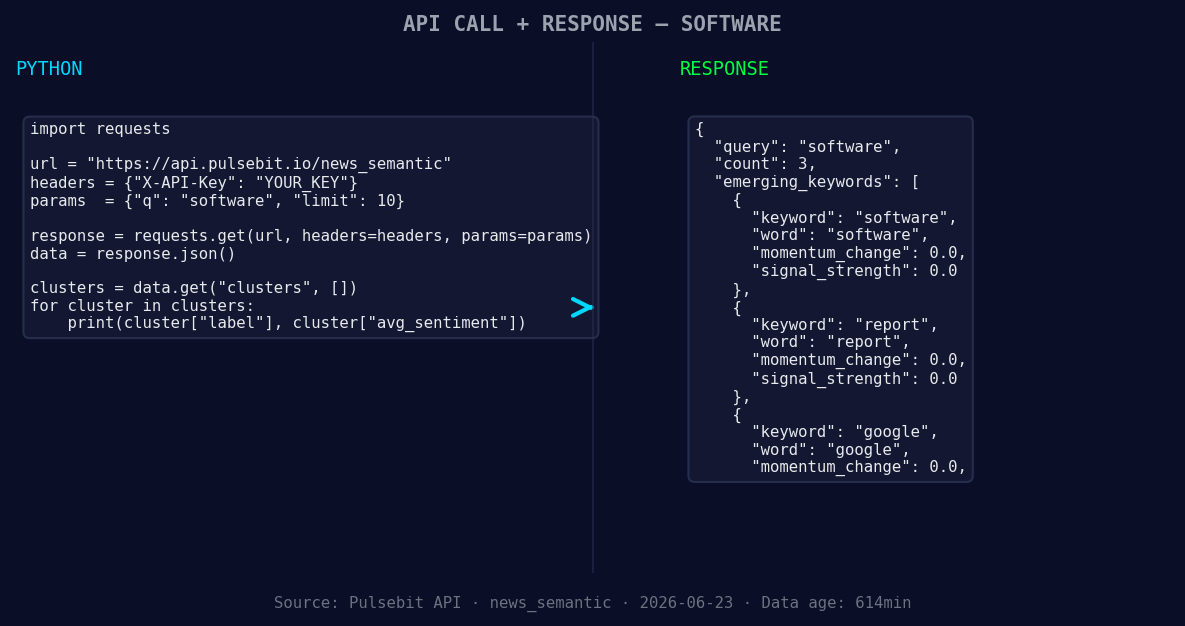
*Left: Python GET /news_semantic call for 'software'. Right: returned JSON response structure (clusters: 3). Source: Pulsebit /news_semantic.*
# Make the API call
response = requests.get('https://api.pulsebit.com/v1/articles', params=params)
data = response.json()
print(data)
Next, we want to analyze the narrative surrounding the spike. To do this, we’ll take the cluster reason string and score it using our sentiment API to see how this framing is perceived:
# Prepare meta-sentiment moment
meta_sentiment_input = "Clustered by shared themes: your, marks:, get, software, products."

# Call to score the narrative framing
sentiment_response = requests.post('https://api.pulsebit.com/v1/sentiment', json={"text": meta_sentiment_input})
sentiment_data = sentiment_response.json()
print(sentiment_data)
Now, let’s get specific about what we can build with this pattern. Here are three actionable steps:
Geo-Filtered Alerts: Create a threshold alert system that triggers when the sentiment score for software articles in English drops below -0.500. This way, you can proactively track potential downturns before they impact your strategy.
Meta-Sentiment Analysis Dashboard: Build an interactive dashboard that visualizes how different themes are evolving in real-time. Leverage the cluster reason string to generate insights and display sentiment scores dynamically.
Content Strategy Adjustments: Integrate a feedback loop that utilizes the sentiment scores from the meta-sentiment analysis to refine your content strategies. For instance, if the forming themes are "software(+0.00)" and "report(+0.00)", you could prioritize content that aligns with these topics to capitalize on rising interest.
To get started with these insights and tools, dive into our documentation: pulsebit.lojenterprise.com/docs. You can copy-paste the code above and run it in under 10 minutes, setting you up to catch these momentum shifts in real time.


Top comments (0)