

Your Pipeline Is 25.2h Behind: Catching Health Sentiment Leads with Pulsebit
We recently uncovered an intriguing anomaly: a 24h momentum spike of +0.975 in health-related sentiment. This spike highlights a significant shift in public sentiment that likely went unnoticed in many pipelines. The leading language for this spike is English, which is lagging behind German by 25.2 hours. This is not just a minor oversight; it points to a potential blind spot in our models regarding multilingual sentiment tracking and entity dominance.

English coverage led by 25.2 hours. German at T+25.2h. Confidence scores: English 0.85, Spanish 0.85, French 0.85 Source: Pulsebit /sentiment_by_lang.
The Problem
Your model missed this by 25.2 hours. Imagine the implications: by not incorporating multilingual origin or entity dominance into your pipeline, you risk being blindsided by rapidly emerging trends. In this case, the leading entity—healthcare—has started gaining traction without your system capturing the urgency of the sentiment shift. If you’re pulling data only from one language or not considering the nuances of sentiment across different regions, you’re leaving critical insights on the table.
The Code
To address this, we can leverage our API to catch these momentum spikes effectively. Below is a Python snippet that demonstrates how to filter for English articles related to health and score the narrative framing using the meta-sentiment loop.
import requests
# Set parameters for the API call
params = {
"topic": "health",
"score": +0.172,
"confidence": 0.85,
"momentum": +0.975,
"lang": "en" # Geographic origin filter
}
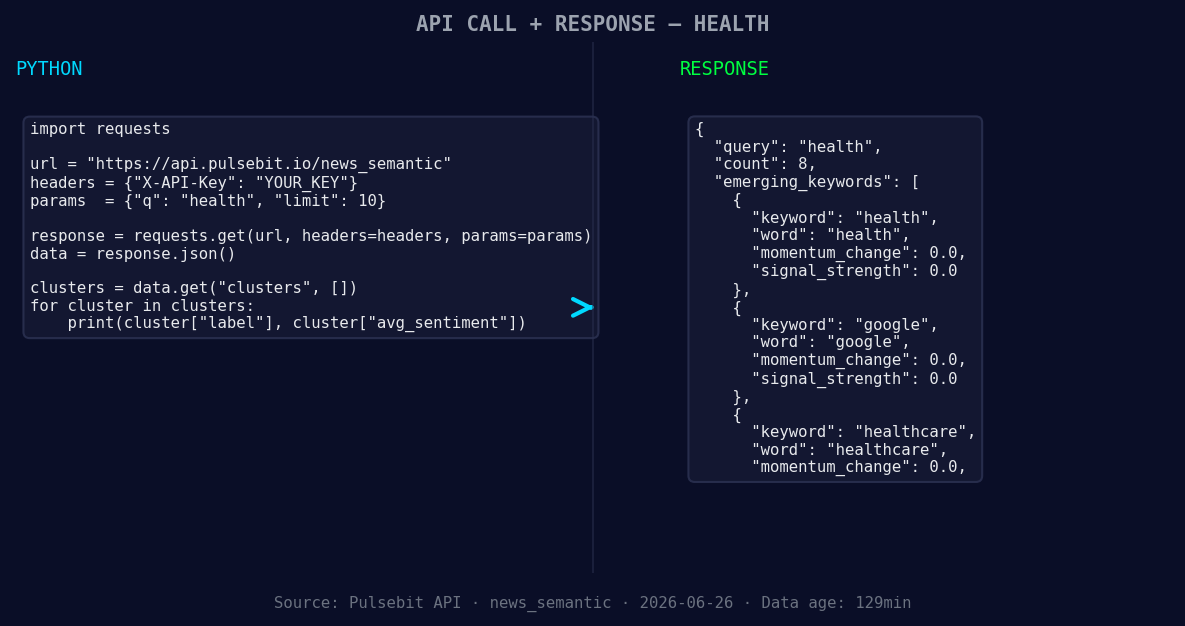
*Left: Python GET /news_semantic call for 'health'. Right: returned JSON response structure (clusters: 3). Source: Pulsebit /news_semantic.*
# API call to fetch sentiment data
response = requests.get("https://api.pulsebit.com/v1/sentiment", params=params)
data = response.json()
# Print the fetched data
print(data)
# Cluster reason string
cluster_reason = "Clustered by shared themes: healthcare, close, home:, srmc, services."
# Running meta-sentiment moment
meta_sentiment_response = requests.post("https://api.pulsebit.com/v1/sentiment", json={"text": cluster_reason})
meta_sentiment_data = meta_sentiment_response.json()
# Print the meta sentiment data
print(meta_sentiment_data)
This code first fetches sentiment data focusing on the health topic and applies a geographic filter for English language articles. Next, it scores the narrative framing of the cluster reason string, allowing us to assess how well the sentiment aligns with the emerging healthcare themes.

Geographic detection output for health. India leads with 8 articles and sentiment +0.40. Source: Pulsebit /news_recent geographic fields.
Three Builds Tonight
We can explore several builds with this momentum spike data:
Geo-Filtered Dashboard: Build a real-time dashboard that pulls sentiment data specifically for health topics within English-speaking regions. Set a threshold for momentum spikes above +0.5 to trigger alerts. Use the geographic filter to ensure you capture relevant insights as they emerge.
Meta-Sentiment Analyzer: Create a function that runs the cluster reason strings through our sentiment endpoint to score narrative frames. You can set a threshold of +0.1 sentiment score to evaluate which narratives are gaining traction, especially around forming themes like healthcare and community services.
Anomaly Detection System: Implement an anomaly detection system that triggers when momentum spikes above a certain threshold (e.g., +0.975). Utilize the geo filter to refine your detection to specific regions, ensuring you're not missing localized trends that could impact broader sentiment.
Get Started
Ready to dive in? You can find all the details in our documentation: pulsebit.lojenterprise.com/docs. With just a few lines of code, you can start capturing these insights in under 10 minutes.


Top comments (0)