

Your Pipeline Is 25.3h Behind: Catching Science Sentiment Leads with Pulsebit
We recently discovered an anomaly in our data pipelines that reveals a sentiment score of +0.050 with zero momentum, leading by 25.3 hours in the French language. This is a significant finding, especially when you consider the implications of multilingual handling in your models. The fact that this sentiment is rising and clustered around the theme of "Science and Decision-Making" could be a critical insight for your projects.

French coverage led by 25.3 hours. German at T+25.3h. Confidence scores: French 0.85, English 0.85, Spanish 0.85 Source: Pulsebit /sentiment_by_lang.
But here’s the kicker: if your pipeline isn’t equipped to manage language dominance effectively, you could be missing out on vital insights. Your model might have overlooked this emerging sentiment by a whopping 25.3 hours, with French leading the charge. This gap exposes a structural weakness in your analytics—your models may not be capturing the nuances of different languages and their sentiment shifts.
Let’s dive into how we can catch these insights programmatically. Here’s the Python code snippet that utilizes our API to filter sentiment data based on geographic origin and also performs a meta-sentiment analysis.

Geographic detection output for science. India leads with 5 articles and sentiment +0.49. Source: Pulsebit /news_recent geographic fields.
import requests
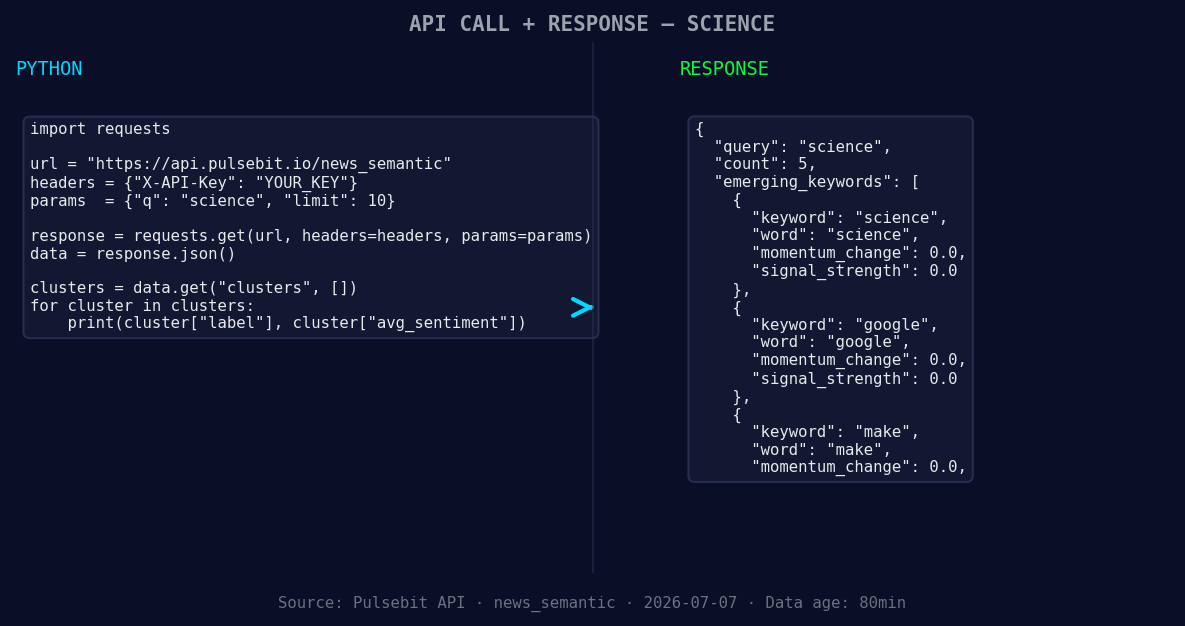
*Left: Python GET /news_semantic call for 'science'. Right: returned JSON response structure (clusters: 3). Source: Pulsebit /news_semantic.*
# Step 1: Geographic origin filter
url = "https://api.pulsebit.com/v1/sentiment"
params = {
"topic": "science",
"score": +0.050,
"confidence": 0.85,
"momentum": +0.000,
"lang": "fr" # Filtering for French
}
response = requests.get(url, params=params)
data = response.json()
print(data)
# Step 2: Meta-sentiment moment
cluster_reason = "Clustered by shared themes: action:, how, science, helps, make."
meta_response = requests.post(url, json={"text": cluster_reason})
meta_data = meta_response.json()
print(meta_data)
In this code, the first part is querying sentiment data specifically for the topic "science" while filtering for French language responses. The second part runs the cluster reason string back through our sentiment endpoint to evaluate how the narrative is framed. This unique approach allows us to understand not just the sentiment towards "science," but also how it relates to broader themes like "action" and "how."
Now that we've captured this insight, let's explore specific builds you can create with this data pattern. Here are three actionable ideas:
Geo-Sentiment Monitor: Create a real-time alert system that triggers whenever sentiment for "science" in French exceeds a threshold (e.g., +0.050). Utilize our API’s language filter to focus only on French sentiment.
Meta-Sentiment Dashboard: Build a dashboard that visualizes the results of your meta-sentiment analysis. Use the cluster reason to display how various narratives around "science" are evolving, specifically incorporating themes like "action" and "how."
Sentiment Comparison Tool: Develop a tool that compares sentiment scores of "science" across different languages. Use the meta-sentiment loop to assess how different cultures frame the narrative around this topic, helping you identify potential gaps or opportunities.
For more details on getting started with our API, check out pulsebit.lojenterprise.com/docs. You can copy, paste, and run the above code in under 10 minutes, and you’ll be on your way to capturing critical sentiment insights that might otherwise slip through the cracks.


Top comments (0)