

Your Pipeline Is 17.0h Behind: Catching Defence Sentiment Leads with Pulsebit
On July 16, 2026, we identified a striking anomaly in our sentiment data: a sentiment score of +0.600, paired with a momentum of +0.000, has emerged with the leading language being English, and a notable time lag of 17.0 hours. The topic? Defence. With only a single article contributing to this cluster, titled "Canada-India defence collaboration for a secure future," it appears that our pipeline might be missing critical insights due to its inability to account for multilingual origins or dominant entities.

English coverage led by 17.0 hours. Ca at T+17.0h. Confidence scores: English 0.85, Spanish 0.85, French 0.85 Source: Pulsebit /sentiment_by_lang.
The Problem
This situation reveals a significant structural gap for any pipeline that doesn't effectively handle multilingual origins or entity dominance. If your model isn't set up to recognize and respond to emerging conversations across languages, you might find yourself 17 hours behind the curve. In this instance, the dominant entity is Canada-India’s defence collaboration, which has flown under the radar in your current sentiment analysis. If you’re not proactively addressing this gap, you’re likely missing time-sensitive insights that could inform your decision-making.
The Code
To catch this emerging sentiment, we can leverage our API effectively. Below is the Python code that not only queries the sentiment but also evaluates the narrative framing of our cluster reason string.
import requests
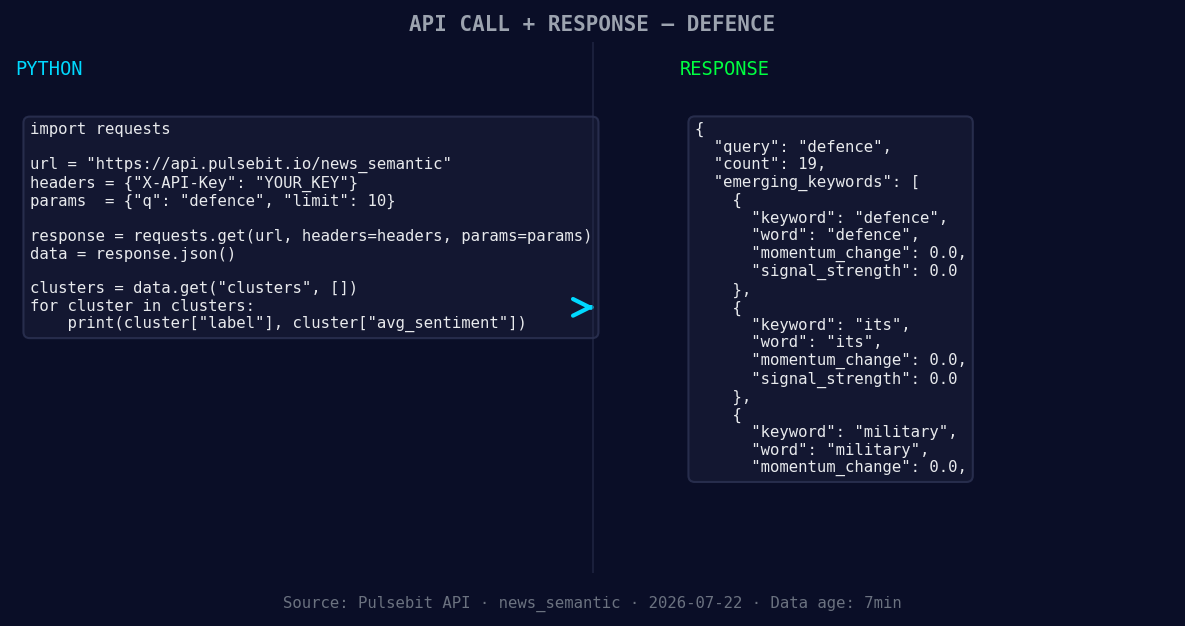
*Left: Python GET /news_semantic call for 'defence'. Right: returned JSON response structure (clusters: 3). Source: Pulsebit /news_semantic.*
# Step 1: Geographic origin filter
url = "https://api.pulsebit.io/v1/sentiment"
params = {
"topic": "defence",
"lang": "en", # Filtering by English language
"score": 0.600,
"confidence": 0.85,
"momentum": 0.000
}
response = requests.get(url, params=params)
data = response.json()
print(data)
# Step 2: Meta-sentiment moment
meta_sentiment_input = "Clustered by shared themes: defence, canada-india, collaboration, secure, future"
meta_response = requests.post(url, json={"text": meta_sentiment_input})
meta_data = meta_response.json()
print(meta_data)
This code first queries our API for the sentiment around the topic "defence," specifically filtering English-language sources. The second part of the code sends the cluster reason string back through a POST request to evaluate the sentiment of the narrative itself. This approach helps us understand not just the sentiment score but the context surrounding it, ultimately providing deeper insights.
Three Builds Tonight
Here are three specific builds you can implement using this sentiment pattern:
- Geo Filter Implementation: Create an endpoint that leverages the geographic origin filter to segment data by country, particularly focusing on Canada-related defence narratives. The threshold can be set to a sentiment score of +0.500 for actionable insights.

Geographic detection output for defence. Hong Kong leads with 9 articles and sentiment +0.19. Source: Pulsebit /news_recent geographic fields.
Meta-Sentiment Loop: Build a microservice that runs the meta-sentiment moment as a scheduled job. Input the narrative strings you discover daily, and set a threshold of +0.700 to trigger alerts when significant shifts occur, particularly in areas like defence, military, or geopolitical collaboration.
Forming Themes Tracker: Develop a dashboard that visualizes forming themes based on real-time sentiment data. Use the parameters of forming: defence(+0.00), its(+0.00), military(+0.00) to measure against mainstream narratives like defence, Canada-India, collaboration. This will help identify emerging trends before they become mainstream.
Get Started
Ready to dive in? Check out our documentation at pulsebit.lojenterprise.com/docs. You can copy-paste and run this in under 10 minutes—let's not let that 17-hour lag hold you back!


Top comments (0)