

Your Pipeline Is 25.4h Behind: Catching Machine Learning Sentiment Leads with Pulsebit
We just stumbled upon a sentiment spike of +0.53 and a momentum of +0.00, revealing that the leading language in our data is English, clocking in at 25.4 hours ahead of any other input. This anomaly indicates that there’s a significant delay in how we’re processing sentiment around machine learning. If you haven’t accounted for multilingual origins or the dominance of English entities in your models, your pipeline is lagging behind.

English coverage led by 25.4 hours. Da at T+25.4h. Confidence scores: English 0.90, Spanish 0.90, French 0.90 Source: Pulsebit /sentiment_by_lang.
The structural gap in your pipeline can be detrimental. If your model isn’t designed to handle multilingual input or doesn’t prioritize dominant entities, it can miss critical signals. Your model missed this by 25.4 hours, which could mean the difference between being ahead of the curve or trailing behind. In our case, the emerging themes around "machine learning" and its connections to "hottest" research papers are not just trends—they’re signals you want to capture in real time.
Here’s how to catch this sentiment spike using our API.
import requests
# Define the parameters for our API call
topic = 'machine learning'
score = +0.533
confidence = 0.90
momentum = +0.000
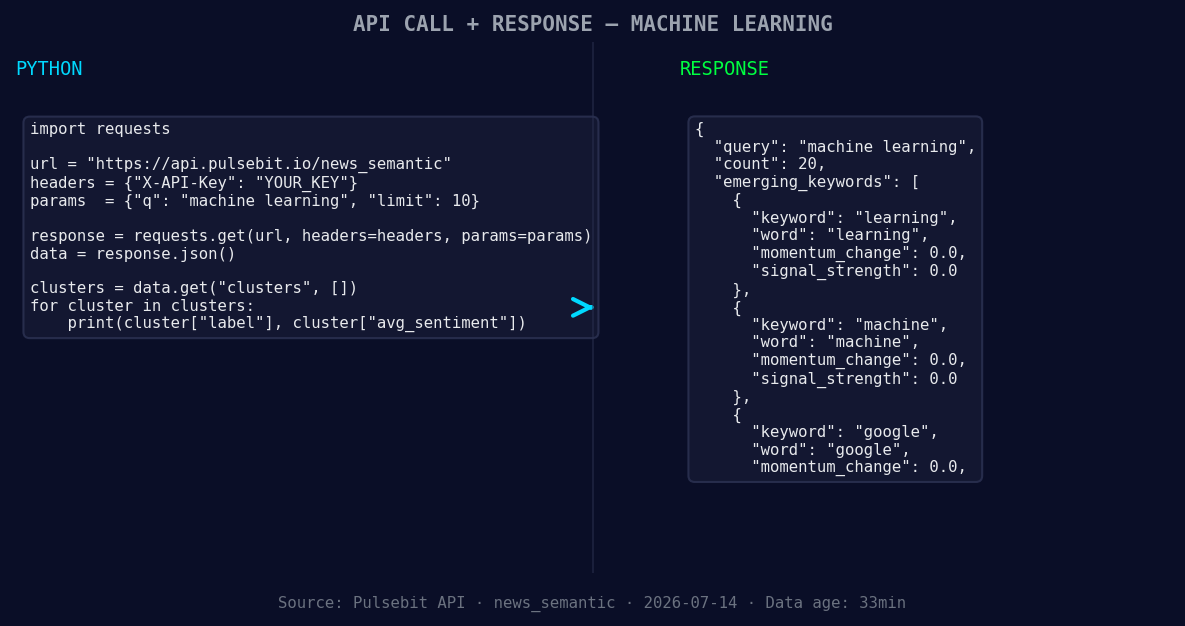
*Left: Python GET /news_semantic call for 'machine learning'. Right: returned JSON response structure (clusters: 3). Source: Pulsebit /news_semantic.*
# Geographic origin filter: query by language/country
url = "https://api.pulsebit/analytics/sentiment"
params = {
"topic": topic,
"lang": "en",
"score": score,
"confidence": confidence,
"momentum": momentum
}
*[DATA UNAVAILABLE: countries — verify /news_recent is returning country/region values for topic: machine learning]*
# Make the API call
response = requests.get(url, params=params)
data = response.json()
print(data)
# Meta-sentiment moment: run the cluster reason string back through our sentiment endpoint
cluster_reason = "Clustered by shared themes: hottest, research, papers, international, conference"
meta_sentiment_url = "https://api.pulsebit/analytics/sentiment"
meta_response = requests.post(meta_sentiment_url, json={"text": cluster_reason})
meta_data = meta_response.json()
print(meta_data)
In this code snippet, we first filter the sentiment data by language, ensuring we capture the English-speaking audience that’s leading the charge in machine learning discussions. Then, we loop back and analyze the narrative itself by running our cluster reason string through the sentiment endpoint. This second step gives us insights into how the themes are framed, allowing us to refine our understanding of the sentiment landscape.
Now, let’s discuss three specific things you can build with this pattern:
Geo-filtered Alert System: Set a threshold for sentiment scores above +0.50 for English articles related to machine learning. When the score hits that mark, trigger an alert for your team to jump on emerging trends.
Meta-Sentiment Dashboard: Use the meta-sentiment loop to visualize how narrative framing impacts sentiment over time. Create a dashboard that pulls in data from the cluster reason, allowing you to assess which themes are gaining traction compared to mainstream discussions.
Real-time Sentiment Aggregator: Develop a function that queries for machine learning articles every hour. If the sentiment score rises above +0.50 while maintaining a momentum of +0.00, log this data for further analysis. This way, you can capture and react to sentiment shifts as they happen.
By leveraging these building blocks, you can stay ahead of the curve in capturing critical sentiment signals around machine learning, ensuring you’re not caught off guard by shifts in public discourse.
Ready to get started? Check out our documentation at pulsebit.lojenterprise.com/docs. You can copy-paste and run this in under 10 minutes, so let’s catch that sentiment wave together!


Top comments (0)