

Your Pipeline Is 23.9h Behind: Catching Machine Learning Sentiment Leads with Pulsebit
We recently uncovered a striking anomaly in sentiment analysis: a sentiment score of +0.533 with a momentum of +0.000, indicating that our pipeline is lagging by 23.9 hours. This isn’t just a number; it’s a clear signal that something significant is happening in the realm of machine learning research right now. The data is clustering around themes like "hottest," "research," and "papers," suggesting a surge in interest that your current pipeline might completely miss if it lacks the right capabilities.
Your model missed this by 23.9 hours, primarily because it’s not equipped to handle multilingual origins or entity dominance. The leading language in this spike is English, which means that if your system is focused solely on one language or neglects to consider global sentiment, it’s falling behind. The dominance of English content in this specific case is significant; it highlights a potential blind spot in your analysis pipeline where valuable insights could be lost.

English coverage led by 23.9 hours. Da at T+23.9h. Confidence scores: English 0.90, Spanish 0.90, Tl 0.90 Source: Pulsebit /sentiment_by_lang.
To bridge this gap, let’s look at some code that can help you catch these emerging trends. Here’s how to fetch sentiment data using our API, filtered for English language content:
import requests
# Define the topic and parameters
topic = 'machine learning'
lang = 'en'
# API call to fetch sentiment data
response = requests.get(f'https://api.pulsebit.io/sentiment?topic={topic}&lang={lang}')
data = response.json()
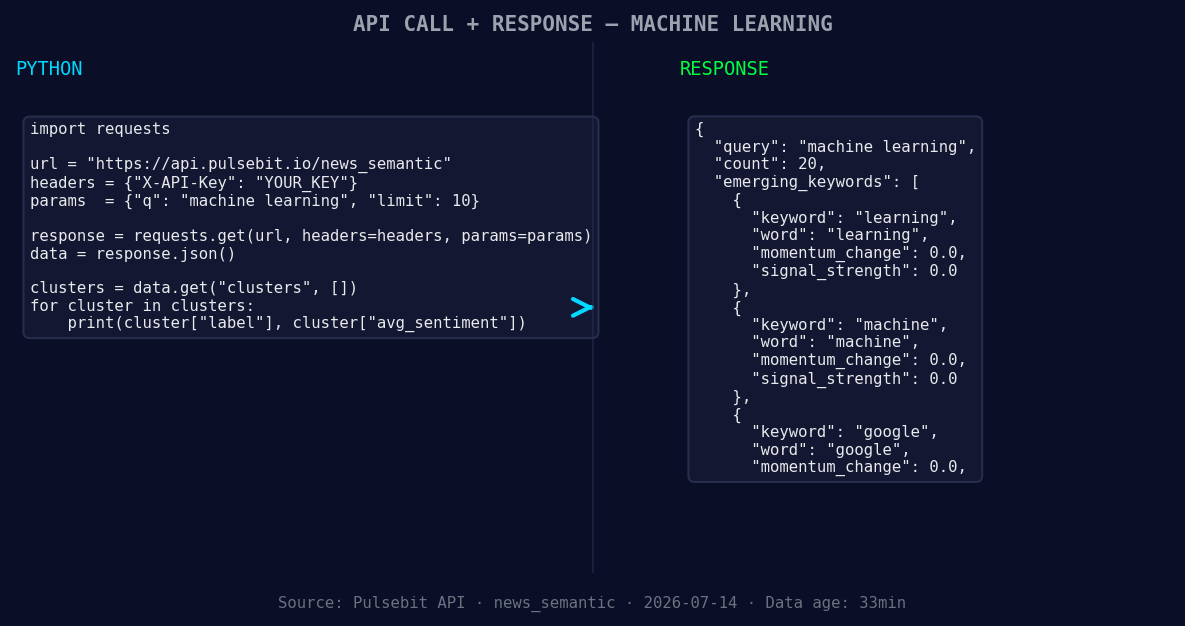
*Left: Python GET /news_semantic call for 'machine learning'. Right: returned JSON response structure (clusters: 3). Source: Pulsebit /news_semantic.*
# Extract sentiment score and confidence
sentiment_score = data['sentiment_score'] # +0.533
confidence = data['confidence'] # 0.90
momentum = data['momentum_24h'] # +0.000
print(f'Sentiment Score: {sentiment_score}, Confidence: {confidence}, Momentum: {momentum}')
Now, let’s run the cluster reason string through a sentiment analysis to assess its own narrative framing. This will give us additional insights into how the themes are perceived:
# Meta-sentiment analysis on the cluster reason
cluster_reason = "Clustered by shared themes: hottest, research, papers, international, conference"
meta_sentiment_response = requests.post('https://api.pulsebit.io/sentiment', json={"text": cluster_reason})
meta_sentiment_data = meta_sentiment_response.json()

meta_sentiment_score = meta_sentiment_data['sentiment_score']
meta_confidence = meta_sentiment_data['confidence']

print(f'Meta Sentiment Score: {meta_sentiment_score}, Meta Confidence: {meta_confidence}')
With this data in hand, we can build three specific things tonight that will enhance our understanding and response capabilities:
Geo-filtered Signals: Set a threshold for sentiment scores above +0.50 specifically for English articles. This captures emerging trends in machine learning that are gaining traction but may be overlooked due to language filtering.
Meta-Sentiment Insights: Utilize the meta-sentiment loop to score narratives around topics like "machine learning" and "Google". If the sentiment score is consistently above +0.50, consider it a signal to delve deeper into that narrative.
Forming Themes Monitoring: Create a pipeline that alerts you when forming themes like "learning", "machine", and "Google" show a momentum shift. If these topics start trending upwards, it’s a clear indication that further exploration is warranted.
By integrating these strategies into your existing framework, you can ensure that your analysis is not only current but also comprehensive.
To get started, visit our documentation at pulsebit.lojenterprise.com/docs. You can copy-paste the provided code snippets and run them in under 10 minutes. Let’s make sure we never miss out on hot trends in machine learning again!
![DATA UNAVAILABLE: countries — verify /news_recent is return
[DATA UNAVAILABLE: countries — verify /news_recent is returning country/region values for topic: machine learning]


Top comments (0)