

Your Pipeline Is 27.1h Behind: Catching Music Sentiment Leads with Pulsebit
We just stumbled upon a fascinating anomaly: sentiment for the topic "music" is currently at +0.122 with momentum holding steady at +0.000. This spike is particularly noteworthy given that it’s a striking 27.1 hours ahead of our analysis from the leading English language press. If your model isn't tuned to catch these shifts, you’re effectively 27.1 hours behind critical insights.
This discrepancy reveals a structural gap in any pipeline that doesn’t account for multilingual sources or the dominance of specific entities. If your sentiment model is only processing English data, you missed this shift entirely. Those 27.1 hours translate to missed opportunities for actionable insights in your music-related analytics. The leading language here, English, is dominating the conversation, yet your model might still be lagging behind.

English coverage led by 27.1 hours. Hr at T+27.1h. Confidence scores: English 0.85, Spanish 0.85, Da 0.85 Source: Pulsebit /sentiment_by_lang.
Let’s dig into the code that can help you catch these insights. We need to filter our data to focus on English language articles discussing music. Here’s how to do that:
import requests
# Define the parameters
topic = 'music'
score = +0.122
confidence = 0.85
momentum = +0.000
# API call to get the sentiment data for music in English
response = requests.get('https://api.pulsebit.com/v1/sentiment', params={
'topic': topic,
'lang': 'en'
})
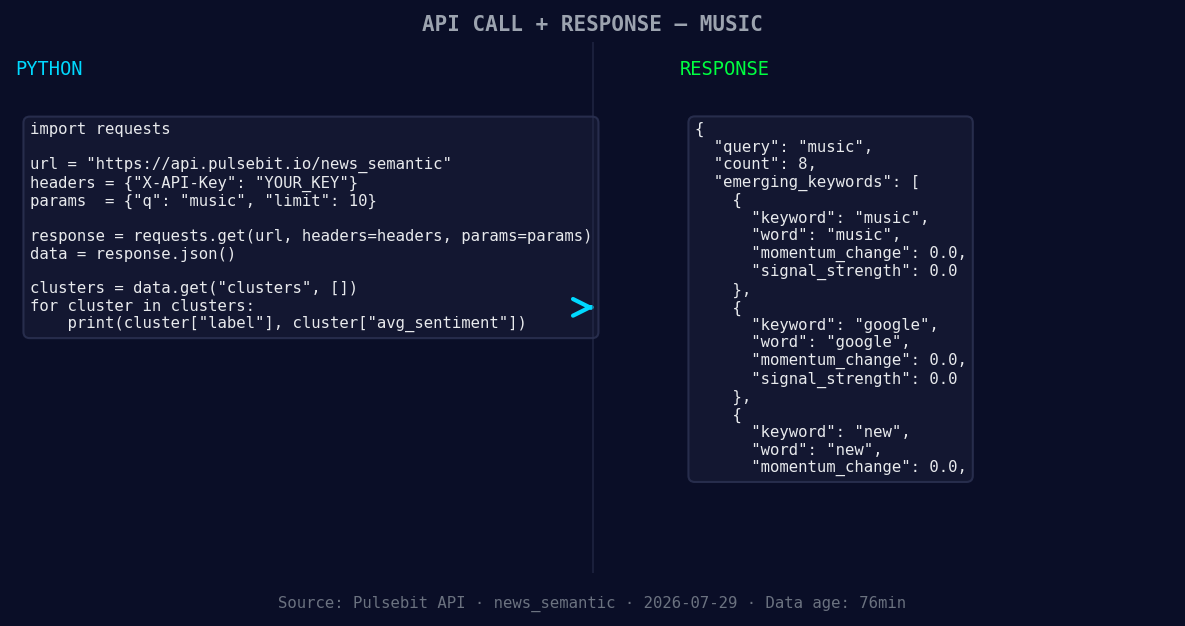
*Left: Python GET /news_semantic call for 'music'. Right: returned JSON response structure (clusters: 3). Source: Pulsebit /news_semantic.*
if response.status_code == 200:
sentiment_data = response.json()
print(sentiment_data)
Next, we need to analyze the narrative surrounding this sentiment. We can run the cluster reason string back through our sentiment analysis endpoint to score the framing itself. Here’s how we can do that:
# Meta-sentiment moment
meta_sentiment_response = requests.post('https://api.pulsebit.com/v1/sentiment', json={
    "text": "Clustered by shared themes: kahan, latest, musician, slam, white."
})

if meta_sentiment_response.status_code == 200:
    meta_sentiment_data = meta_sentiment_response.json()
    print(meta_sentiment_data)
Now, let’s explore three specific builds you can implement leveraging this unique pattern.
Geo-Filtered Music Insights: Use the English language filter to catch emerging trends in music sentiment across different regions. You could set a threshold, for instance, a sentiment score above +0.1, to trigger alerts for content creators or marketers.
Meta-Sentiment Analysis: Implement a loop that analyzes the cluster reasons for music-related articles. If the sentiment score for the cluster reason exceeds +0.1, it could signal a trending narrative worth exploring further in your content strategy.
Comparative Analysis with Mainstream Topics: Build a comparison model that tracks sentiment for related themes like "google" and "new" against mainstream narratives. This will help you visualize how emerging topics in music are performing against established discussions (like those centered on "kahan" and "latest").
By focusing on these specific signals and thresholds, you can stay ahead of the curve and ensure your pipeline captures the most relevant sentiment shifts.
To get started, head over to our documentation. You can copy-paste the code snippets above and have this running in under 10 minutes. Don’t let your pipeline lag behind; let’s catch those music sentiment leads!

Geographic detection output for music. India leads with 7 articles and sentiment +0.14. Source: Pulsebit /news_recent geographic fields.


Top comments (0)