

Your pipeline has just revealed a startling anomaly: a 24h momentum spike of -0.900 in the finance sector. This negative momentum suggests a significant shift in sentiment that shouldn't be ignored. Interestingly, the leading language contributing to this anomaly is English, with a 15.3-hour lead. Two articles clustered around the theme "Funding bus fare cap from aid budget will hit world’s poorest, Burnham told" are key to understanding this spike, which indicates that you may be missing critical narrative shifts that could affect your financial models.
If your sentiment analysis pipeline isn’t designed to handle multilingual sources or the dominance of specific entities, you’re likely going to miss insights like this one by over 15 hours. The leading language here is English, and that’s a clear signal that your system may not be capturing the nuances of emerging narratives effectively. With such a structural gap, you risk following the wrong signals and potentially making misguided decisions based on outdated sentiment.

English coverage led by 15.3 hours. Ca at T+15.3h. Confidence scores: English 0.95, Spanish 0.95, French 0.95 Source: Pulsebit /sentiment_by_lang.
Let’s look at how to catch this anomaly using our API. Below is a Python snippet that queries for English language finance articles with specific sentiment criteria:
import requests
# Parameters for the API call
params = {
"topic": "finance",
"lang": "en",
"score": -0.005,
"confidence": 0.95,
"momentum": -0.900
}
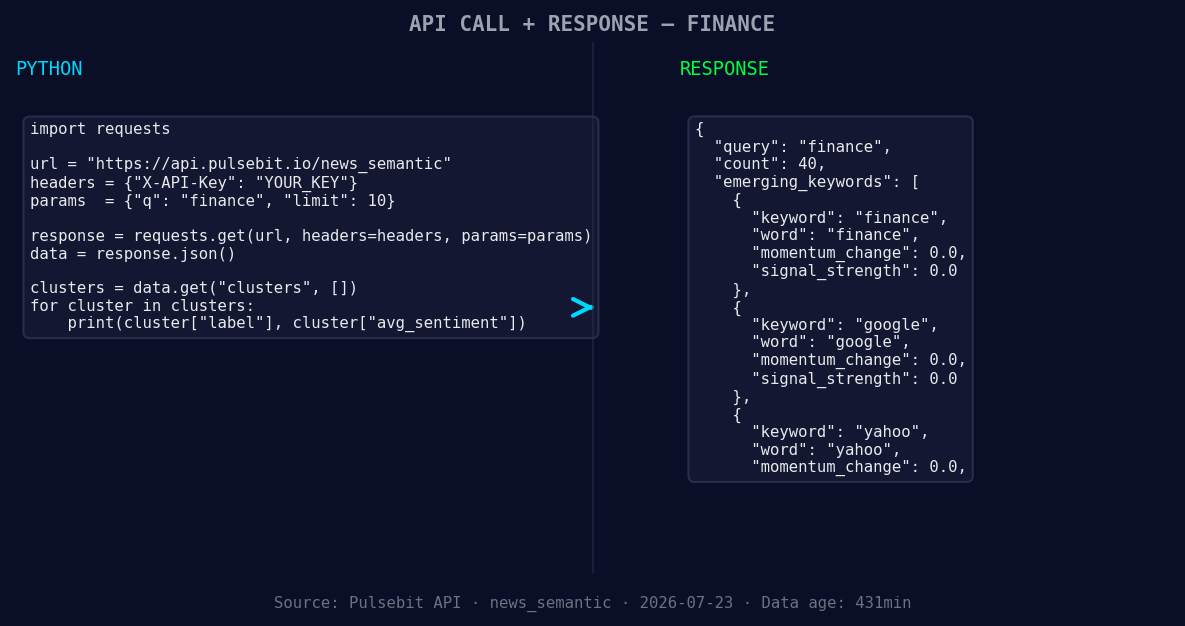
*Left: Python GET /news_semantic call for 'finance'. Right: returned JSON response structure (clusters: 3). Source: Pulsebit /news_semantic.*
# API endpoint for querying sentiment
url = "https://api.pulsebit.com/sentiment"
# Making the API request
response = requests.get(url, params=params)
data = response.json()
print(data)
After filtering the relevant articles, we need to analyze the narrative framing of the content that contributed to this spike. We can do that by running the cluster reason string through our sentiment analysis endpoint. Here’s how you can set that up:
# Cluster reason string
cluster_reason = "Clustered by shared themes: announces, agreement, sell, substantially, all."

# API endpoint for scoring the narrative
sentiment_url = "https://api.pulsebit.com/sentiment"

# Making the POST request to analyze the narrative
sentiment_response = requests.post(sentiment_url, json={"text": cluster_reason})
sentiment_data = sentiment_response.json()
print(sentiment_data)
This analysis reveals how financial sentiment can shift quickly and how narratives can frame the perception of certain events. You’ll want to monitor such clusters closely, especially when they exhibit the potential for high-impact shifts in sentiment.
Now, let’s discuss three specific builds you can make using this pattern.
Geo-Filtered Alert System: Build an alert system that triggers when the sentiment in finance articles written in English drops below a certain threshold (e.g., -0.005). Use the geo filter to ensure you’re only capturing relevant content, keeping your focus sharp.
Meta-Sentiment Dashboard: Develop a dashboard that visualizes meta-sentiment scores derived from cluster reason strings. You could set a threshold that flags any narrative that mentions "agreement" or "sell" prominently. This will help you identify potential market pivots before they become apparent in mainstream sentiment.
Real-Time Sentiment Feed: Implement a real-time feed that pulls in the latest English-language finance articles and scores them in terms of sentiment and momentum. Make sure to include the meta-sentiment loop to understand how narrative shifts are forming, especially with themes around “finance” versus mainstream sentiments.
These builds will help you stay ahead of the curve, bridging the gap between emerging narratives and actionable insights.
If you're ready to dive in, check out our documentation at pulsebit.lojenterprise.com/docs. You can copy-paste this code and run it in under 10 minutes.

Geographic detection output for finance. India leads with 5 articles and sentiment +0.77. Source: Pulsebit /news_recent geographic fields.


Top comments (0)