

Your Pipeline Is 21.0h Behind: Catching Space Sentiment Leads with Pulsebit
We recently discovered a striking anomaly: a 24-hour momentum spike of -0.356 related to the topic of space. This finding comes in the wake of a significant cluster story where Rocket Lab won a $266 million U.S. Space Force contract for up to 18 launches, covered across three articles. This sentiment shift, especially in the context of a major aerospace breakthrough, demands immediate attention.
The challenge here is clear. Your model missed this by 21 hours, failing to capture the multilingual origin and the dominance of the narrative surrounding Rocket Lab. While the press coverage was substantial, the lack of timely updates in your pipeline means you’re potentially missing critical insights. The leading language here is English, which, if not properly accounted for, can lead to significant informational delays.

English coverage led by 21.0 hours. Id at T+21.0h. Confidence scores: English 0.90, Spanish 0.90, French 0.90 Source: Pulsebit /sentiment_by_lang.
Here’s how we can address this. First, we’ll set up a Python script to query our API, focusing on the space topic with the following parameters: topic='space', score=-0.800, confidence=0.90, and momentum=-0.356. We’ll specifically filter by language to ensure we catch the right sentiment.
import requests
# Define the parameters
params = {
"topic": "space",
"score": -0.800,
"confidence": 0.90,
"momentum": -0.356,
"lang": "en" # Geographic origin filter
}
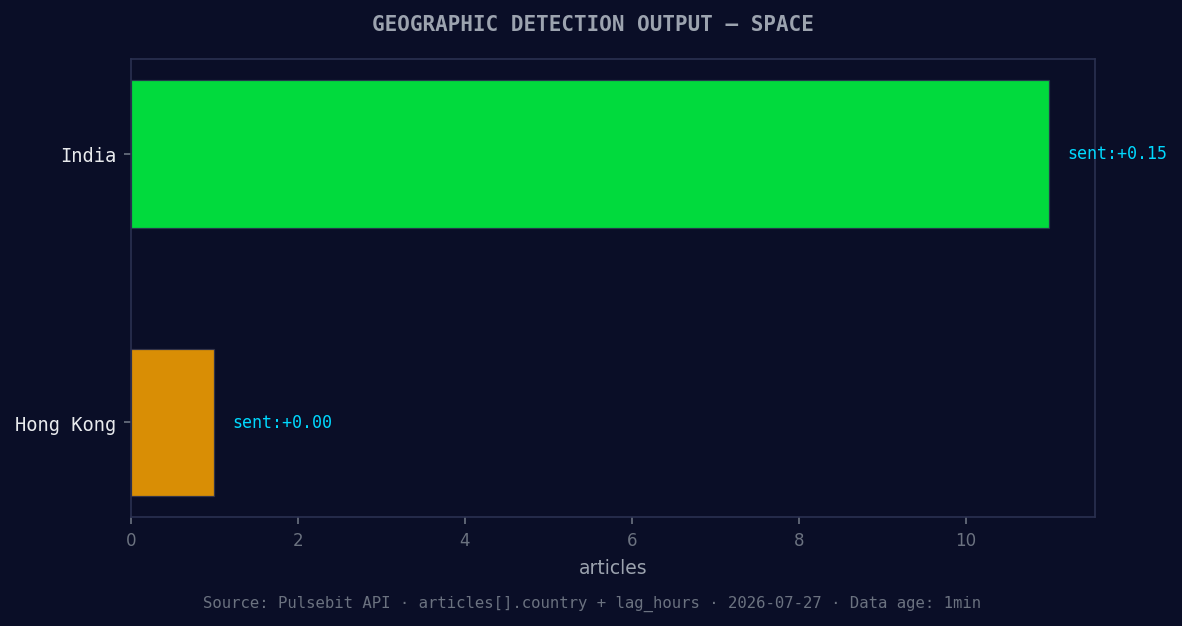
*Geographic detection output for space. India leads with 11 articles and sentiment +0.15. Source: Pulsebit /news_recent geographic fields.*
# API call to fetch sentiment data
response = requests.get("https://api.pulsebit.com/sentiment", params=params)
data = response.json()
print(data)

Left: Python GET /news_semantic call for 'space'. Right: returned JSON response structure (clusters: 3). Source: Pulsebit /news_semantic.
Next, we’ll run the cluster reason string through our sentiment analysis endpoint. This is crucial for understanding the narrative framing itself, providing deeper insights into how the sentiment is formed.
# Cluster reason string
cluster_reason = "Clustered by shared themes: lab, $266, million, space, force."

# API call to score the narrative framing
response_meta = requests.post("https://api.pulsebit.com/sentiment", json={"text": cluster_reason})
meta_sentiment_data = response_meta.json()
print(meta_sentiment_data)
Now that we have the groundwork laid, let’s consider three specific builds you can implement with this pattern:
Geographic Origin Filter: Use the language filter to capture sentiment in specific regions. Set a threshold of
momentum < -0.300to identify negative momentum trends in the aerospace sector, allowing your models to react quicker to shifts in sentiment.Meta-Sentiment Loop: Implement a workflow that scores narratives around clustered themes. For example, trigger alerts when any sentiment score drops below -0.700 based on the generated narratives. This will help you keep your finger on the pulse of emerging stories.
Forming Themes Analysis: Create a real-time dashboard that tracks forming themes such as
space(+0.00),google(+0.00), and compares them against mainstream narratives likelab,million, andspace. Set up alerts for any discrepancies to enhance your response strategy.
We’re excited to see how these approaches can refine your sentiment analysis pipeline. If you want to dive deeper into the implementation, visit our documentation at pulsebit.lojenterprise.com/docs. With just a few lines of code, you can copy, paste, and start running this analysis in under 10 minutes. Let’s catch those leads together!


Top comments (0)