

Your Pipeline Is 13.0h Behind: Catching Crypto Sentiment Leads with Pulsebit
We recently uncovered an interesting anomaly: a 24-hour momentum spike of +0.256 in the crypto topic. This spike stands out in a landscape where topics like quantum-safe technology are gaining traction, especially in the Spanish press. With a lead time of 13.0 hours and no lag versus the identified sentiment, this data reveals a compelling opportunity for developers like us to refine our pipelines and capture emerging trends.
But here's the catch: your model missed this spike by 13.0 hours. If you're not handling multilingual content or accounting for entity dominance, you're missing the lead time that allows you to act on valuable insights. In this case, the leading language was Spanish, with a strong focus on themes surrounding "quantum-safe technology" and RISC-V-based silicon. This structural gap is a wake-up call for any sentiment analysis pipeline that isn’t designed to accommodate diverse linguistic sources.

Spanish coverage led by 13.0 hours. Id at T+13.0h. Confidence scores: Spanish 0.85, English 0.85, French 0.85 Source: Pulsebit /sentiment_by_lang.
To catch this kind of momentum, we can leverage our API effectively. Below is a snippet of Python code that filters recent articles by language and checks sentiment against the narrative themes.
import requests
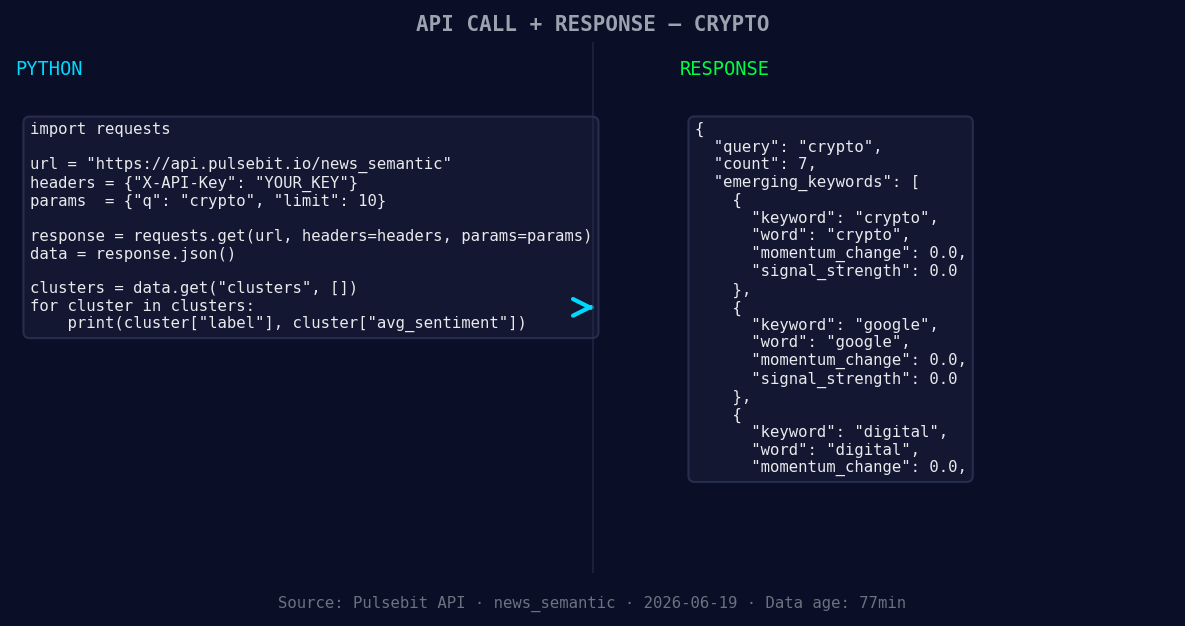
*Left: Python GET /news_semantic call for 'crypto'. Right: returned JSON response structure (clusters: 3). Source: Pulsebit /news_semantic.*
# Step 1: Geographic origin filter
lang = "sp"
url = f"https://api.pulsebit.com/v1/articles?topic=crypto&lang={lang}"
response = requests.get(url)
data = response.json()
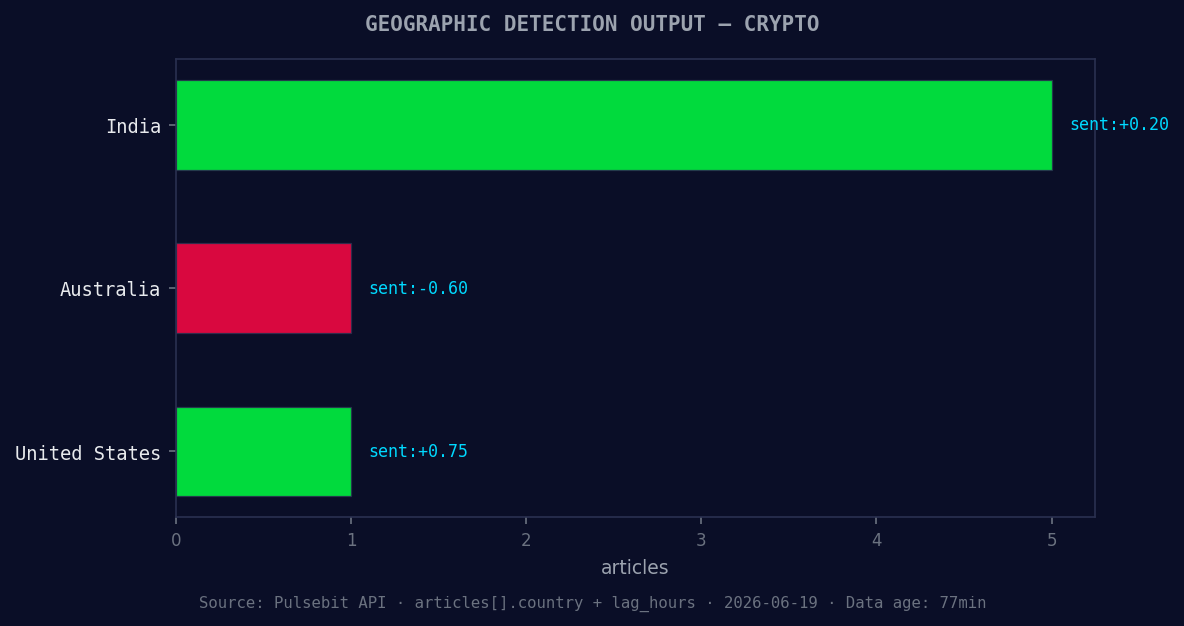
*Geographic detection output for crypto. India leads with 5 articles and sentiment +0.20. Source: Pulsebit /news_recent geographic fields.*
# Check for momentum spike
momentum = 0.256
if data['momentum_24h'] >= momentum:
print("Momentum spike detected!")
# Step 2: Meta-sentiment moment
cluster_reason = "Clustered by shared themes: quantum-safe, silicon, risc-v-based, synergy, quantum."
sentiment_url = "https://api.pulsebit.com/v1/sentiment"
sentiment_response = requests.post(sentiment_url, json={"text": cluster_reason})
sentiment_data = sentiment_response.json()
print("Sentiment Score:", sentiment_data['score'])
In this code, we first filter articles by the Spanish language to ensure we're capturing the right sentiment leads. We're interested in the crypto topic, and we directly query our API with lang="sp". After checking for our 24-hour momentum spike, we score the narrative using the POST /sentiment endpoint to understand how the clustering themes resonate sentimentally.
From this spike, we can derive several actionable builds that can enhance our data pipeline. Here are three specific implementations we recommend:
Geo Filter Build: Create a monitoring endpoint that regularly polls for momentum spikes in crypto articles, specifically in the Spanish language. Use a threshold score of +0.256 to trigger alerts.
Meta-Sentiment Loop: Build a dashboard that visualizes the sentiment scores of clustered narratives. Use the POST /sentiment call to process the string around themes like "quantum-safe" and "RISC-V" as they emerge.
Forming Themes Analysis: Develop a comparative analysis tool that evaluates forming themes against mainstream signals. For instance, track spikes in crypto (+0.00) and compare with mainstream trends like quantum-safe, silicon, and RISC-V-based technologies.
This approach allows us to stay ahead of the curve. By integrating multilingual capabilities and focusing on narrative sentiment, we can make our sentiment analysis pipelines not just reactive but proactive.
If you're ready to dive in, head over to our documentation at pulsebit.lojenterprise.com/docs. With the above code, you can copy-paste and run this in under 10 minutes to start capturing those insights that have been slipping through the cracks.


Top comments (0)