

Your pipeline just missed a significant anomaly: a 24-hour momentum spike of +0.592 in software sentiment. This spike isn’t just a blip; it reflects an accelerating trend in software product launches that you need to catch. The leading sentiment in this context is English press coverage, which has a 22.8-hour lead over Hindi sources, meaning your model likely hasn’t processed this critical information in time.
Let’s break it down. If your pipeline doesn’t account for multilingual origin or entity dominance, you could be lagging behind by hours or even days. In this case, your model missed the software sentiment shift by 22.8 hours. The leading narratives are slipping through the cracks while you’re still processing outdated data. This gap can cost you valuable insights that could influence your decisions.

English coverage led by 22.8 hours. Hindi at T+22.8h. Confidence scores: English 0.85, Spanish 0.85, French 0.85 Source: Pulsebit /sentiment_by_lang.
Here’s how to catch this anomaly using our API. First, you want to filter for the English-language sentiment around the topic of software. Below is the Python code that accomplishes this:
import requests
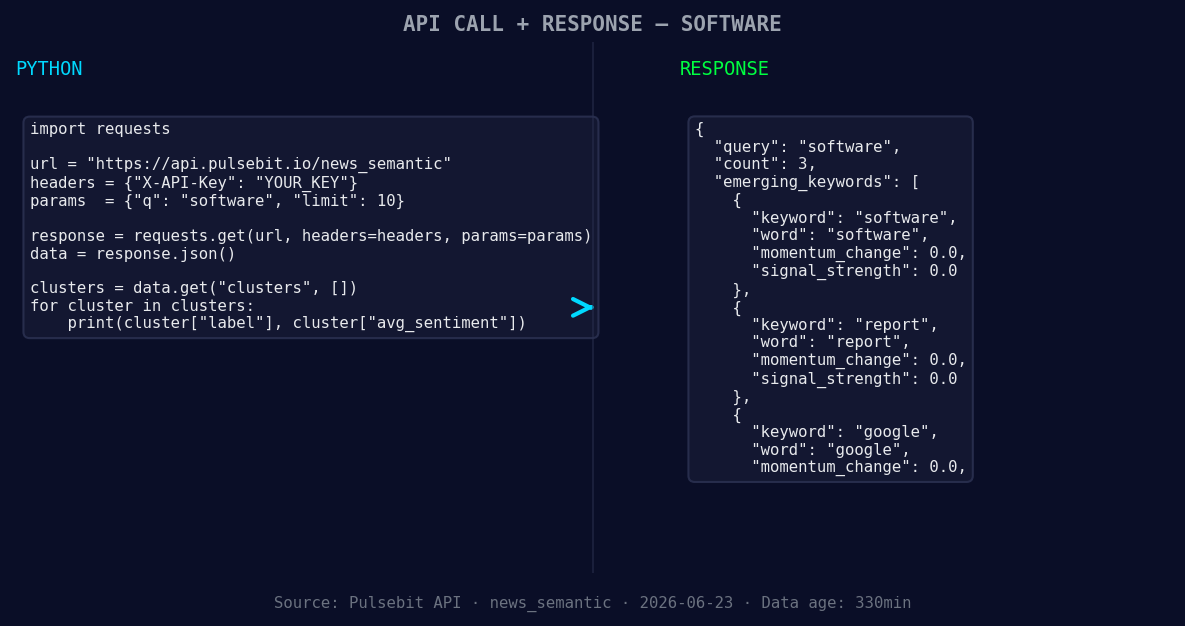
*Left: Python GET /news_semantic call for 'software'. Right: returned JSON response structure (clusters: 3). Source: Pulsebit /news_semantic.*
# Geographic origin filter
response = requests.get("https://api.pulsebit.com/v1/sentiment", params={
"topic": "software",
"lang": "en",
"score": -0.700,
"confidence": 0.85,
"momentum": +0.592
})
data = response.json()
print(data)
Next, we’ll run the cluster reason string through our sentiment endpoint to gauge the narrative framing of the spike itself. This step is crucial as it allows us to understand not just the sentiment but the thematic context around it.
# Meta-sentiment moment
cluster_reason = "Clustered by shared themes: your, marks:, get, software, products."
meta_response = requests.post("https://api.pulsebit.com/v1/sentiment", json={
    "text": cluster_reason
})

meta_data = meta_response.json()
print(meta_data)
Now that we have our sentiment data and context, there are three specific builds we can implement this evening:
- Geo Filter Implementation: Create a scheduled job that queries for sentiment on software topics each hour, using the geographic filter for English language sources. Set a threshold of a momentum score greater than +0.5 to prioritize significant spikes.

Geographic detection output for software. India leads with 3 articles and sentiment +0.37. Source: Pulsebit /news_recent geographic fields.
Meta-Sentiment Analysis Loop: Integrate a feedback loop that takes the cluster reason strings of trending topics and runs them through our sentiment endpoint at the end of each day. If the sentiment score is below -0.5, trigger an alert for potential risks in that area.
Forming Theme Tracker: Develop a dashboard widget that monitors forming themes, specifically targeting keywords like "software," "report," and "google." Use the momentum score as a signal to visualize trends, ensuring you catch any shifts in narrative before they become mainstream.
These builds will allow you to not only catch up but also stay ahead of sentiment trends in the software landscape. You can start implementing these strategies today. For more information, check out our comprehensive documentation at pulsebit.lojenterprise.com/docs. With these insights and code snippets, you can copy-paste and run your tests in under 10 minutes.


Top comments (0)