

Your Pipeline Is 19.1h Behind: Catching Defence Sentiment Leads with Pulsebit
In our latest analysis, we discovered a striking anomaly: a 24h momentum spike of +0.531 in the topic of defence. This spike indicates a significant uptick in sentiment that has gone largely unnoticed, particularly in the English press, which led the discussion by 19.1 hours—missing the mark for most sentiment pipelines. The dominant narrative revolves around "Canada-India defence collaboration for a secure future," with themes emerging that could reshape how we think about geopolitical relations.
But here's the catch: If your model isn’t set up to handle multilingual origins or entity dominance, your insights are lagging behind by a staggering 19.1 hours. This gap means you might be missing crucial conversations in the defence space, especially considering the leading language was English, and the dominant entity was Canada-India. You don’t want to be the last to know about vital shifts in sentiment that could impact your strategies.

English coverage led by 19.1 hours. Nl at T+19.1h. Confidence scores: English 0.85, French 0.85, Spanish 0.85 Source: Pulsebit /sentiment_by_lang.
Let’s dive into how we can catch this anomaly using our API. Below is the Python code that highlights the 24h momentum spike for the topic of defence:
import requests
# Set the parameters for the API call
params = {
"topic": "defence",
"score": -0.062,
"confidence": 0.85,
"momentum": +0.531,
"lang": "en" # Geographic origin filter
}
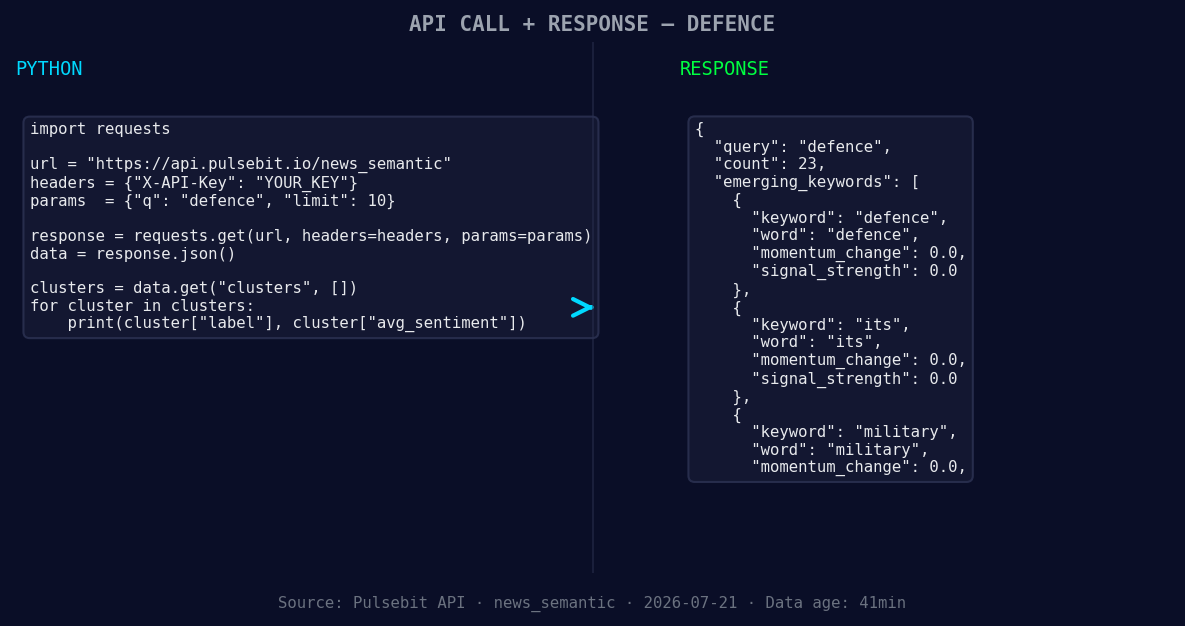
*Left: Python GET /news_semantic call for 'defence'. Right: returned JSON response structure (clusters: 3). Source: Pulsebit /news_semantic.*
# Make the API call to get sentiment data
response = requests.get("https://api.pulsebit.com/sentiment", params=params)
data = response.json()
print(data)
Now, let's enhance our analysis by scoring the actual narrative framing itself. We can run the cluster reason string "Clustered by shared themes: defence, canada-india, collaboration, secure, future" through our sentiment endpoint to understand how the narrative is shaping up:
# Meta-sentiment moment: scoring the narrative
narrative = "Clustered by shared themes: defence, canada-india, collaboration, secure, future"
meta_response = requests.post("https://api.pulsebit.com/sentiment", json={"text": narrative})
meta_data = meta_response.json()
print(meta_data)
This allows us to not only catch the spike but also assess the underlying sentiment of the narratives contributing to it. The insights we extract can be pivotal in shaping our strategies around defence topics.
Now that we have a solid foundation, let’s talk about three specific builds we can implement using this pattern:
-
Geographic Filter Implementation: Set a threshold to capture articles specifically mentioning "defence" in the context of Canada-India, filtering out noise from other regions. Use the geo filter with a specific time window, like
last 24h, to hone in on local sentiments.

Geographic detection output for defence. Hong Kong leads with 11 articles and sentiment +0.10. Source: Pulsebit /news_recent geographic fields.
Meta-Sentiment Dashboard: Create a dashboard that continuously scores narrative themes like "defence," "its," and "military" against mainstream discussions. Use the meta-sentiment loop to keep this updated in real-time.
Anomaly Detection Alerts: Build an alert system that triggers when momentum spikes exceed a threshold (e.g., +0.5) for topics like "defence." This alert can help you act swiftly on emerging trends, especially when the mainstream is slow to catch up.
All these builds leverage the insights we've extracted, allowing you to stay ahead of the curve in sentiment analysis. You can easily implement these in your systems to ensure your pipeline isn’t left lagging behind.
To get started, check out our documentation at pulsebit.lojenterprise.com/docs. You can copy-paste the above code and run it in under 10 minutes to catch the latest sentiment anomalies. Let's make sure we're not missing out on crucial insights!


Top comments (0)