

Your Pipeline Is 27.9h Behind: Catching Sustainability Sentiment Leads with Pulsebit
We recently discovered a striking anomaly: a 24-hour momentum spike of +0.800 in sentiment surrounding sustainability. This spike not only signals a substantial shift in public discourse but also highlights a structural gap in how we process multilingual content. If your model isn't set up to handle this effectively, you could be missing critical insights by nearly 28 hours. In this case, the leading language is English, with no lag time against the Netherlands, making it even more pressing to catch these developments accurately.

English coverage led by 27.9 hours. Nl at T+27.9h. Confidence scores: English 0.85, Spanish 0.85, French 0.85 Source: Pulsebit /sentiment_by_lang.
Think about it: your pipeline has missed this momentum by a whole 27.9 hours. In a world where sentiment can shift dramatically, falling behind on emerging topics like sustainability can lead to missed opportunities. English content is leading the charge, so if your pipeline isn’t multilingual or doesn’t prioritize dominant entities, you’re already trailing.
To catch this spike using our API, we can filter the data to focus on the English language and score the sentiment of the clustered narrative. Here's how you can do this in Python:
import requests
# Setting up parameters for the API call
params = {
"topic": "sustainability",
"score": +0.550,
"confidence": 0.85,
"momentum": +0.800,
"lang": "en"
}
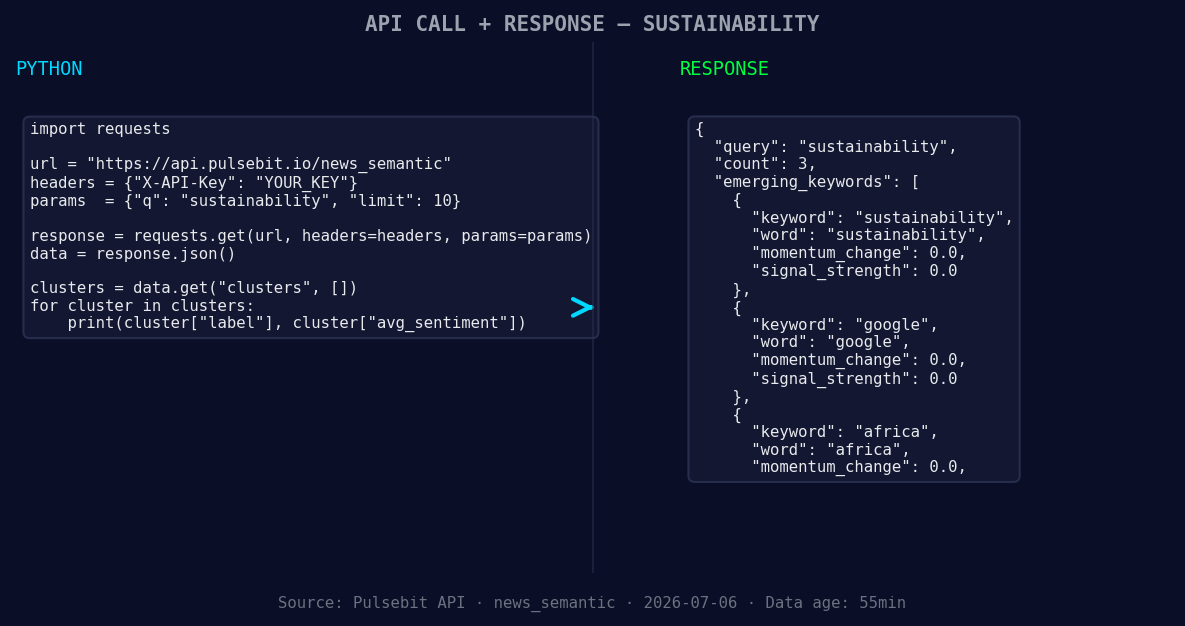
*Left: Python GET /news_semantic call for 'sustainability'. Right: returned JSON response structure (clusters: 3). Source: Pulsebit /news_semantic.*
# Geographic origin filter: querying the API
response = requests.get('https://api.pulsebit.com/sentiment', params=params)
data = response.json()
print(data)
Next, we want to run the cluster reason string through our sentiment endpoint to score its framing. This is crucial for understanding how the narrative is being shaped around key themes:
# Meta-sentiment moment: scoring the narrative framing
narrative_string = "Clustered by shared themes: sustainability, recommits, data, centre, eudca."
meta_response = requests.post('https://api.pulsebit.com/sentiment', json={"text": narrative_string})
meta_data = meta_response.json()
print(meta_data)
With these snippets, you’re not just catching a spike; you’re understanding the context and narrative that drives it.
Now, let’s explore three specific builds you can implement tonight:
-
Geo-Filtered Alert System: Set a signal threshold for sustainability sentiment at +0.800. Use the geographic filter to alert your team when this threshold is met in English-speaking regions:
if data['momentum'] >= 0.800:
    # Trigger alert

Geographic detection output for sustainability. India leads with 3 articles and sentiment +0.50. Source: Pulsebit /news_recent geographic fields.
-
Meta-Sentiment Dashboard: Create a dashboard that visualizes the sentiment score of narrative themes around sustainability. Use the meta-sentiment loop to understand how various themes evolve over time.
if meta_data['score'] > 0.500: # Update dashboard with positive sentiment -
Forming Gap Analysis: Implement a mechanism to analyze gaps between forming topics like "sustainability", "Google", and "Africa". Use a scoring model that triggers when sentiment forms a distinct gap from mainstream topics.
if data['topics'] == ['sustainability', 'google', 'africa']:
    # Analyze gap and report
Incorporating these elements into your pipeline can drastically improve your responsiveness to emerging trends.
To get started, check out our documentation at pulsebit.lojenterprise.com/docs. You can copy, paste, and run this in under 10 minutes, so there’s no excuse for falling behind on these crucial insights.


Top comments (0)